

Tametsugu (為継) worked in the beginning of the Nanbokuchô era and was originally from Echizen Province (越前国). While there is some controversy as to whether he was, in fact, the son of Gô Yoshihiro (江義弘) and a student of Etchû Norishige (越中則重), that seems to be a longstanding theory. I am going to devote the initial part of this treatise to the major smiths who had either a direct or indirect influence on Tametsugu (為継) and, hopefully, shed some light on this theory.
When we consider the founding of the Sôshû school (相州), we must start with Shintogo Kunimitsu (新藤五国光). Kunimitsu (国光) was the son of Awataguchi Kunitsuna (粟田口国綱) who died at the age of 93 in the seventh year of Kenchô (建長) (1255). In the Daizan it says that Kunitsuna’s (国綱) son was born to him in his old age and separated from him at the age of six. That would make the birth year of Shintôgo Kunimitsu (新藤五国光) 1249. This loosely ties in with Dr. Honma’s belief that rather than there being a direct lineage of Sôshû (相州) smiths, i.e. Kunimitsu (国光) teaching Yukimitsu (行光); Yukimitsu (行光) teaching Masamune (正宗); Masamune (正宗) teaching Norishige (則重); etc., the more likely situation was that Masamune (正宗), Norishige (則重), Go Yoshihiro (江義弘), and even Yukimitsu (行光) were all fellow students of Shintôgo Kunimitsu (新藤五国光). They may have been students at varying times and for varying periods of time. Since we have dated works by Kunimitsu (国光) as late as the Gentoku (元徳) era (1329-1331), this is entirely possible.
In the case of Norishige (則重), this theory is supported by the reliable source material Kiami-bon that was published in the first year of Eitoku (永徳) (1381). It pointed out that Norishige (則重) was a student of Shintogo Kunimitsu (新藤五国光). Further, Norishige’s (則重) extant works are known with the respective dates of the third year of Shôwa (正和) (1314), Gen-ô (元応) (1330). In addition, Kôzan oshigata has a record of a blade having a date in the Enkei (延慶) era (1308). The blade with the date of the third year of Shôwa (正和) (1314) has the surface texture (hada) appearing at first glance like Yukimitsu’s (行光) instead of the so-called matsukawa-hada for which Norishige (則重) is famous. This would tend to indicate that this blade was probably made at the beginning of Norishige’s (則重) career. These points are made in an article by Koizumi Tomitaro in the NBTHK Journal.
Nihontô Koza further references the Kotô Meijin Taizen as stating that Norishige (則重) was born in the second year of Shôô (正応) (1290) and that he died at the age of 77 in the fifth year of Jôji (貞治) (1366). This would make Masamune (正宗) 28 years older than Norishige (則重). Masamune’s (正宗) generally accepted dates are from approximately 1262 to 1343. Nihontô Koza cites a reference that Masamune (正宗) died at the age of 81 years old in the second year of Kôei (康永) (1343). Also, if we do the math, we will find that Masamune (正宗) was only 13 years the junior of Kunimitsu (国光), yet no one disputes that they had a teacher/student relationship.
When we consider the short life span of Go Yoshihiro (江義弘), these theories become even more interesting. The Nihontô Koza says that Go Yoshihiro (江義弘)was 21 years old around the Gen-ô era (元応) (1319-1321) and that he died at the age of 30. This means that he was born in 1300 and he passed away around 1330. If we assume that by the age of fifteen he was learning to make swords, it is easy to see how he could also have been under the direct influence of Kunimitsu (国光), Masamune (正宗), Norishige (則重), and Yukimitsu (行光) either directly or indirectly. The point is that we do not have to button-hole any of these smiths as being the students of only one of these great smiths. Rather, we can make the case that they had overlapping contemporary lives and worked, experimented, and learned together.
There is a scarcity of detailed information about Tametsugu (為継), but based on the known working dates we have from his few remaining signed pieces, I feel confident that we can place his life approximately between 1315 and about 1380.
As we know, his father, Go Yoshihiro (江義弘), died at the young age of 30 in 1330. If we assume that Tametsugu (為継)was at least 15 years old at the time of his father’s death (old enough to begun studying the making of swords with his father), that would mean that Tametsugu (為継) entered the Norishige Kei (則重系) when Norishige (則重) was about 40 years old and in his prime. When we examine the works of Tametsugu (為継), we can easily see the influence of the Sôshû (相州) school and particularly the forging characteristics of Norishige (則重). We find the areas of dark steel associated with the swords of the “Northern” area of Honshû and occasionally we find areas of matsukawa-hada for which Norishige (則重) is famous.
When describing the works of Go Yoshihiro (江義弘), Albert Yamanaka made the following comments about Tametsugu (為継). He wrote, “…Of the very few smiths that followed YOSHIHIRO and his style, probably the most outstanding and whose works we often encounter is that of TAMETSUGU and in many cases, the better of TAMETSUGU’s works are passed off as YOSHIHIRO, though actually, there is a world of difference in the skill of these two smiths, like the sun and the moon”.
Albert Yamanaka further states when describing the works of Tametsugu (為継); ” All blades made by this smith are very similar to those of NORISHIGE though slightly inferior”.
These two descriptions offered by Albert Yamanaka might, at first glance, seem to be unflattering. However, when you consider that Yamanaka considered Tametsugu (為継) to be “slightly inferior” to Norishige (則重) and of less skill than Go Yoshihiro (江義弘), these comments can be construed as praise indeed. To be “slightly inferior” to Norishige (則重) and of “less skill” than Go Yoshihiro (江義弘), two of the greatest smiths in the history of Japanese sword making, and to further say that Tametsugu’s (為継) better works are often passed off as being the works of Go Yoshihiro (江義弘), is high praise indeed. All things are relative and must be taken in their entire context.
When we study the history and genealogy of sword smiths who lived 650 or more years ago, we have very few facts to go on and must rely heavily on old texts that were often written hundreds of years after the smiths died or on old oral traditions. Fortunately, we do have one source of reliable information that many smiths left for us, i.e. some of them occasionally chose to put dates on their blades.
Among Tametsugu’s (為継) remaining works there is one dated in the second year of Enbun (延文) (1357) and one dated the second year of Ôan (応安) (1369). They are both signed Echizen no Kami Fujiwara Tametsugu (越前守藤原為継). There is also a work dated as being made in the seventh year of Ôan (応安) (1374). This example, however, is signed Noshû Jû Fujiwara Tametsugu (濃州住藤原為継). From the dates on these three blades and the change in the location of manufacture, we can surmise that at some point between 1369 and 1374, Tametsugu (為継) moved from Echizen Province (越前国) to Akasaka (赤坂) in Mino Province (美濃国). If we go back and reference the probable working dates of Etchu Norishige (越中則重), we can draw the conclusion this would have been about the time that Norishige (則重) stopped working so Tametsugu’s move at that time from Etchu Province (越中国) entirely logical.
Since this period (1369-1374) was also near the end of the working career of Shizu Kaneuji (志津兼氏), there is even the remote possibility that Tametsugu (為継) also spent some amount of time working with this smith who is also considered to have been one of the Masamune Jittetsu (正宗十哲), ten students of Masamune (正宗). Thus, we have the strong possibility that Tametsugu (為継) studied with and was influenced by three of the greatest smiths of his time. However, a more likely reality is that he moved to Mino (美濃) in time to work with the second generation Kaneuji (兼氏) as Shizu Kaneuji (志津兼氏) by that time was probably too old to do much teaching.
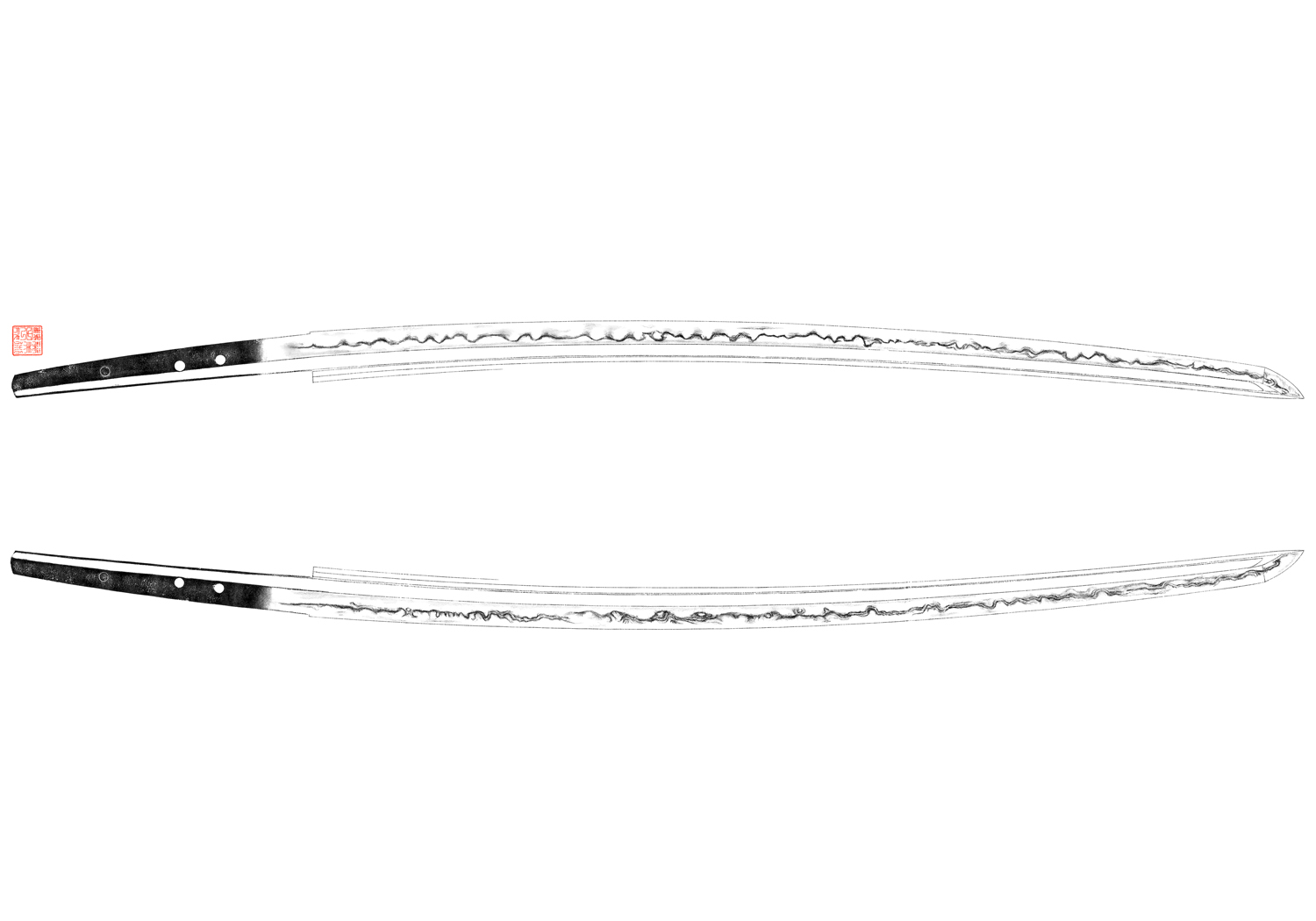
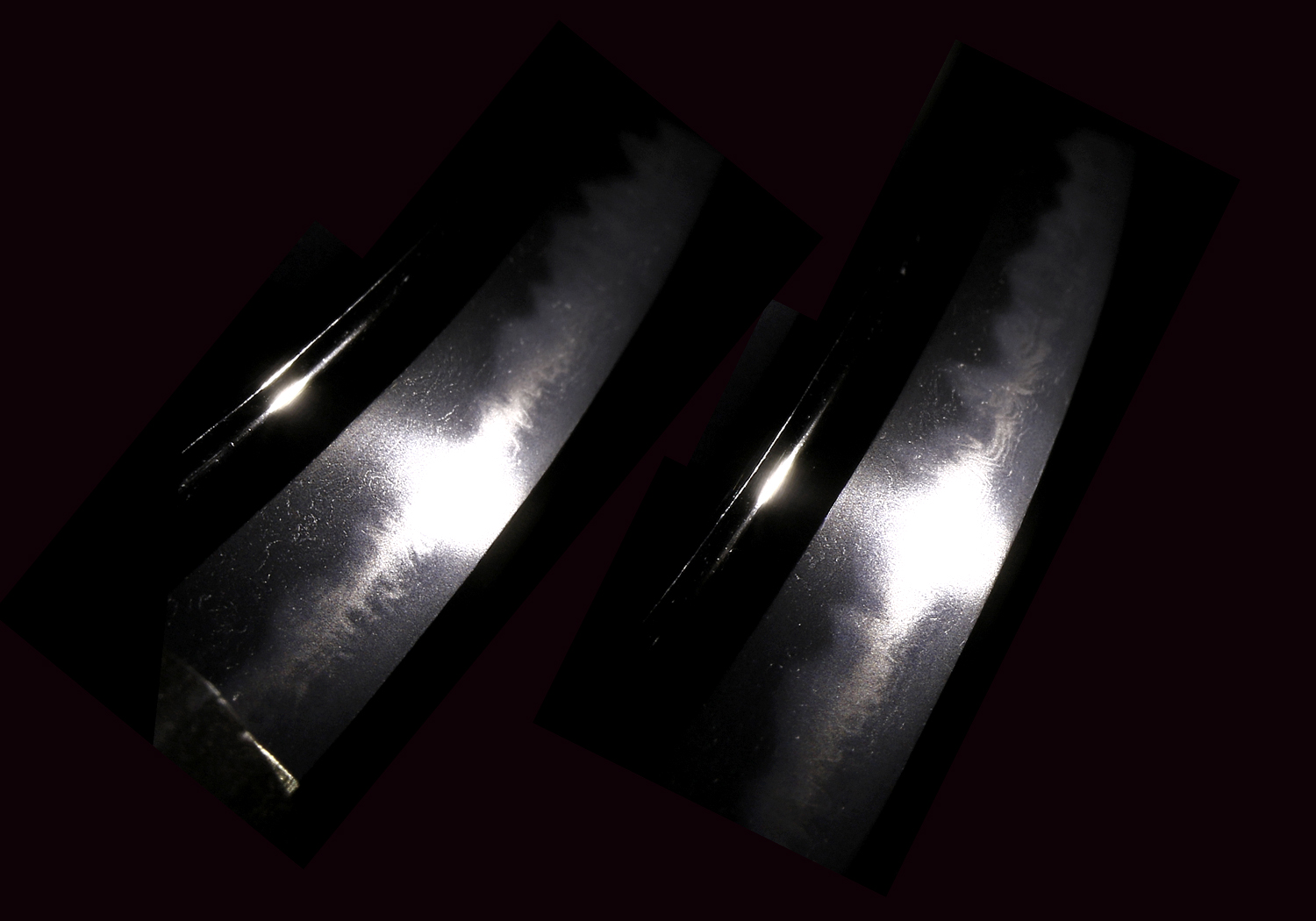
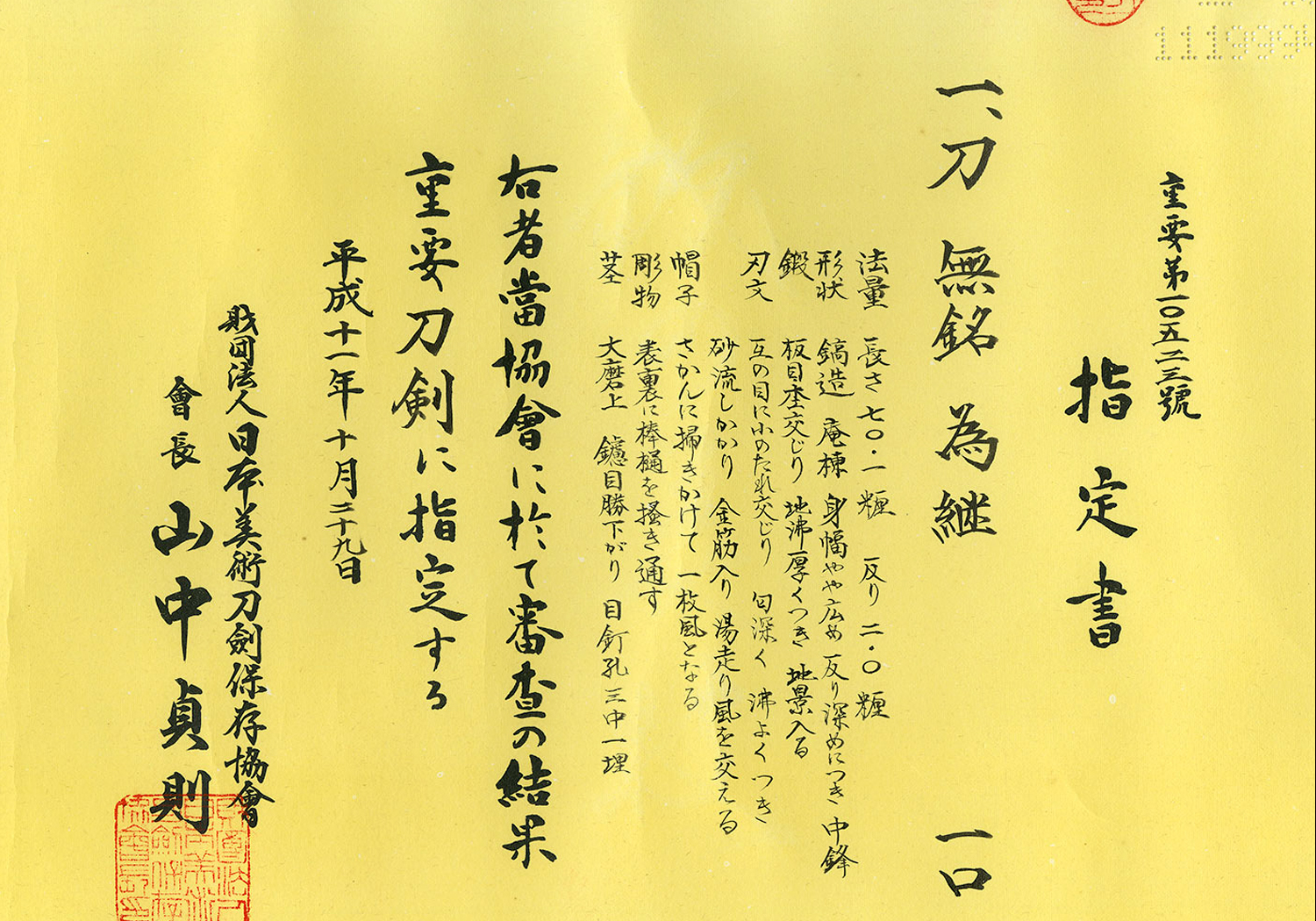
The subject blade for sale here is an excellent example of the work of Tametsugu (為継) in his mature, later years after he moved to Mino (美濃). As is pointed out in the Jûyô zufu write-up, “Regarding his style of workmanship, the jigane is well covered in ji-nie, the itame hada is prominent and flowing, and there is a mixing in of blackish steel. The ha is notare based with a mixing in of gunome, and there are conspicuous streaks of sunagashi. The bôshi is heavily brushed. All of these characteristics give the feeling of a mixing together of the Northern area’s and the Mino’s (美濃) styles of workmanship.”
The sugata of this sword is very typical of the later part of the Nanbokucho era. It differs slightly from the works of Yoshihiro (義弘) and Norishige (則重) by its wider mihaba, elongated kissaki, thin kasane, and lack of any narrowing from the moto-haba to the kissaki-haba. The flowing itame hada with areas of mokume hada and even a few areas of o-mokume hada and the presence of a few areas of a “blackish” darker steel point to a combination of Mino(美濃) traits mixed with the steel of the Northern region of Etchu/Echizen (越前/(越中). Throw in the jigane that is covered in ji-nie;a hamon that is gunome-midare with a slight mixing in of ko-notare; ashi and yô activity here and there; streaks of sunagashi; a habuchi that is well covered in nie and you have a strong Sôshû (相州) influence, much like the works of Norishige (則重).
The following is a translation of the Jûyô Tôken zufu description of the above blade:
Jūyō-tōken at the 45th Jūyō shinsa from October 29, 1999
Katana, mumei: Tametsugu (為継)
Measurements:
Nagasa 70.1 cm, sori 2.0 cm, moto-haba 2.85 cm, saki-haba 1.95 cm, kissaki-nagasa 3.0 cm, nakago- nagasa 21.4cm, only very little nakago-sori
Description:
Keijō: shinogi-zukuri, iori-mune, relatively wide mihaba, deep sori, chū-kissaki
Kitae: itame that is mixed with mokume and that features chikei and plenty of ji-nie
Hamon: nie-laden gunome with a wide nioiguchi that is mixed with ko-notare, ashi, yō, many
sunagashi, kinsuji, and yubashiri-like elements
Bōshi: widely hardened, tending to ichimai, and featuring plenty of hakikake
Horimono: on both sides a bōhi that runs as kai-tōshi through the tang
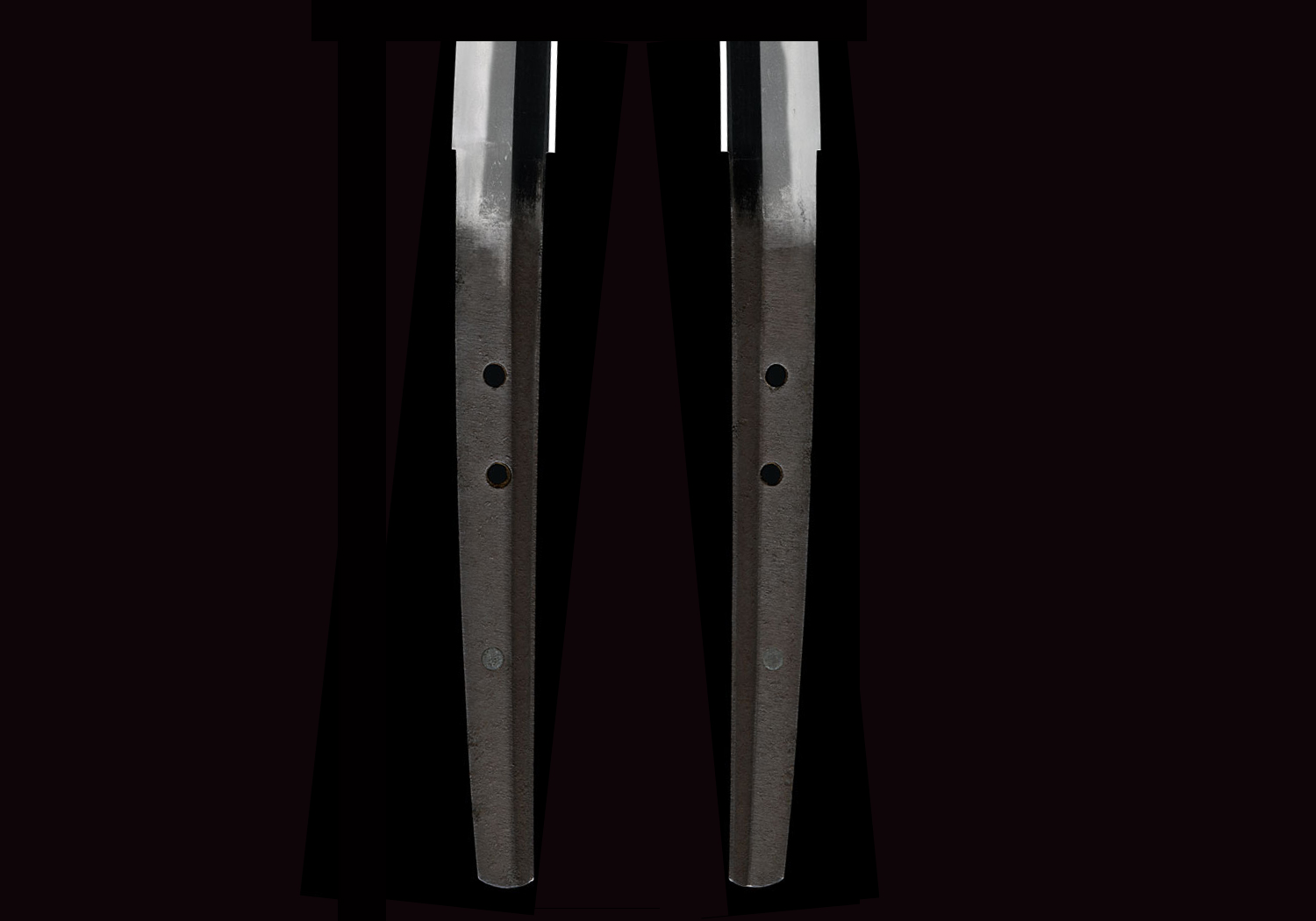
Nakago: ō-suriage, kurijiri, katte-sagari yasurime, three mekugi-ana (of which one is plugged), mumei
Explanation:
According to the prevailing view, Tametsugu (為継) was the son of Gō Yoshihiro (郷義弘) and a student of Norishige (則重), although from the point of view of active periods of all of these smiths, this approach may be revised. There exist oshigata of blades by Tametsugu which are dated Enbun two(延⽂,1357) and Ōan two(応安,1369) and which are signed “Echizen no Kuni Fujiwara Tametsugu”(越前国藤原為継),“Fujiwara Tametsugu from Echizen province.” Apart fromthat, a blade exists which is dated Ōan seven (1374), which is signed “Nōshū-jū Fujiwara Tametsugu”(濃州住藤原為継),“Fujiwara Tametsugu, resident of Mino province.” Thus, we learn that the smith had moved between Ōan two and Ōanseven from Echizen to Mino province. This blade shows a kitae in itame that is mixed with mokume and that features chikei and plenty of ji- nie. The hamon is a nie-laden gunome with a wide nioiguchi that is mixed with ko-notare, manysunagashi, and kinsuji, and the bōshi features much hakikake. Thus, the deki of this blade is quite ambitious and itsinterpretation attributes it to Tametsugu. We have here a masterwork among all blades by this smith.
You will see that in the “Explanation” section of the zufu, the kantei judges express serious doubts as to the validity of the common theory that Tametsugu (為継) was, indeed, the son of Go Yoshihiro (江義弘) and the student of Etchu Norishige (越中則重). I hope that the chronological periods of Go Yoshihiro (江義弘), Norishige (則重), and the others presented in the lifespan timeline below (Appendix A) help to substantiate those opinions.
This sword is accompanied by a fine set of Edo Era koshirae that is both beautiful and tasteful. The overall theme is that of a marine nature with the exception of the menuki which are shakudo dragons. Please see the photos below for details of this koshirae.
SOLD