Kunikiyo was born in 1589 in Matsuhiro city in Shinshu. His given name was Shimada Kichiemon and he was a student of his father, the third generation Shimana Sukemune. Later he is said to left his hometown and became a student of the famous swordsmith and samurai, Horikawa Kunihiro. He might also have been a student of Horikawa Kunitomo because Horikawa Kunihiro was quite old that the time of Kunihiro’s move to Kyôto.
Around 1613 after Kunihiro’s death, Kunikiyo moved to Fukui in Echizen to work for the Daimyô Matsudaira Tademasa. In 1628 he changed his name to Kunikiyo, using the kanji character for Kuni (國) in his new name to honor former Kyôto teacher at the time he was granted the Yamashiro-daijo. He was awarded the Yamashiro-no-kami title in the following year, 1628.
At this same time, he also allowed to carve the 16-petal imperial family chrysanthemum mon into his swords, a very high honor. After he was given this honor, he consistently carved the chrysanthemum just below the habaki on his swords. There are conflicting stories about his date and age of death. Some sources say he died in either in 1649 at age 60 or 1665 at age 76.
The title and smith’s name were then continued by his son. The work of the first and second-generation Kunikiyo is nearly indistinguishable, both consistently produced high-quality blades. Both are rated as Jô-saku (superior) quality smiths and additionally the Shodai is rated as a wazamono smith (extremely sharpness).
They worked mostly in suguha hamon which they mastered like few others. Occasionally there will be a slight bit of midareba. The second generation achieves slightly tighter forging than the first, while the first generation produced brighter crystals in the hamon.
Also, the style of signatures between the two generations is nearly indistinguishable with the exception of a few key strokes that differ on a consistent basis. The second generation eventually started to write ichi (一) under the chrysanthemum mon but not on his early works.
The major characteristics of Kunikiyo and his school are as follows:
SUGATA: His early blades will show definite influences of the Horikawa school of Kunihiro. Blades will show the typical characteristics of the Keicho Shintô school with a wide mihaba, shallow sori and relatively large kissaki. While early blades of Kunikiyo will not be as robust as many of Kunihiro’s students, definite Horikawa traits will be obvious. His later blades will be show more of the traditional, more graceful Yamashiro tradition. The kissakiwill be smaller and the mihaba (width) of the blade will decrease a bit. More along the lines of the Echizen Yasutsugu school.
HAMON: Generally, nioi with abundant ko-nie. Chu-suguha is the most prevalent for both of the first two generations. There will be some slight midareba on occasion. On the Shodai’s early works a basic pattern of o-notare mixed with ko-notare and o-gunome as in the Horikawa tradition can be found. His later works will tend to be more along the lines of the quieter and more graceful Yamashiro tradition, as is the case with his sugata.
JIHADA: Generally, ko-mokume mixed with masame and masame hada in the shinogi-ji. Sometimes itame mixed with masame will be found. In either case, there will be ji-nie and a great many chikei covering the surface. On many works both sides may be loose grained, more so on the first generation than the second.
BÔSHI: Generally, the bôshi is rounded in a ko-maru shape with a fairly long kaeri. Nie-kuzuri and hakikake styles will be often found.
NAKAGO/MEI: Kurjiri, and ha-agari kurijiri can be found. The yarisume is sujikai. The mune of the nakago will be square and the ha side will also be square or almost square. The sixteen-petal chrysanthemum will be carved just below the habaki. The nagamei (long signature) will be chiseled neatly almost in printed style in the middle of the nakago just a bit closed to the mune side.
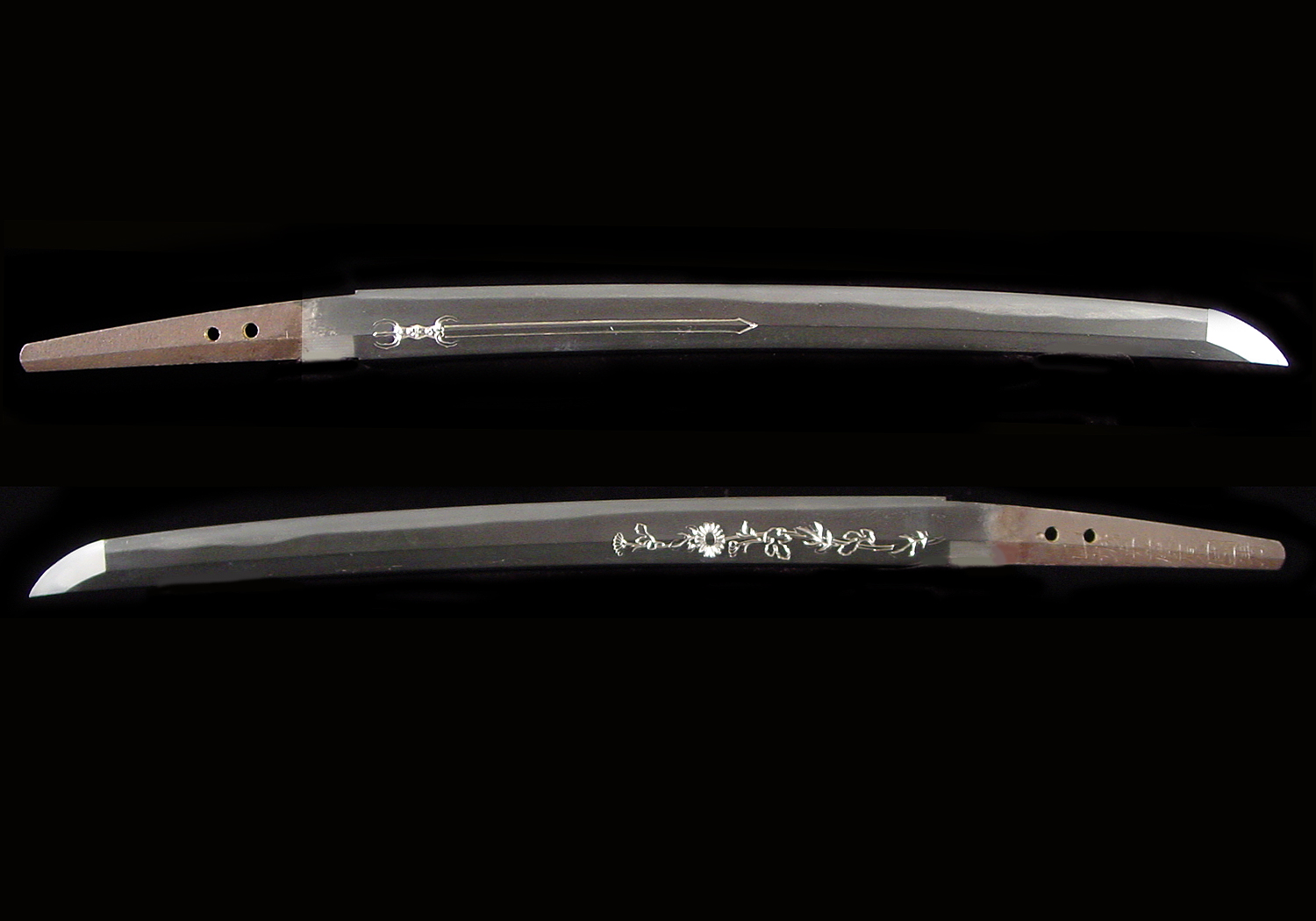
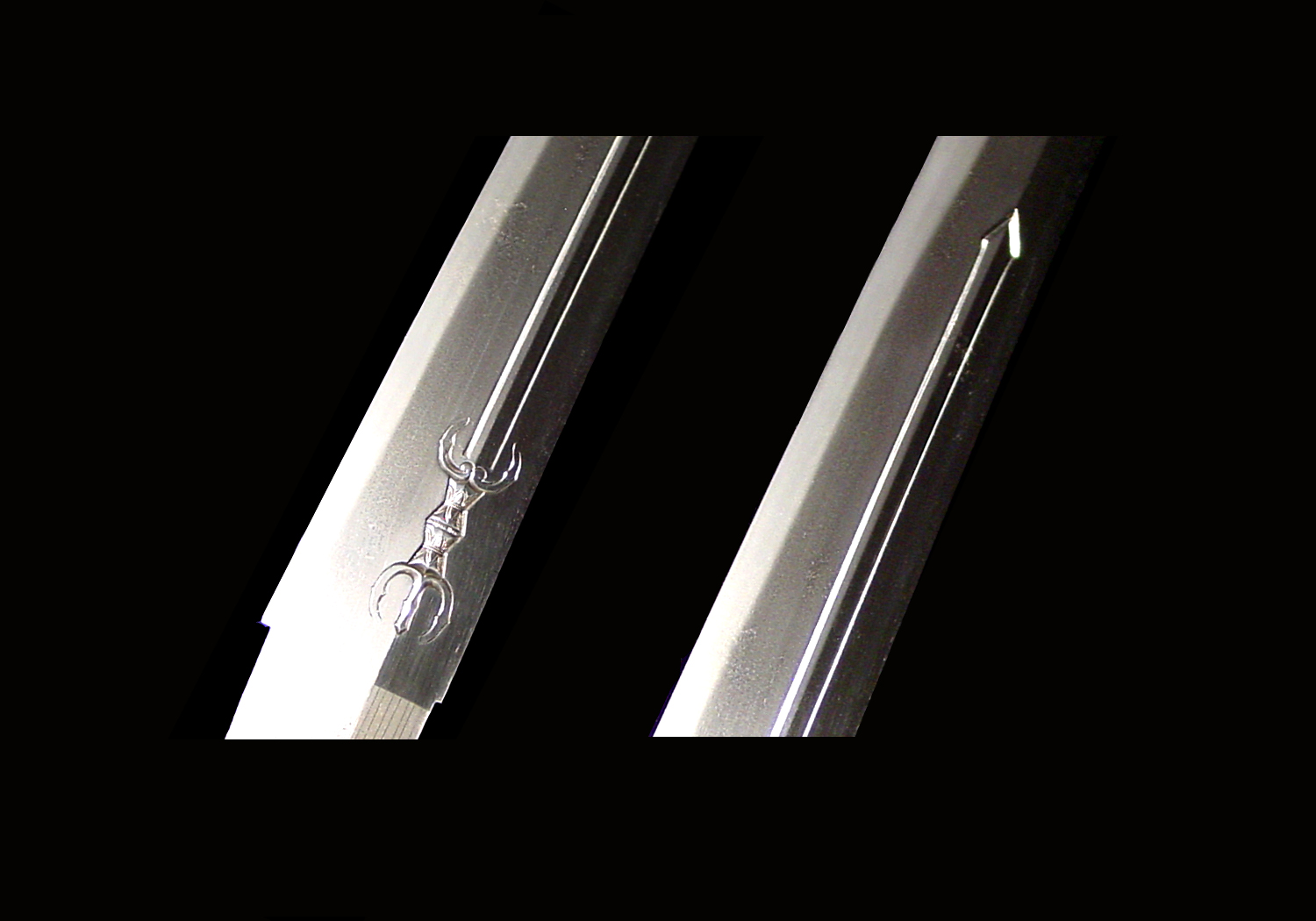
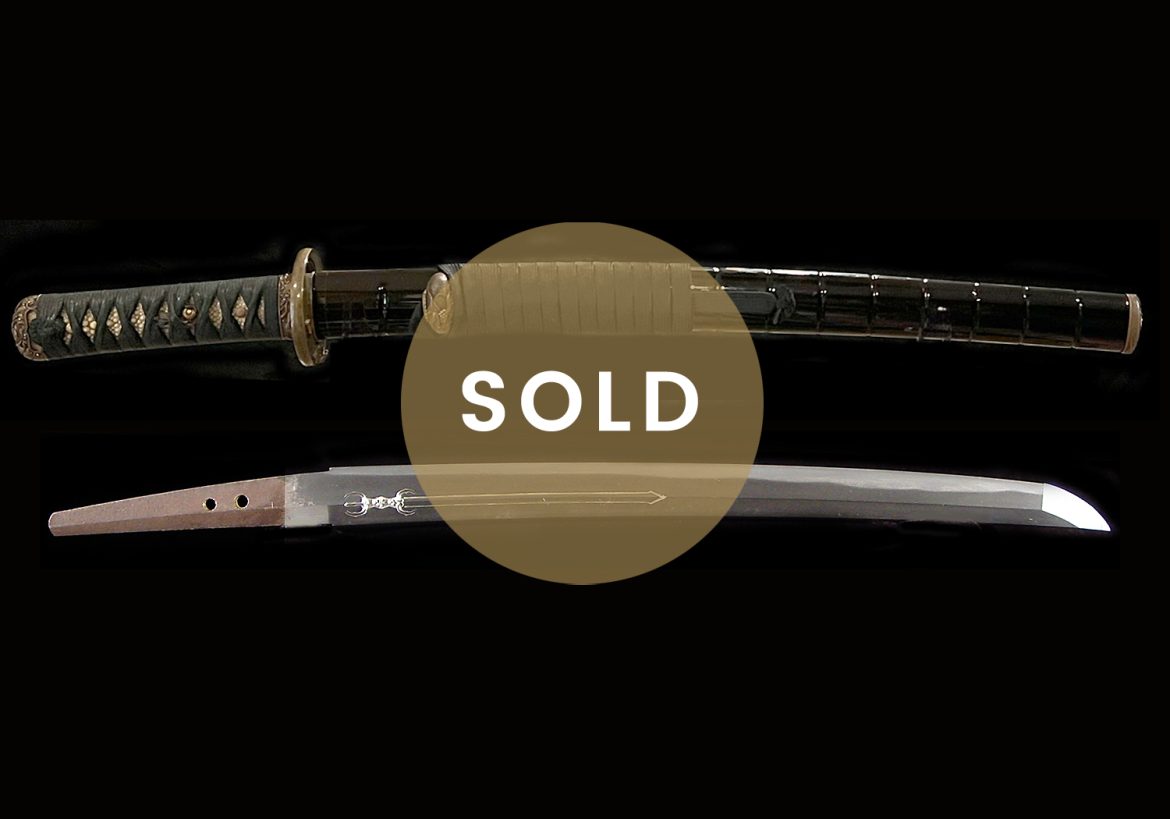
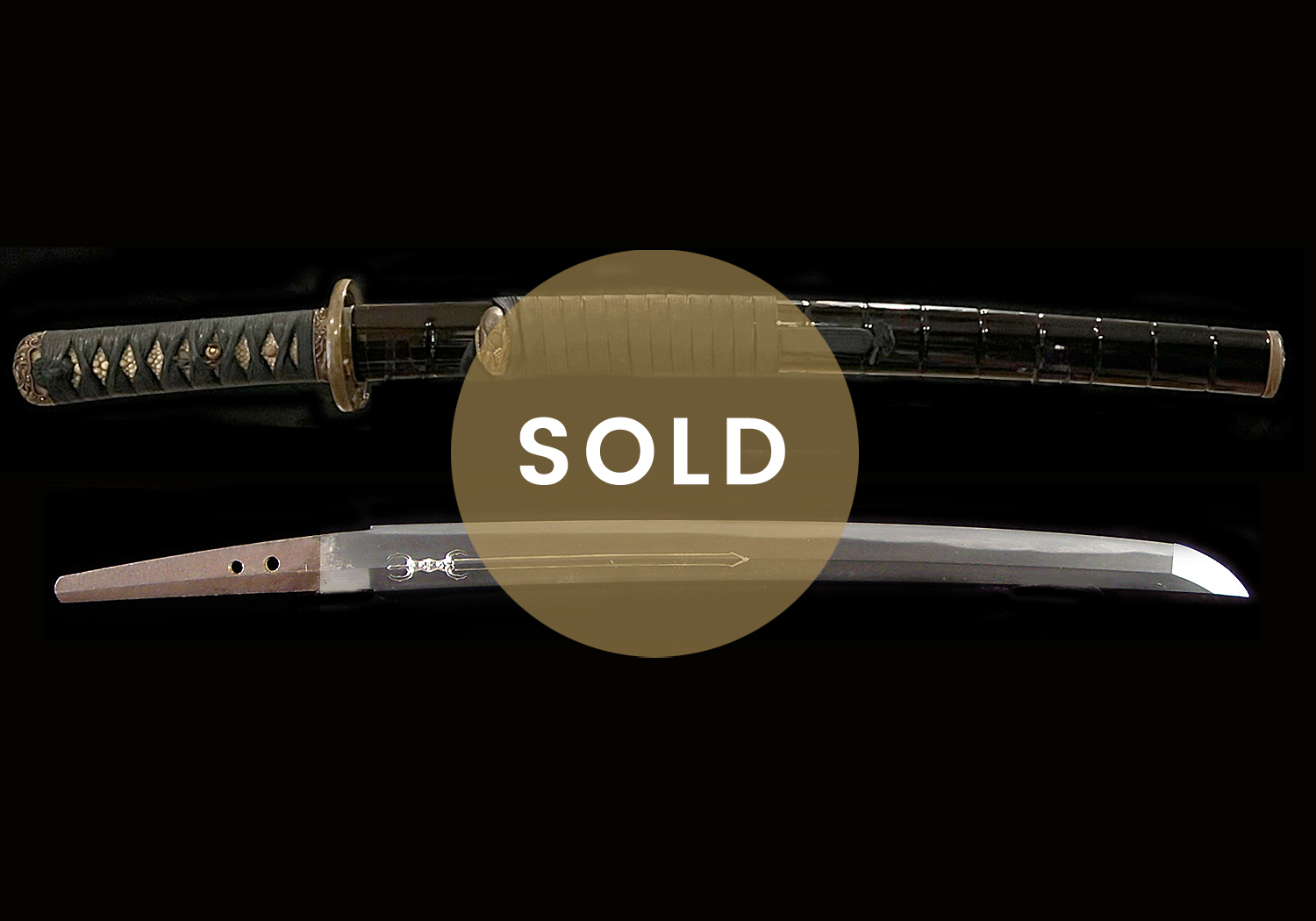
The sword presented here is a wakizashi signed Yamashiro no Kami Fujiwara Kunikiyo (山城守藤原国清). It is in the style of swords created in the Kanbun period (1661). It is wide and thick blade with a longer style kissaki. This leads me to believe that it is a blade made by the second generation (Nidai) Kunikiyo. The blade nagasa is 15 13/16 inches or 40.2.0 cm. The sori is shallow measuring 0.20 inches or 0.51 cm. The width at the hamachi is 1.24 inches or 3.16 cm and the width at the kissaki is 0.87 inches of 2.22 cm. The blade is ubu (unshortened) with two mekugi-ana (holes) in the nakago.
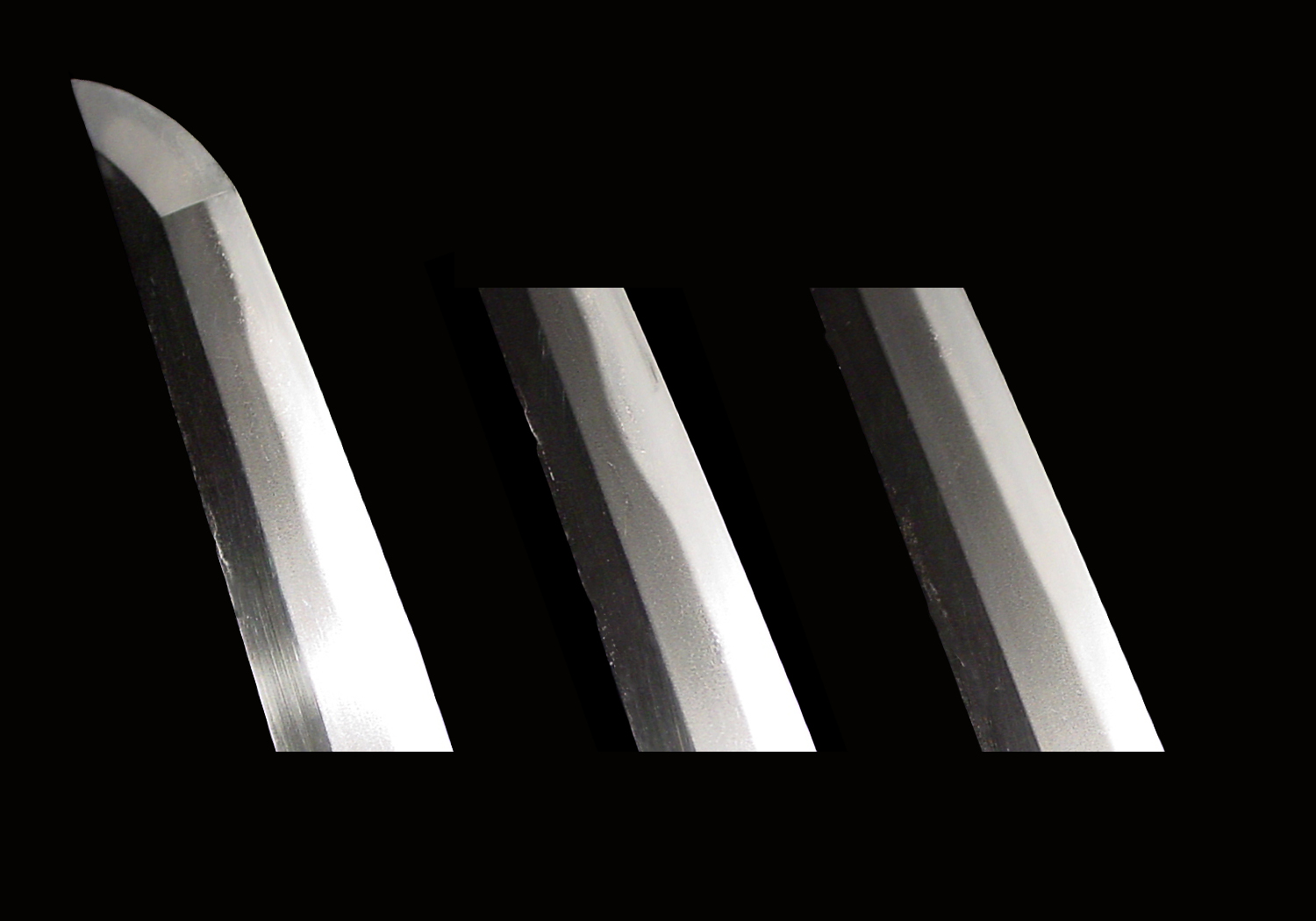
The jigane is ko-itame mixed with masame and masame above the shinogi in the shinogi-ji. There is abundant chikeithroughout the jigane. The hamon is nie deki done in a shallow notare midare. The nioiguchi is thick with nie and there is sunagashi, and kinsuji here and there along the length of the hamon. The bôshi is pointed and hakikake on the omoteand o-maru on the ura. Neither side has a kaeri. The nakago is ubu with two mekugi-ana and a the long signature carved with a thin chisel reading, Yamashiro no Kami Fujiwara Kunikiyo (山城守藤原国清).
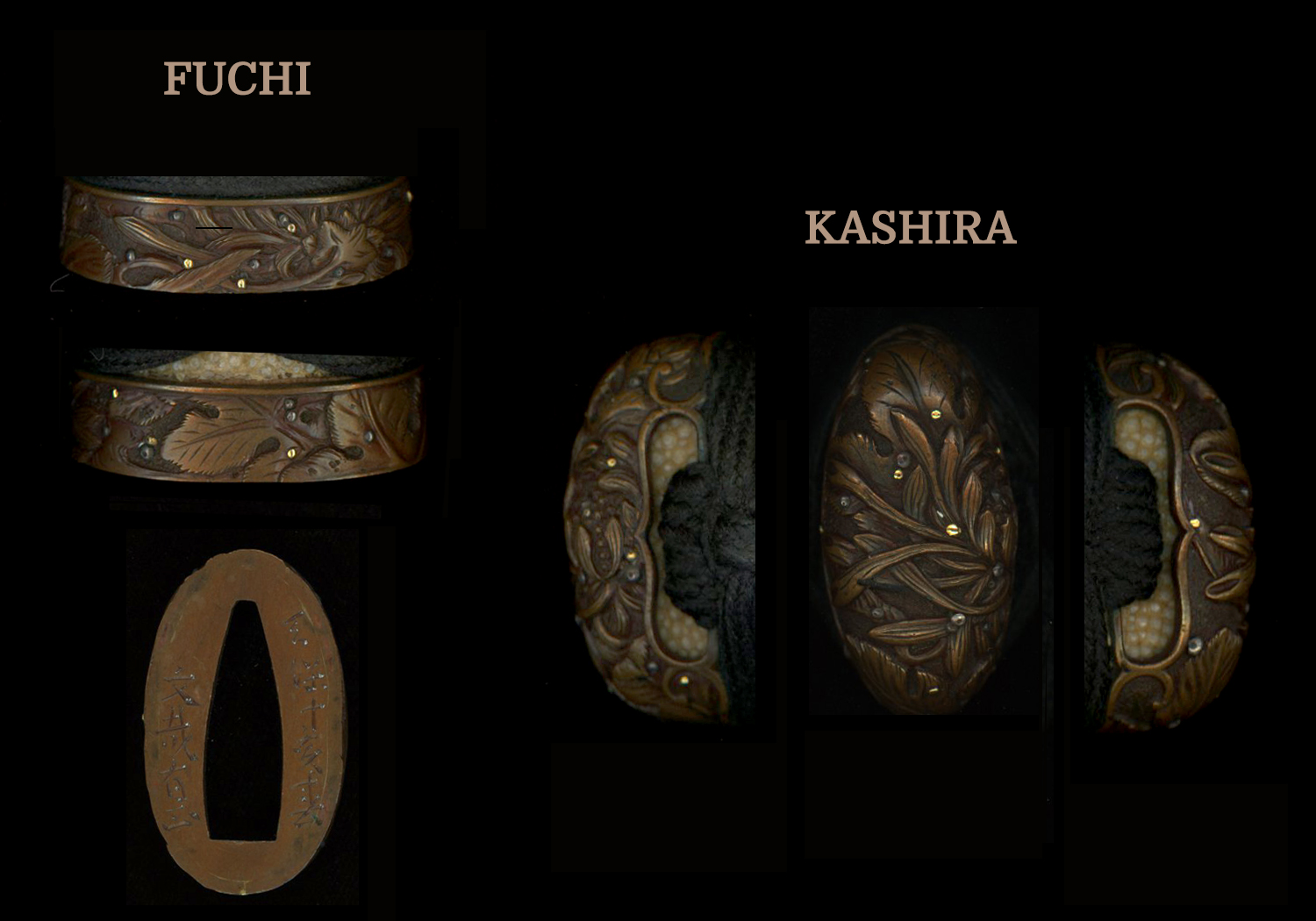
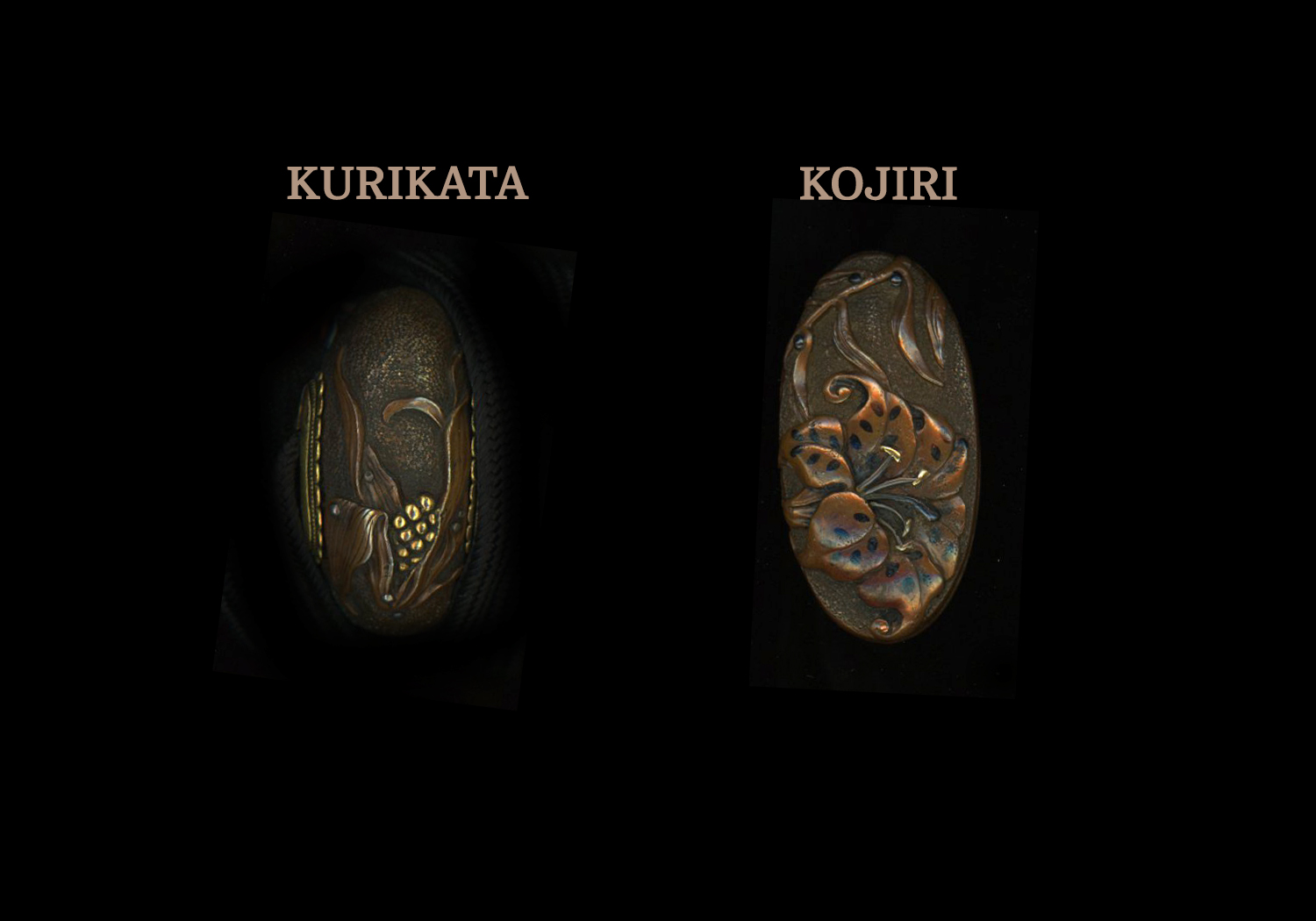
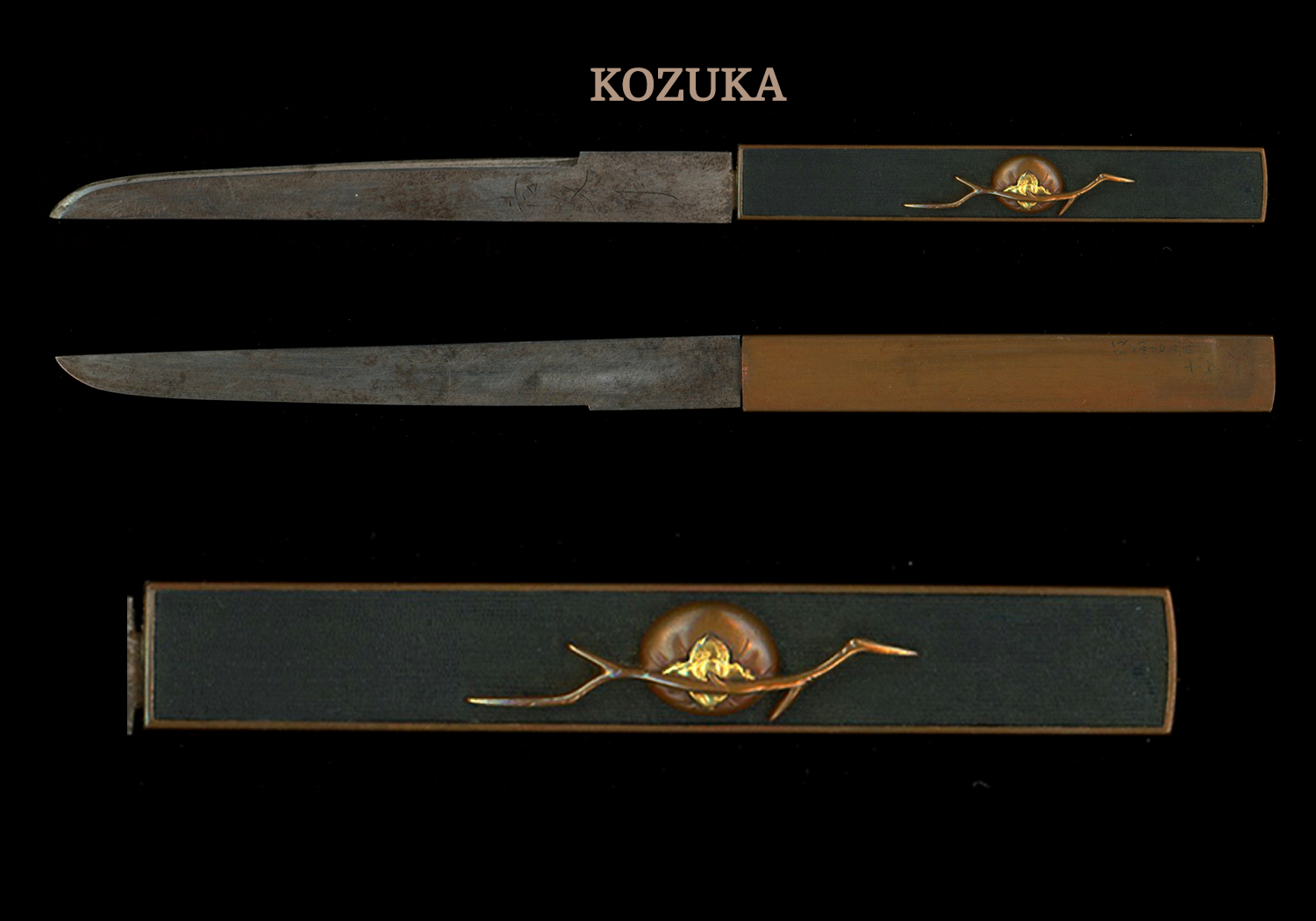
This blade comes with a fine set of Edo period koshirae with a black lacquered, ribbed saya. All of the metal fittings including the tsuba, menuki, fuchi and kashira, kozuka, kurikata and kojiri are made of solid copper or in the case of the tsuba, brass with heavy copper decorations. All of the fittings are carved in the form of flowers such as chrysanthemums, iris, kaki (persimmon), lily blossoms, etc. All of the carving has been done in a luscious and highly detailed manner. The fuchi and kashira are signed by Fumichika Arimasa and it is dated the tenth year of Tenpô (1839). I have no reason to doubt that most or all of the other pieces were done by the same craftsman as they are of equal quality.
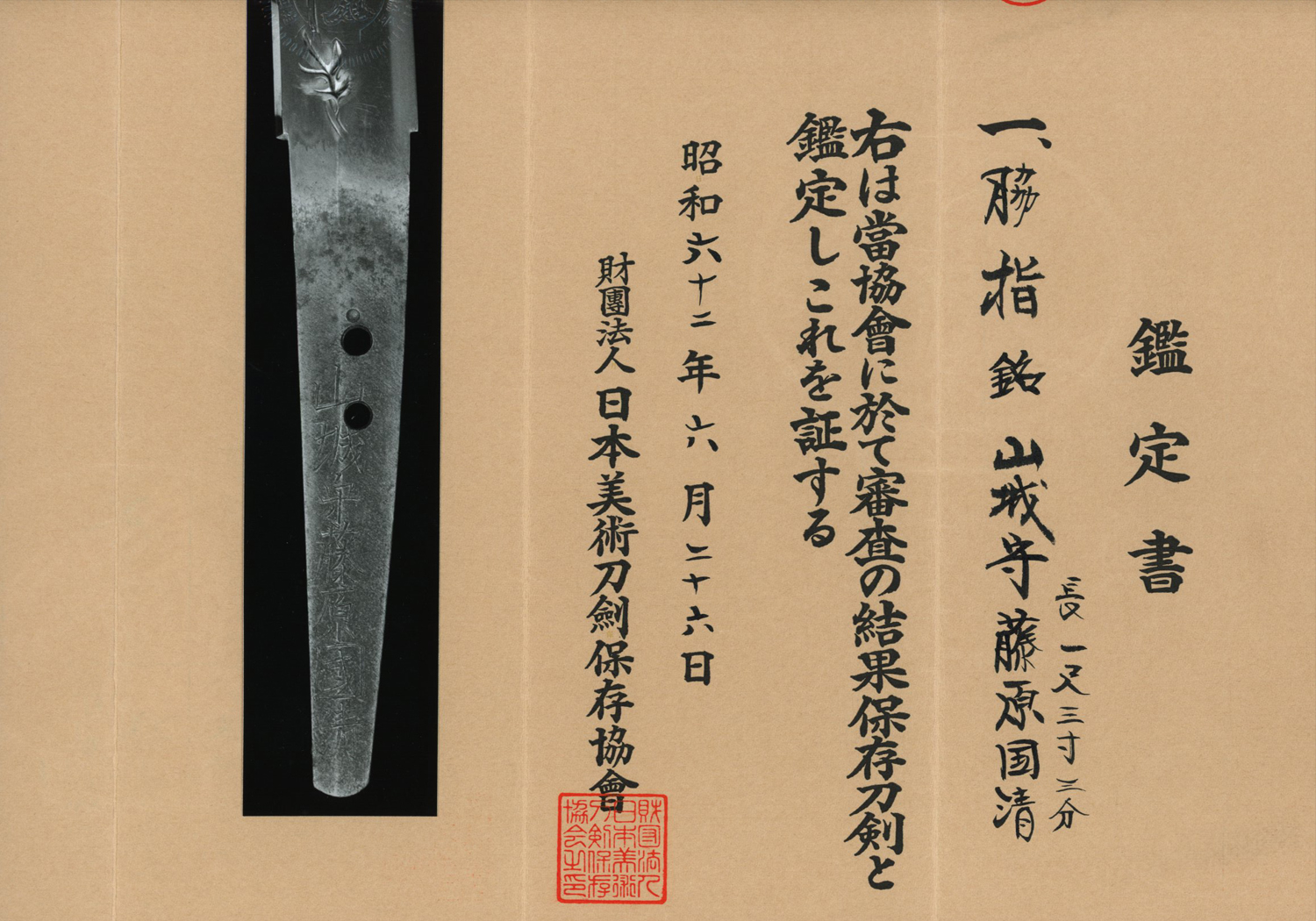
It is in excellent polish and totally without problems or flaws. It comes with a gold wrapped single habaki. It was awarded NBTHK Hozon papers attesting to the quality, condition of the blade, and authenticity of the signature.
SOLD