

Any study of second generation (nidai) Muramasa (二代村正系) would be remiss if it did not start with a bit of historical lore. For hundreds of years the swords of nidai Muramasa (二代村正) have been regarded as swords with evil powers. When we say evil powers we are speaking about their supposed ability to cause bad things to happen to their owners, especially the Tokugawa family. The Tokugawa family who ruled Japan for 250 years certainly felt that the swords of Muramasa boded ill for their family, thus fostering and enhancing this reputation. This is contra to what we are taught about swords. Historically they have been thought to have been divine objects derived from the elements of fire, water, iron, wood and earth with protective powers to be treasured and revered by their owners. As far as the Tokugawa were concerned, this was not so with blades by nidai Muramasa (二代村正).
The story about the “evil” swords of Muramasa (村正) bringing bad fortune to the Tokugawa family originated from incidents during the Sentoku Jidai and the Edo Jidai. In Tenbun 4 (1535) the grandfather of Ieyasu (家康), Matsudaira Jirôsaburô Kiyoyasu (清康), was assassinated at the young age of 25 by Abe Masatoyo using a katana made by Muramasa (村正). In Tenbun 14 (1545) Ieyasu’s father, Hirotada, received a serious sword cut by a Muramasa wakizashi at the hands of a drunken Samurai named Iwamatsu Hachiya.
Ieyasu’s (家康) son, Nobuyasu (信康), was ordered to commit seppuku by Oda Nobunaga (織田信長) in order to test Ieyasu’s (家康) loyalty. Nobuyasu’s kaishakunin used a blade by Muramasa (村正). Finally while viewing heads of defeated generals after the battle of Sekigahara, Ieyasu (家康) cut himself on the hand with a ko-gatana (some say a yari) made by Muramasa (村正). Thus, it is fairly easy to understand that, as far as the Tokugawa family was concerned, the swords of Muramasa (村正) were evil and should be shunned and avoided at all costs. Further, during the Edo Jidai when the Tokugawa family was all powerful, it is not unreasonable that the story of Muramasa (村正) swords being evil became popular and became as sort of a political tool used by Daimyo who were out of favor with the ruling Tokugawa bakufu.
This was truly very unfortunate for Muramasa (村正)and his lineage. His swords were avoided and spurned by the Tokugawa and all daimyô seeking their favor. Conversely, among the daimyô and military families who harbored animosity towards the Tokugawa family, there was a tendency for them to treasure swords made by Muramasa (村正). It is said that this began with the families that had deep feelings for the Toyotomi family such as the Sanada, Fukushima, and such. Later, during the Bakamatsu era, it included the anti-bakufu clans of the Satsuma, and Chôshû and others.
However, in reality, the reputation of the swords made by Muramasa (村正) for being exceptionally sharp is an actual fact. The yakiba epitomizes keenness, combined with a clarity of the ji and the ha. These factors in themselves may have added fuel to the stories about them being evil swords. They were said to cry out in the night for blood, driving their owners to commit murder.
It is also a fact that blades by Muramasa were favored by the Samurai of the Mikawa domain because of their cutting ability. Since this was the home domain of the Tokugawa it is almost understandable that the presence of so many Muramasa blades among the Mikawa bushi was a contributing factor to why so many unfortunate accidents befell the Tokugawa household due to blades by this smith.
The historical facts about Muramasa (村正) himself are somewhat muddied. Some old books place him around the Enbun or Jôji eras (1356-1368) of the Nanbokuchô Jidai. There are even some that link him to Masamune (正宗) as a student. However, modern sword scholars have long since swept away these ideas. In actuality, the line of Muramasa smiths starts around the beginning of the Bunki era (1501-1504) as this is the oldest dated work found to date. This would make this Muramasa the first generation of smiths by this name.
The second generation was active during the Tenbun era (1532-1555) and the third generation is circa Tenshô (1573-1592). The second generation was, by far, the most skilled of the Muramasa lineage. Consequently, he is the smith who is most closely associated with the many evil attributions we run into when we read about the evil swords of Muramasa. During the Edo period, the family of the Tokugawa Shogunate put many written and unwritten restrictions on the ownership of Muramasa blades and avoided contact with these blades. Thus we find many blades that have been attributed to Muramasa having had their signatures removed or altered in an effort to make them more “socially acceptable”. As a consequence of this evil reputation, the Muramasa (村正) lineage of smiths did not go beyond the fourth generation.
When studying the roots and dates of origin of swords by Muramasa (村正), we must consider more than just the dated examples mentioned above. We must also consider that since Ise had no notable smiths before them and few after them, they must have learned their craft somewhere. The fact is that the sugata, and especially the “tango bara” shape of the nakago, that became the special traits of Muramasa kei (村正系), are remarkably similar with the kaji of Bushû Shitahara, the Sôshû school, and the Shimada Kei of Suruga. These are lines of smiths along the same road and this points to an interesting possible interaction which merits further study in the future.
When we are studying the history and development of a smith and trying to pin down his actual working dates, signed and dated examples are invaluable. While we do have the signed example of the first generation Muramasa’s (村正) work dated in the Bunki era (1501-1504), and some signed works of the second generation dating from the Tenbun era (1532-1555), finding a large selection of dated examples is somewhat hampered due to of his reputation for “evil” swords. As we have stated before in this article, since swords by Muramasa (村正) were looked upon unfavorably by the ruling Tokugawa family, many were defaced and had their signatures obliterated or changed. There are some in which the kanji for Masa (正) was changed to Tada (忠) making the mei read Muratada (村忠). In other cases, the Mura (村) character was changed Hiro (廣) making the mei read Hiromasa (廣正). At other times, the mei was either partially or completely obliterated. This practice, of course, also opens up the door for the less scrupulous to try to pass of gimei swords as genuine Muramasa (村正) swords that have had their mei changed.
Now let’s talk for a bit about the general forging traits of Muramasa (村正) particularly as they relate to the nidai Muramasa (二代村正):
SUGATA: The sugata will be in accordance with the period of manufacture. In other words, with katanathere will be a somewhat shallow sori with saki sori present. With tantô there will be some saki sori or no sori in most cases. The shinogi will be somewhat high and there will be little hira-niku. The kissaki will be slightly stretched. Mitsumune will be the most common and katana, ko-wakizashi, and tantô will all give the impression of sharpness.
JITETSU: The kitae will show a marked resemblance to that of the Sue-Seki works of the Mino school. A slight difference will be that the kitae of the Sengo school is not as whitish as the Sue-Seki’s. Generally, it will be mixed with mokume forming a partially straight grain. The ji will have an abundance of nie containing chikei and jifu. Often yubashiri will be found.
HAMON: The hamon will be nioi deki with clumps of nie. There are combinations of notare, notare midare, ô-midare, gunome-togari, areas of sanbon sugi, hako midare, etc. All of them are extremely exaggerated, characteristics that are in the tani (valleys) of the midare press close to the ha saki (edge), there are some that appear to leave the blade, and the tani between the midare become notare. When sanbon sugi appears, it is in specific areas and does not encompass the entire blade as with the Mino den. A key kantei point for this school is that the hamon will be the same on both sides of the blade. Another key kantei point for Muramasa is a squarish koshiba that is often seen in his works, even if they are gunome or sanbon sugi. Sunagashi and kinsuji will be found. The yakidashi starts near the machi.
BÔSHI: Often we find a jizô boshi with a long kaeri reminiscent of the Mino school. There will be midare in the kaeri, often togari. Others will be kaen with hakikake.
NAKAGO: The nakago will have the distinctive tanagobara-gata or “fish belly” shape with a sharp tapering to form a iriyama-gata. This is particularly pronounced in tantô. The yasurime are usually kiri. Occasionally a very slight katte-sagari slant will be found.
MEI: Signatures are generally ni-ji mei (two characters). The ni-ji mei will be deeply cut and done in thick, semi-cursive chisel cuts. MURAMASA 村正
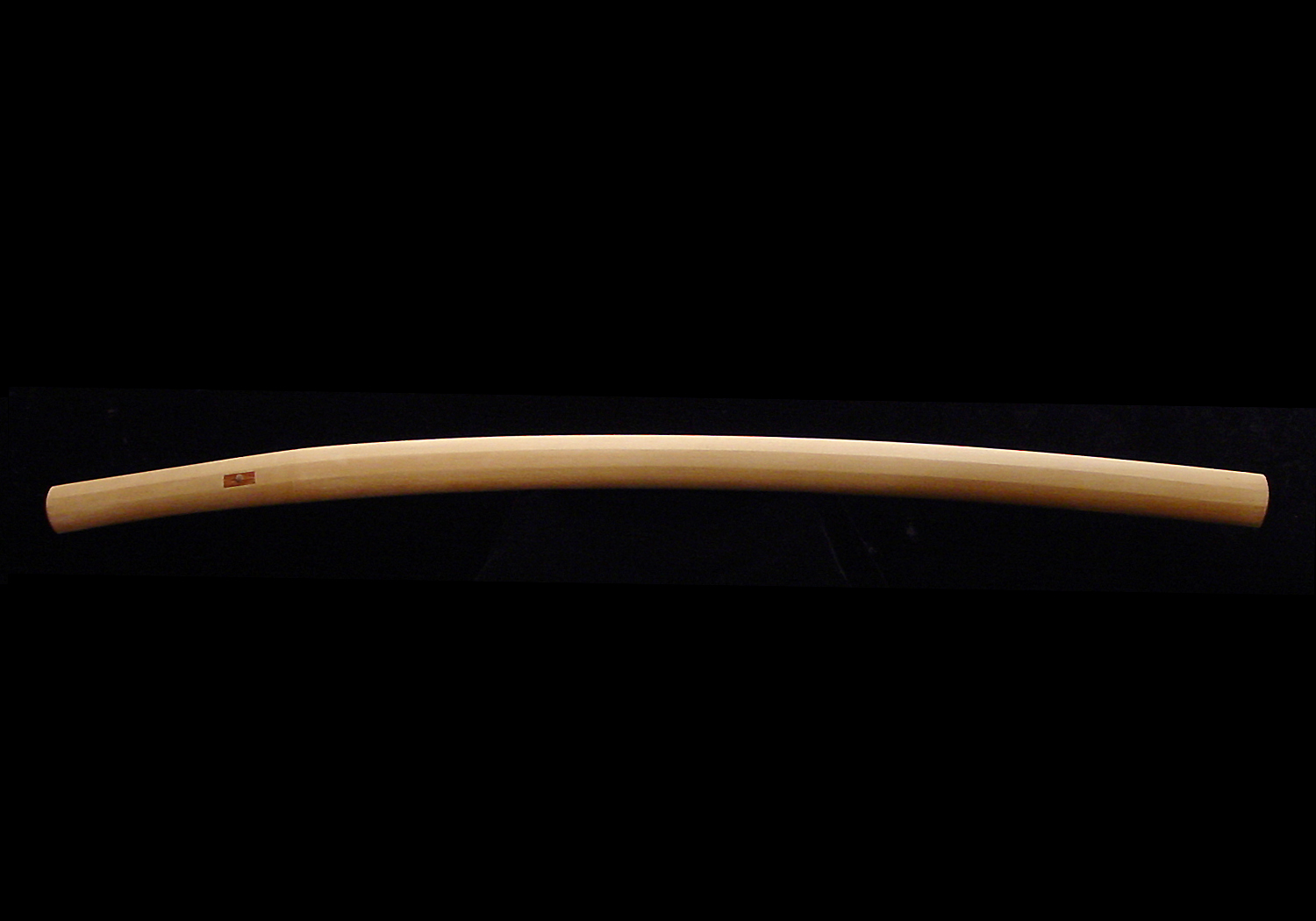
Today’s kantei blade is unusual in many respects. It is a katana by the second generation Muramasa (二代村正). That in itself is unusual because most of the surviving works by this smith are tantô and wakizashi. Katana are much more scarce. It is also somewhat unusual in that it strays from his normal characteristics in several respects. Most notably are the fact that it has an ichimai boshi while he is most well-known for his jizo bôshi. Also, the yasurimei are a slight katte-sagari (slightly slanting) as opposed to his more usual kiri (straight file marks). Finally, the hamon on omote side is not the mirror image of that on the ura. I must confess that I have seen very few katana by him so this may be more of the norm for his katana. I have seen many wakizashi by him and the mirror image of the hamon on both sides is certainly his norm and what we would expect to see.
This blade has a nagasa of 27.25 inches or 69.2 cm. The moto-haba (width at the base) is 1.25 inches or 3.25 cm while the saki-haba (width at the yokote) is 0.9 inches or 2.3 cm. The kasane (thickness of the blade) is 0.24 inches or 0.6 cm. The sori is predominantly torii sori measuring 0.67 inches or 1.7 cm and there is some slight saki-zori. The mune is a mitsu-mune as one would expect. The jitetsu (grain of the metal) is close to that of the Sue-seki school but it is not as whiteish. It is a very fine mokume mixed with a touch of itame with abundant ji nie primarily on and around the habuchi. The hamon is nioi deki with clumps of nie. It is formed into a gunome midare pattern mixed with areas of togariba. It widens toward the monouchi and when it crosses the yokote, it becomes and almost completely ichi-mail bôshi. The nakago is typical of Muramasa being shaped in a tanago-bara or “fish belly” form. It is slightly suriage with the end of the nakago cut straight across and slightly machi-okuri.
This blade is a true treasure and it is in excellent condition. It come with NBTHK Tokubetsu Hozon papers attesting to its authenticity, condition, and quality.
The following is an interesting timeline of the Muramasa Kei as it relates to the legend of Nidai Muramasa:
文亀 Bunki (1501-1504) Peak working period for 1st generation Muramasa
天文 Tenbun (1532-1555) Peak working period for 2nd generation Muramasa.
天文 Tenbun 4 (1535) December – Ieyasu’s Grandfather, Kiyoyasu, assassinated (some say it was an accident) with a Muramasa blade.
天文 Tenbun 14 (1545) March – Ieyasu’s father, Hirotada, injured by a Muramasa.
永禄 Eiroku (1558-1592) Peak working period for 3rd generation Muramasa.
永禄 Eiroku 22 (1579) Ieyasu’s eldest son, Nobuyasu, ordered to commit seppuku by Nobunaga. His kaishaku-nin uses a Muramasa blade.
慶長 Keicho 3 (1600) While viewing heads after the battle of Sekigahara, Ieyasu is injured by a yari (some say ko-gatana), forged by Muramasa.
寛永 Kanei 11 (1634) Takenaka Shigeyoshi and his son Genzaburo are ordered to commit seppuku, in part because he had collected some two dozen blades by Muramasa.
天和-元禄 Tenwa-Genroku (1681-1703) Divination by sword becomes popular, spreading the idea of “Tataru-tô” or evil swords.
寛政 Kansei 9 (1797) March – Sato Kotoba Awase Kagami, a kabuki play, debuts, featuring a murderer who uses a Muramasa. There are many imitators that follow.
万延 Manen 1 (1860) July – Hachiman Matsuri Yomiya no Nigiwai by Mokuami debuts, also featuring a murderer who uses a Muramasa.
明治 Meiji 13 (1880) Koma no Hoshi Hakone no Shikibue debuts, featuring a central character who is driven mad by his tanto, a Muramasa.
明治 Meiji 15 (1882) Kirikogata Kyô no Benizome debuts, featuring a murderer who uses a Muramasa.
明治 Meiji 32 (1899) Akagoshi Chishio no Funakoshi debuts, featuring a murderer who uses a Muramasa.
平成 Heisei 28 (2016) October – The Kuwana City Prefectural Art Museum debuts an exhibition featuring 24 works of Muramasa
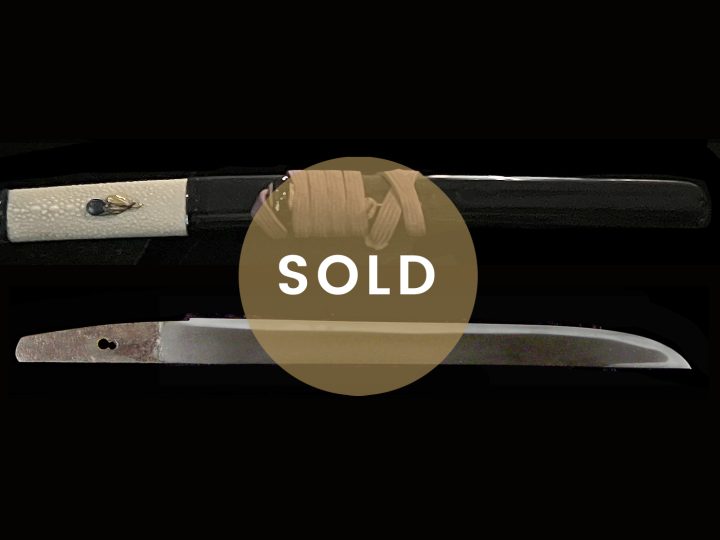
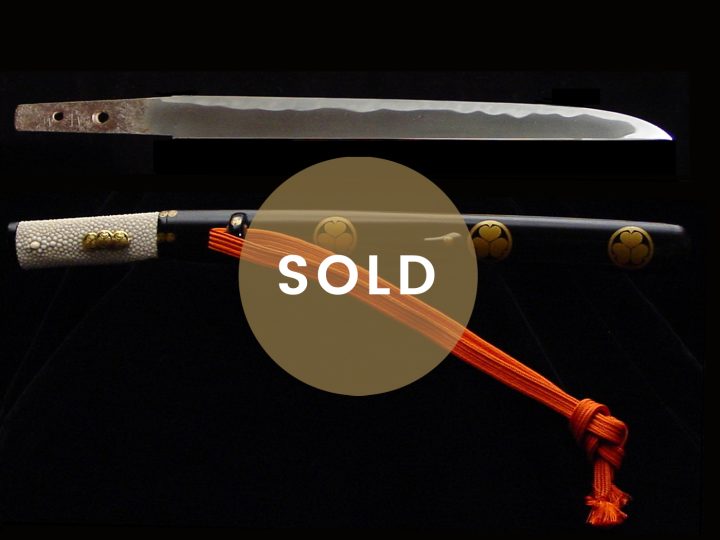
SOLD