
THE BATTLE OF UJIGAWA (1184)
Toward the end of the Gempei War between the armies of the Taira and Minamoto, a revolt occurred in the Minamoto forces. Minamoto no Yoshinaka (Kiso Yoshinaka) a cousin of Minamoto Yoritomo joined forces with Yoritomo’s uncle, Yukiie, and marched on Kyoto. He stormed the city forcing the Taira army to flee taking with them the young emperor, Antoku.
Yoshinaka then kidnapped the retired emperor, Go-Shirakawa, burned the imperial palace and forced the retired emperor to name him as Shogun. Yoritomo, hearing of this, placed his two younger brothers, Noriyori and Yoshitsune, at the head of an army of 60,000 men and sent them against Yoshinaka. They caught up with Yoshinaka’s forces at the Uji rived outside of Kyoto and the famous battle of Ujigawa (Uji river) took place.
In an effort to slow their attack, Yoshinaka removed many of the planks of the bridge spanning the Uji River. He also placed obstacles secured by heavy ropes in the river to impede their crossing. Since it was early January of 1184 and much of the mountain snow had melted, the river was high and the current was particularly strong.
As Yoshitsune was pondering how best to cross the river and attack the forces of Yoshinaka, two of his Samurai galloped into sight and made a dash for the river. Each wanted the honor of being the first to cross the river and engage the enemy forces. Their names were Sasaki Shiro Takatsuna and Kajiwara Genda Kagesue. They were both riding horses of renown that belonged to Minamoto Yoritomo. Kagesue took an early lead in the race to the river, but was hailed by Takatsuna telling him that his saddle girth appeared to be loose and he should be careful. Hearing this Kagesue stopped to adjust his saddle allowing Takatsuna to overtake him.
They plunged into the river and Takatsuna crossed first using his tachi to cut the ropes holding the impediments as he crossed. Yoshitsune crossed over the partially dismantled bridge and led his army on to defeat his cousin, Yoshinaka.
The theme of this famous battle has been wonderfully reproduced in the form of a very large tsuba of the Hiiragiya school. Around the Genroku period (1688-1703) there was a Kyoto tsuba merchant named Hiiragiya who produced very elegant tsuba depicting historical scenes, personages, etc. They were done in sukashi bori (open carving) with gold and silver zôgan that became quite popular in the public eye. Very few of these tsuba were signed by the tsubakô who made them.
Later, there was a man from Hikone (Omi province) named Kitagawa Sôten who worked in Kyôto making similar tsuba that were also quite popular. Eventually he founded his own school and had many students. It could be said that the Hiiragiya school was the forerunner of the Soten school.
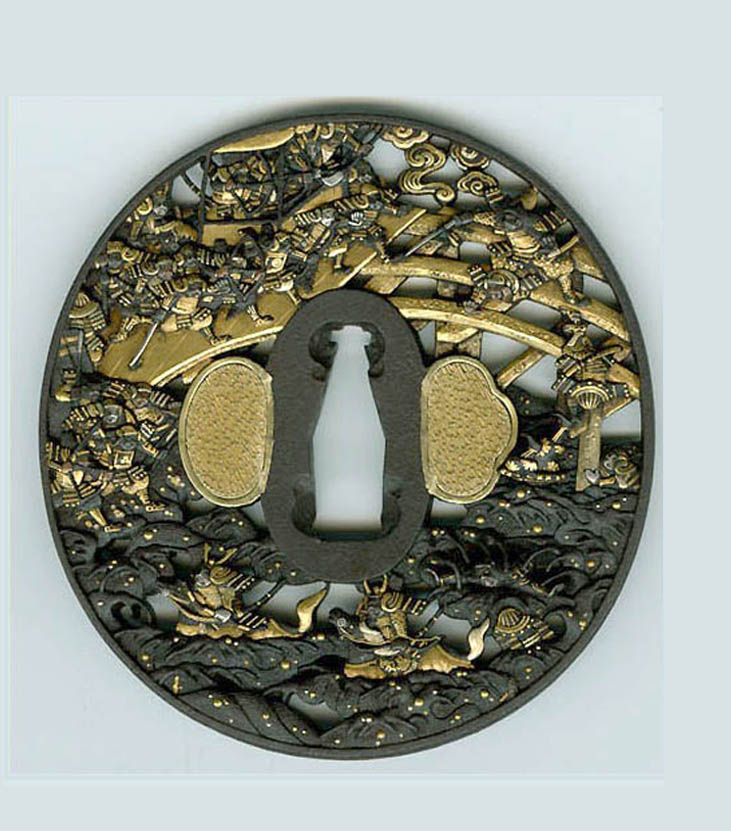
I am pleased to present with this paper a very fine example of the carving of the Hiiragiya school of tsuba making. The featured tsuba measures 8.8 cm by 8.5 cm. It is made of iron and is deeply carved with the battle scene of the Ujigawa conflict of 1184. The bottom third of the omote (front) of the tsuba depicts the fast flowing Uji river. Prominently within the waves we find both Sasaki Shiro Takatsuna and Kajiwara Genda Kagesue fighting the currents in their efforts to cross the river on horseback.

The central, left part of the omote of the tsuba shows the massed army of Kiso Yoshinaka fending off the attack of the Yoshitsune forces.
The upper third of the omote of the tsuba shows the Uji bridge with Minamoto Yoshitsune standing on the back of a fallen foe while he balances himself and fights his way across the bare underpinnings of the bridge. The upper left side of the omote shows the army of Kiso Yoshinaka defending the bridge.

Behind the advancing figure of Yoshitsune we find several Samurai who are falling into the fast moving river or clinging to the piers of the bridge in an attempt to stave off drowning.
The ura (reverse) of tsuba shows the rear of the Samurai facing the omote along with the front of additional Samurai who could not be seen when viewing the omote of the tsuba.
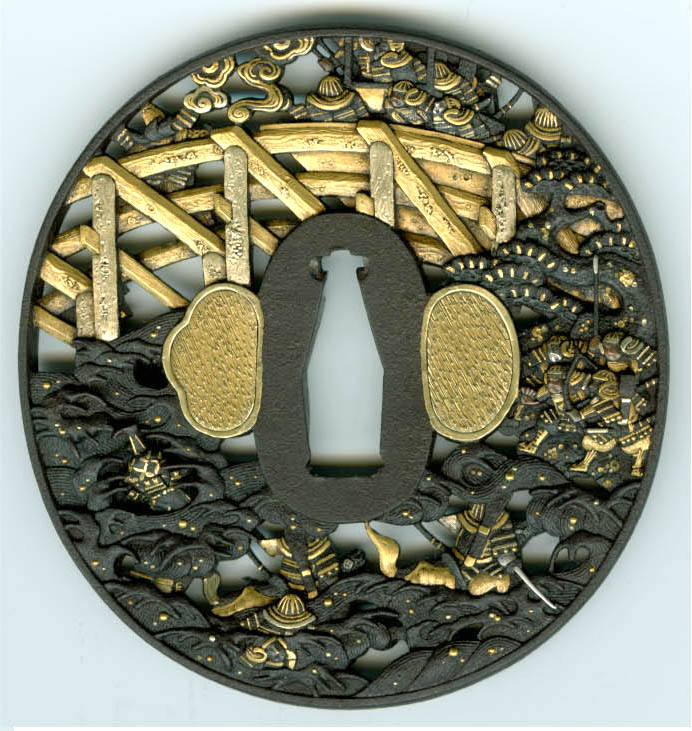
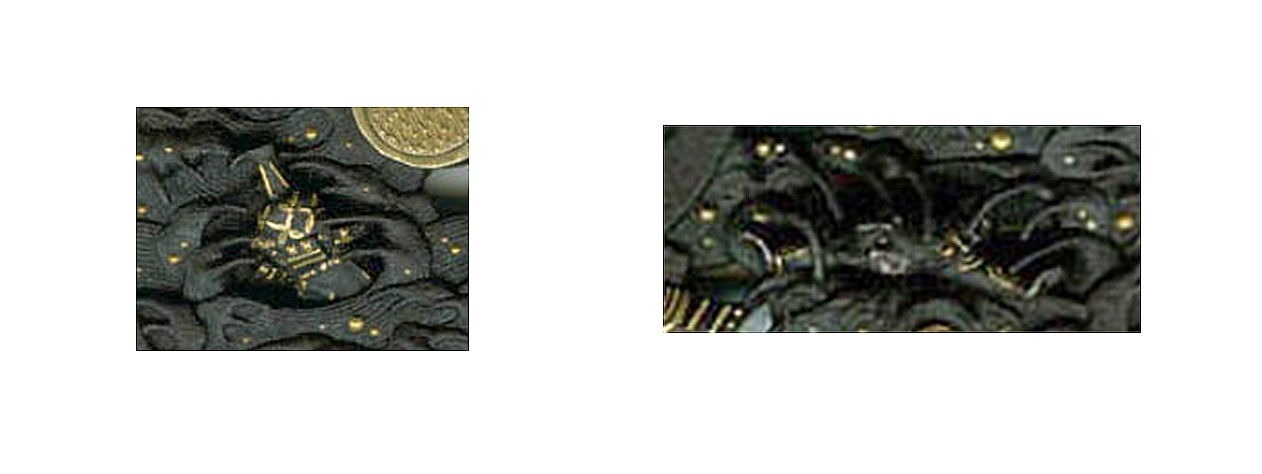
One point of particular interest and further evidence of the carver’s skill is in the 4:00 position of the omote and conversely the 8:00 position of the ura. It is a Samurai who has fallen beneath the waves. He is carved with his head and spread-eagled arms under water on the omote. On the ura we find his back and legs entering the water. What is really interesting is that he is carved into a free moving piece that is trapped beneath the iron waves. He actually moves back and forth.
All in all this is an excellent example of the fine carving done by the Hiiragiya School which has been passed down to current generations is excellent condition. It is a real piece of tsubakô art.