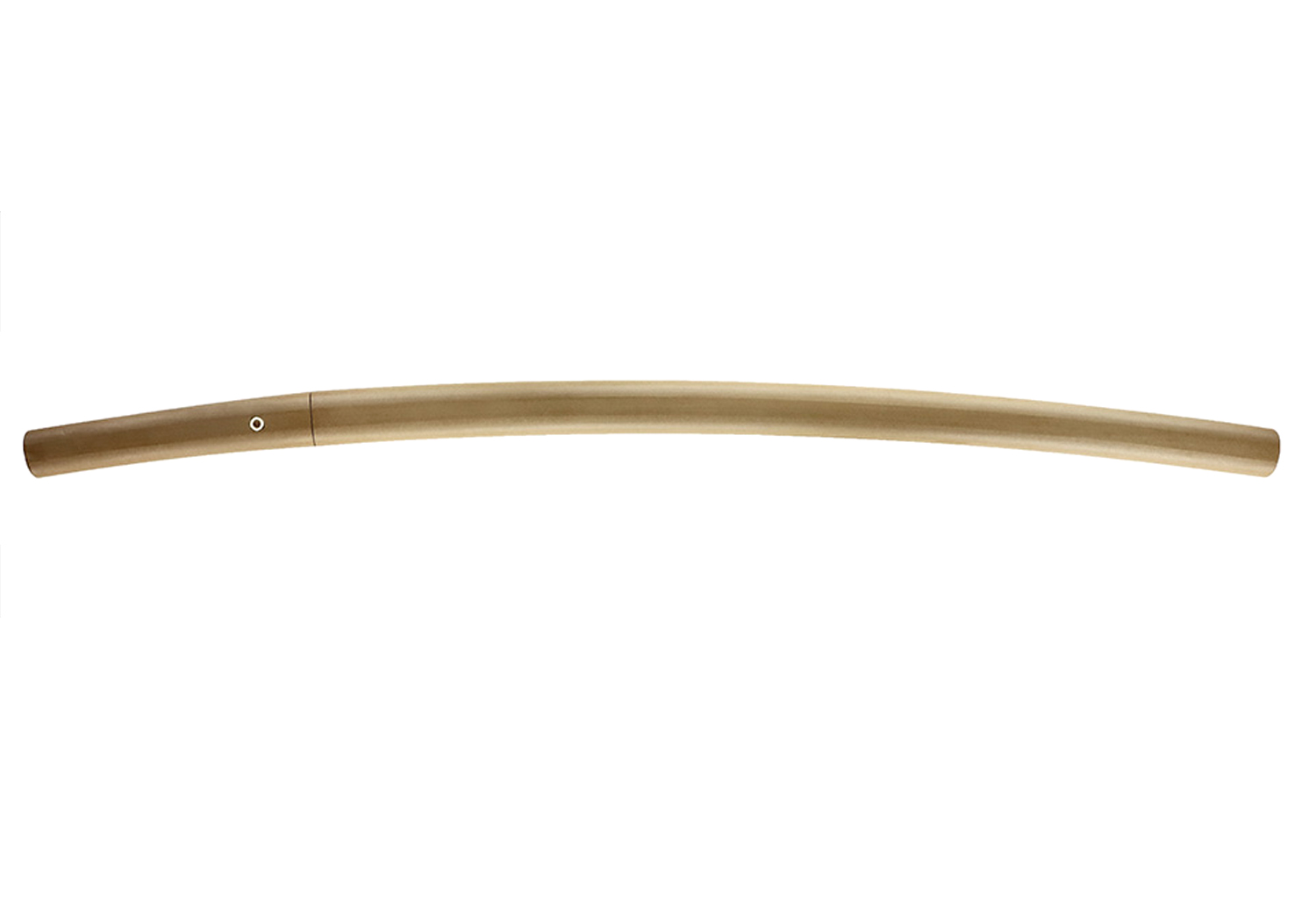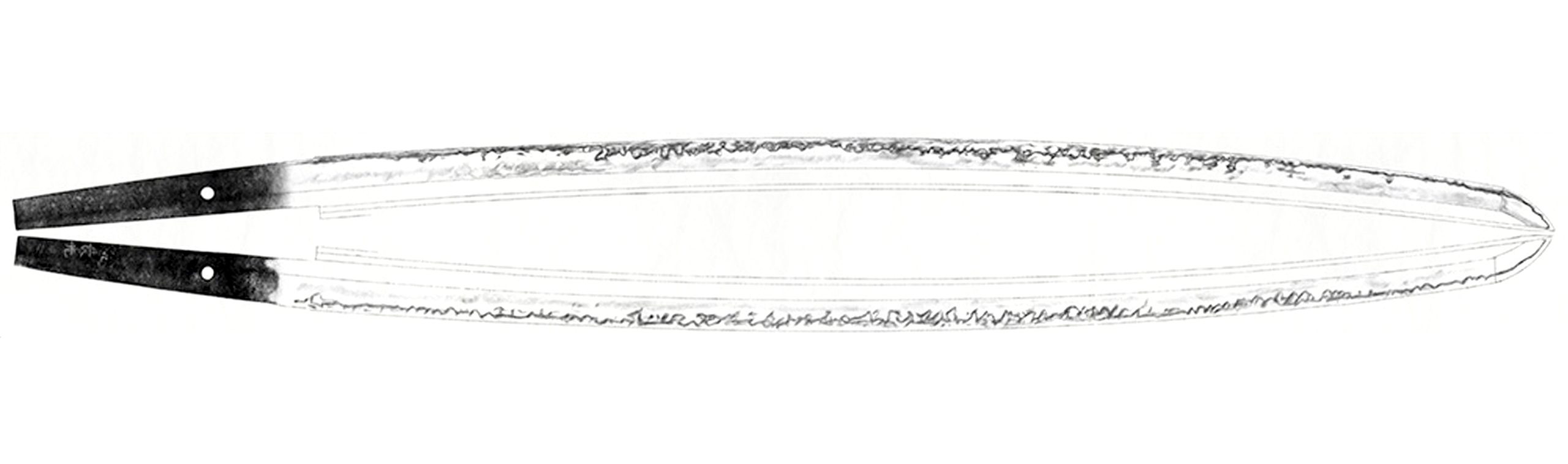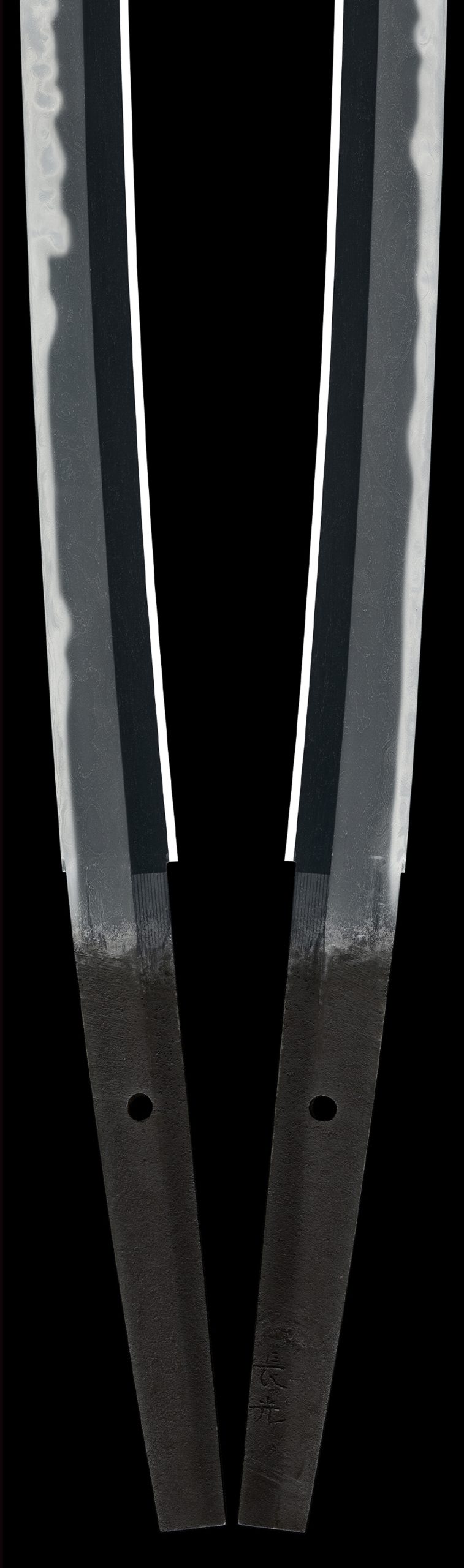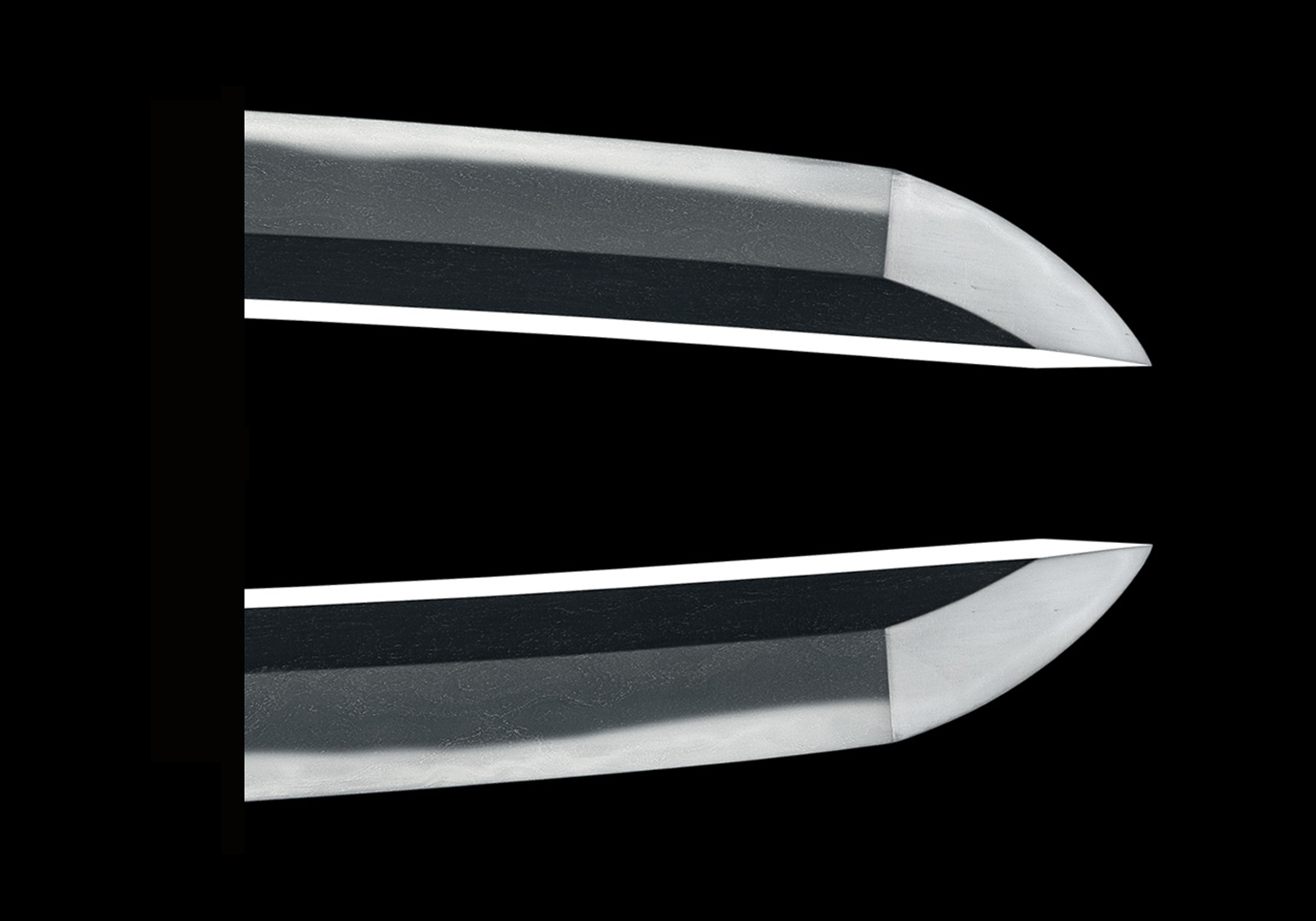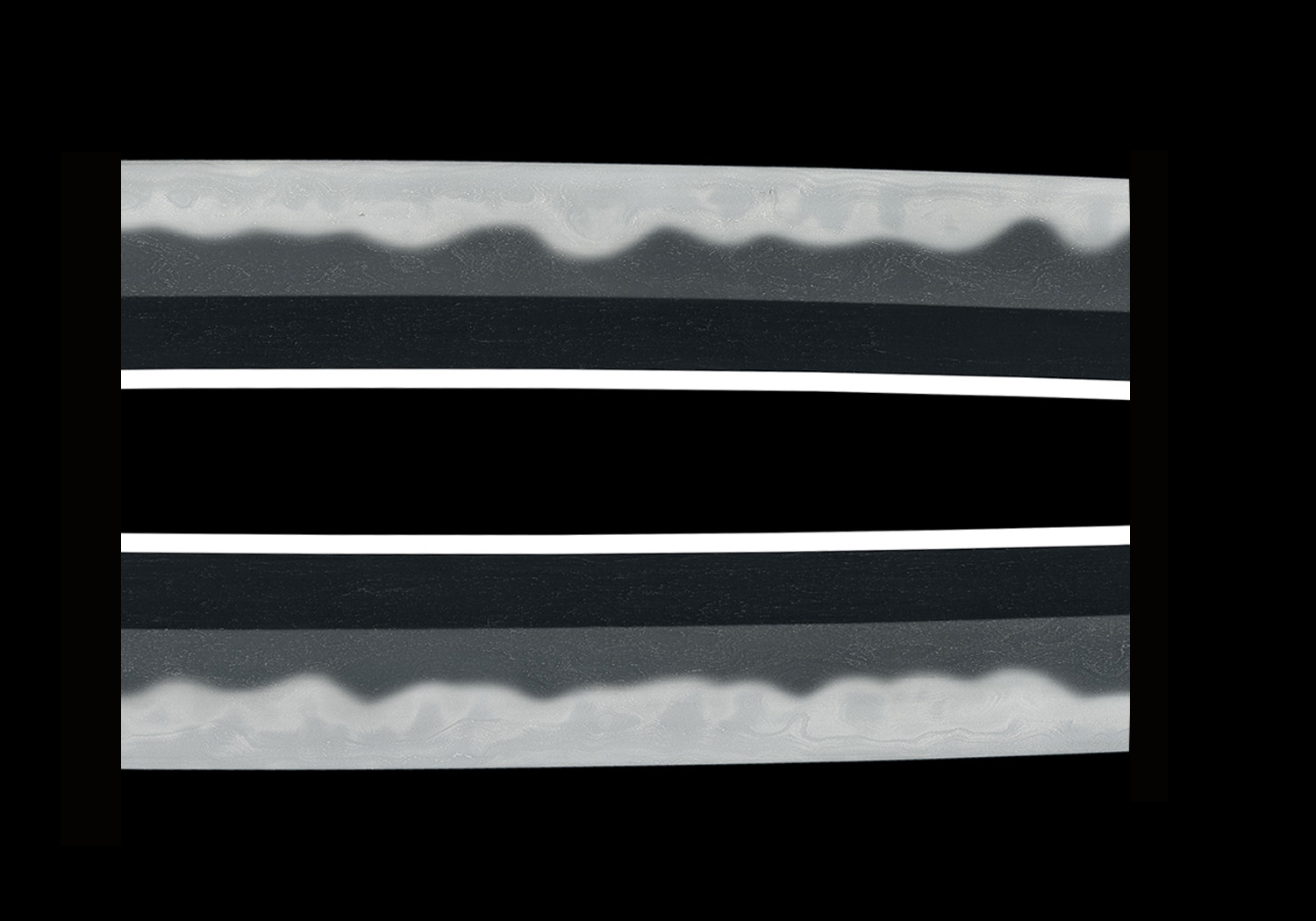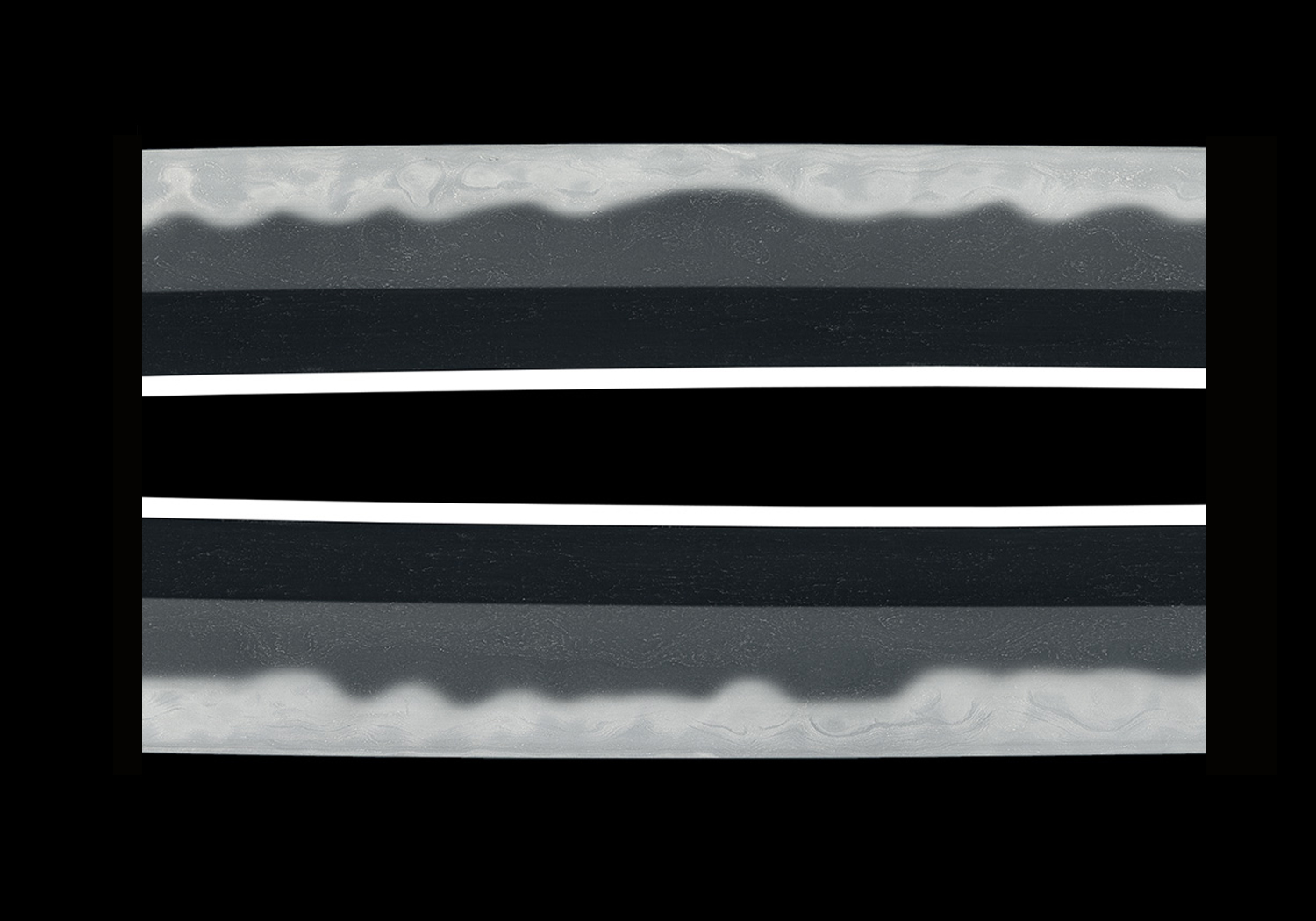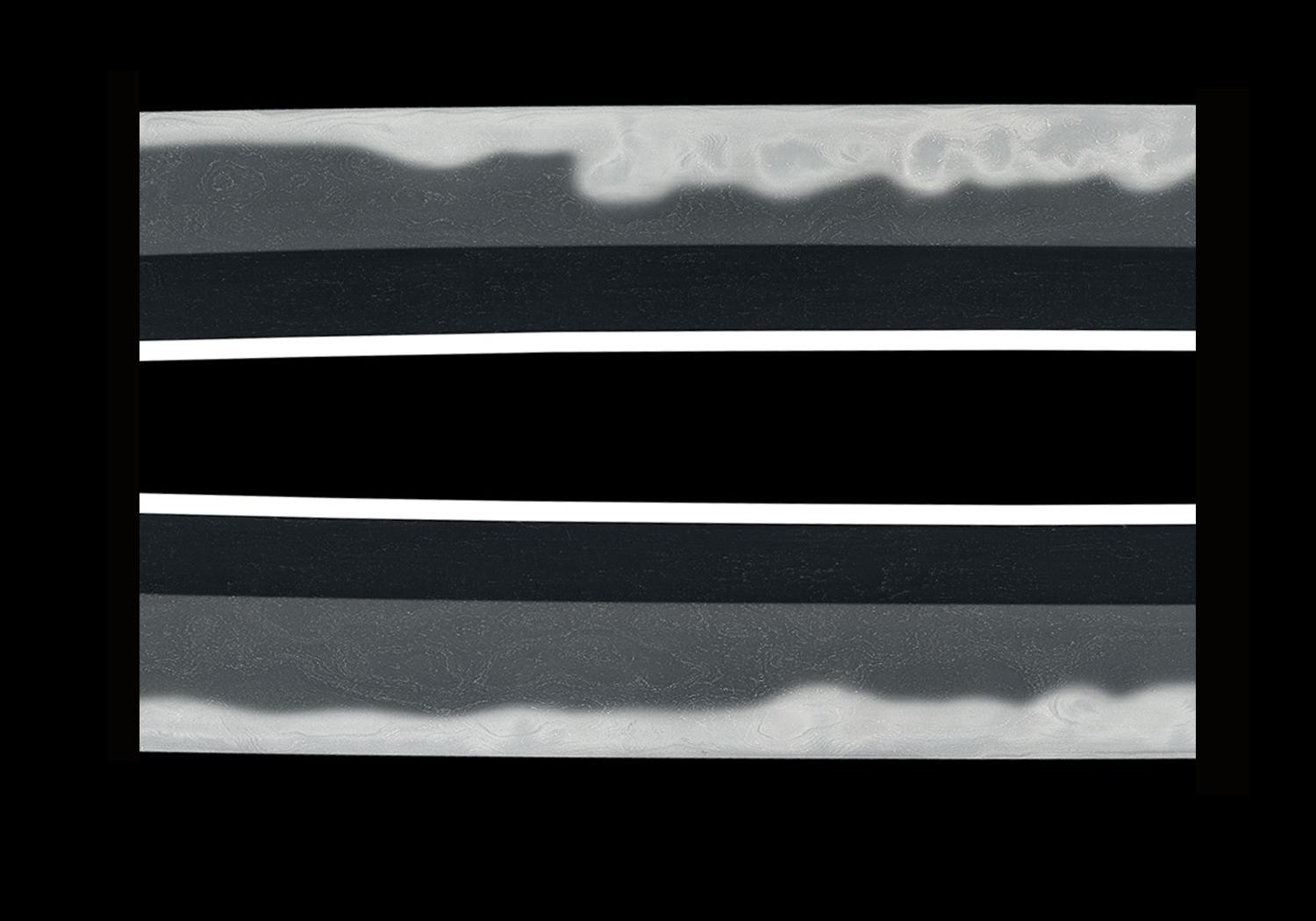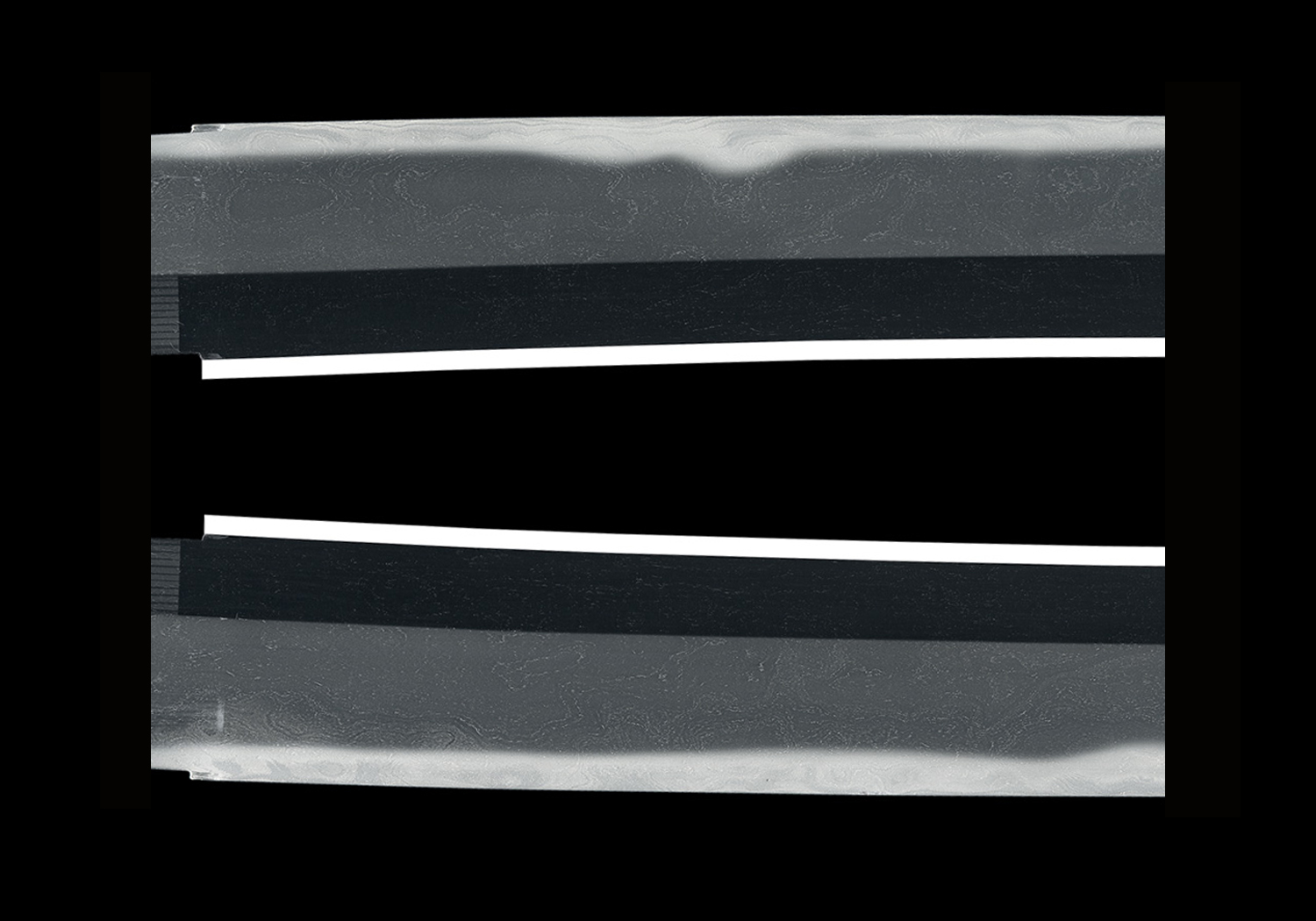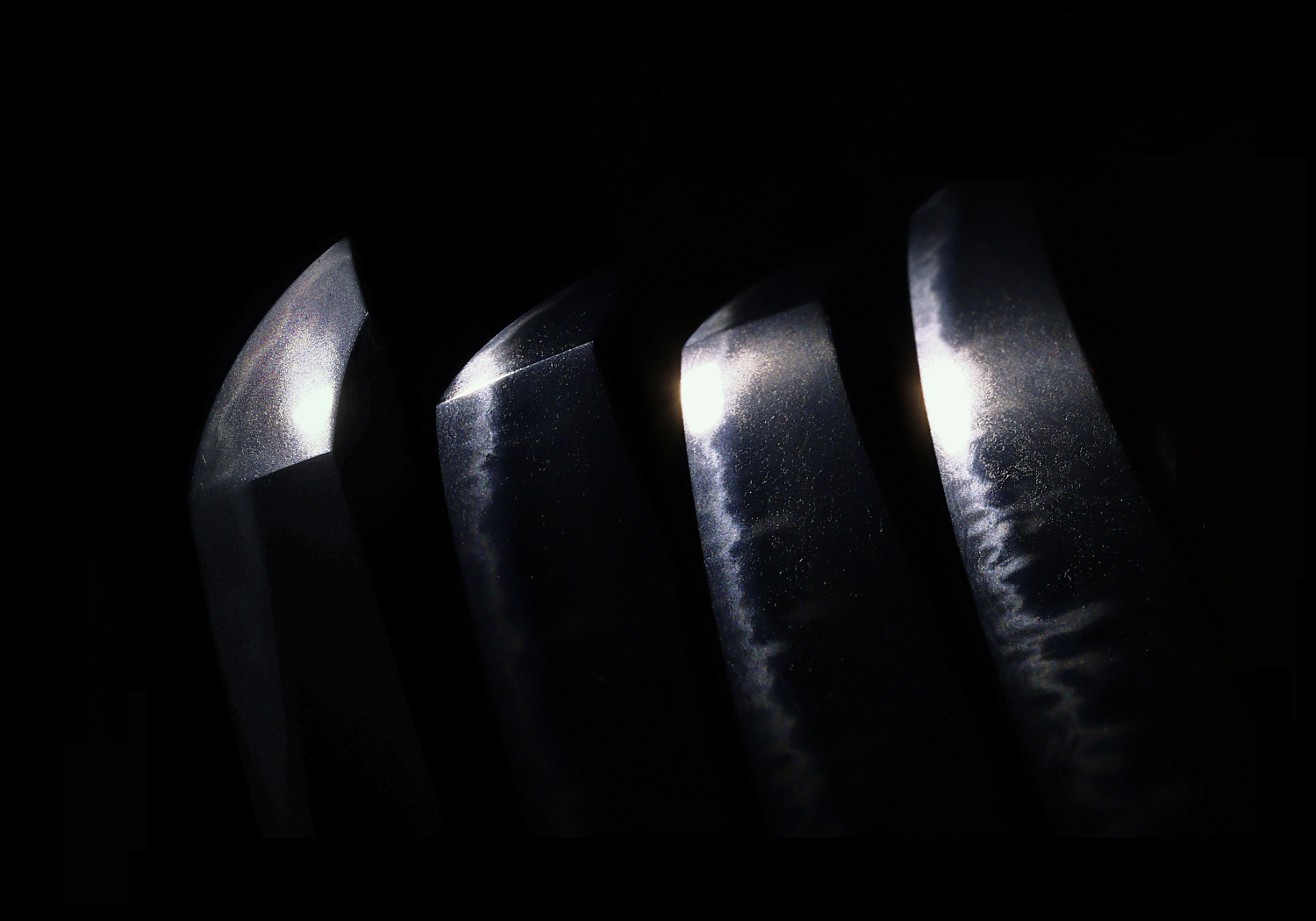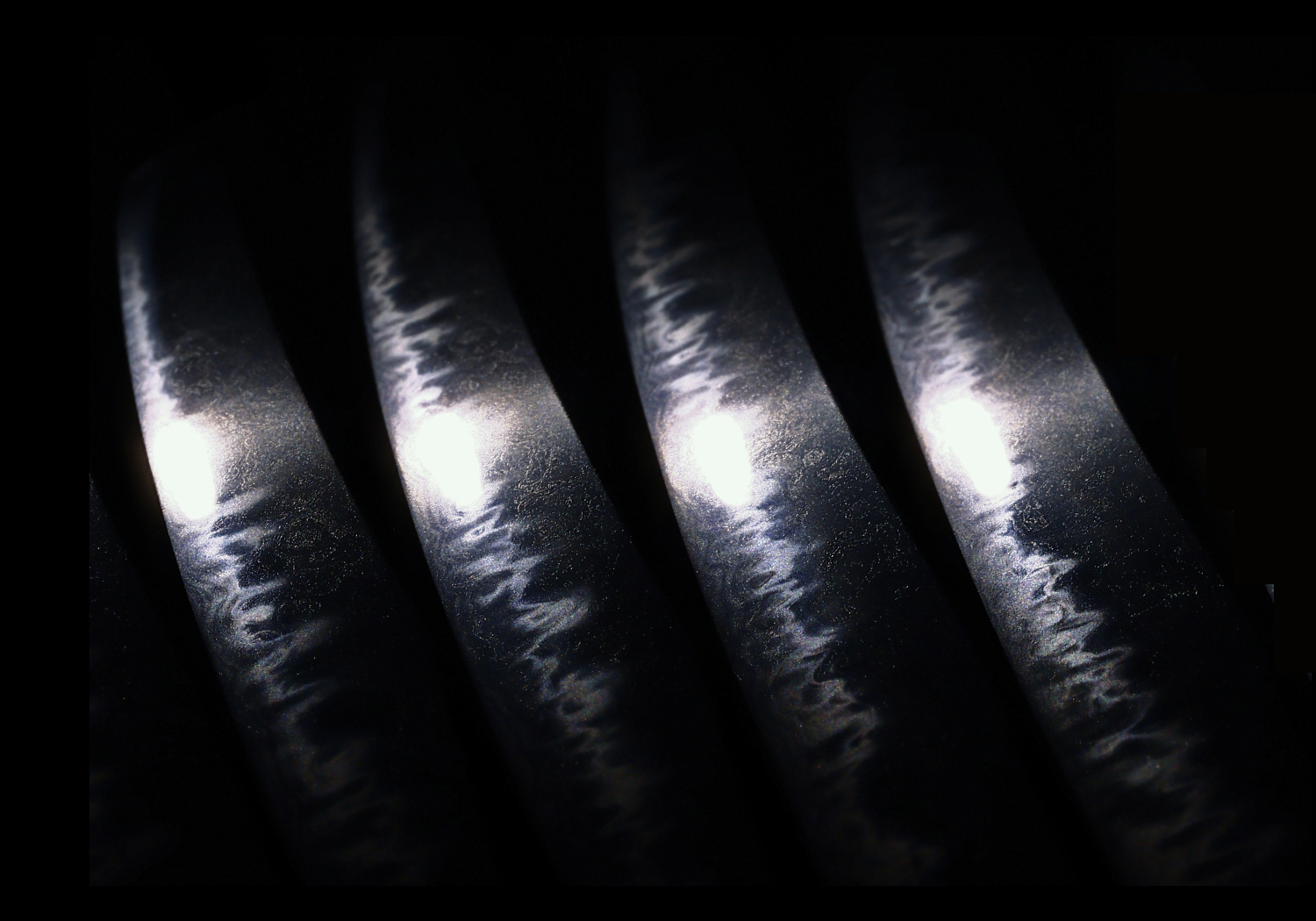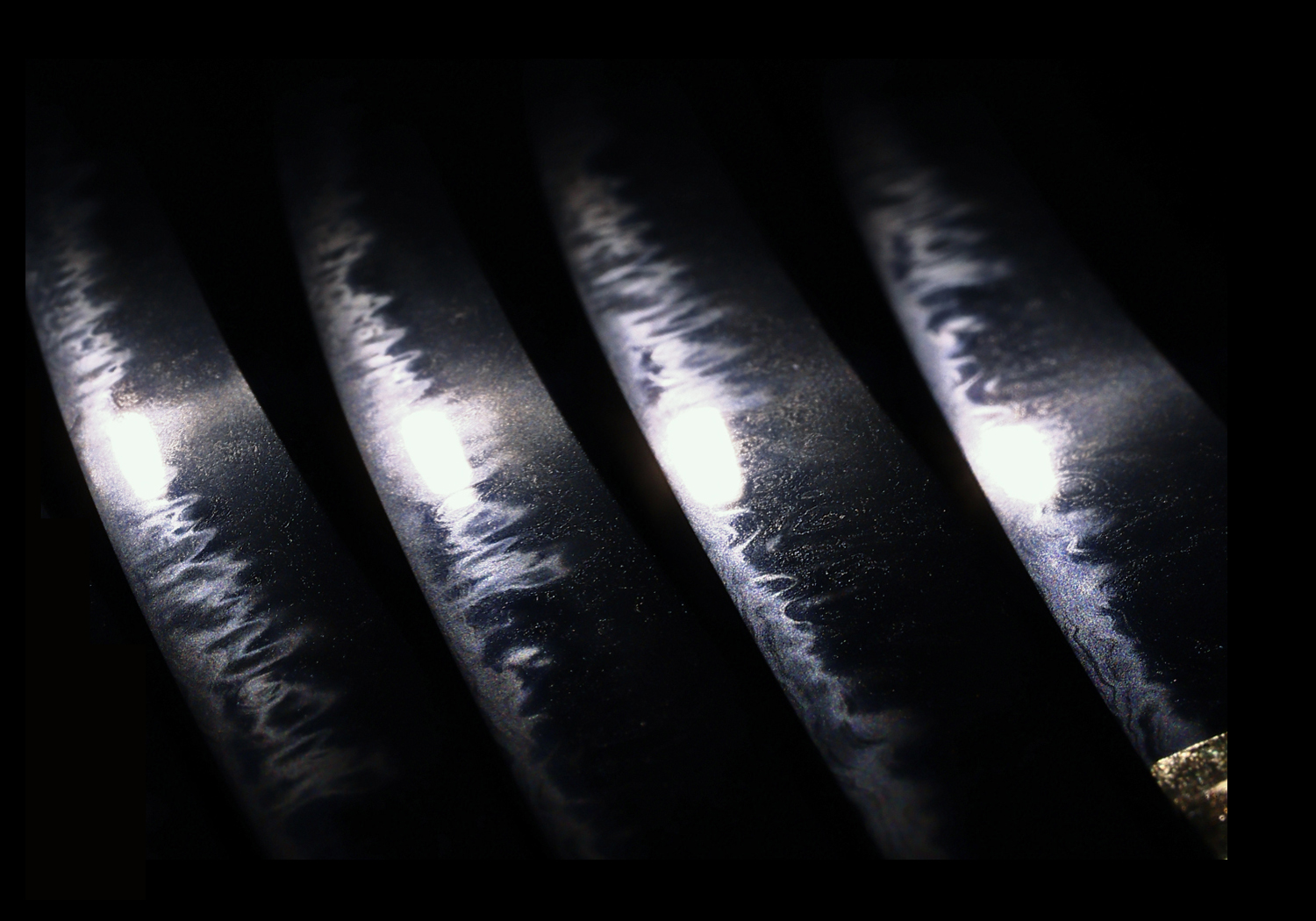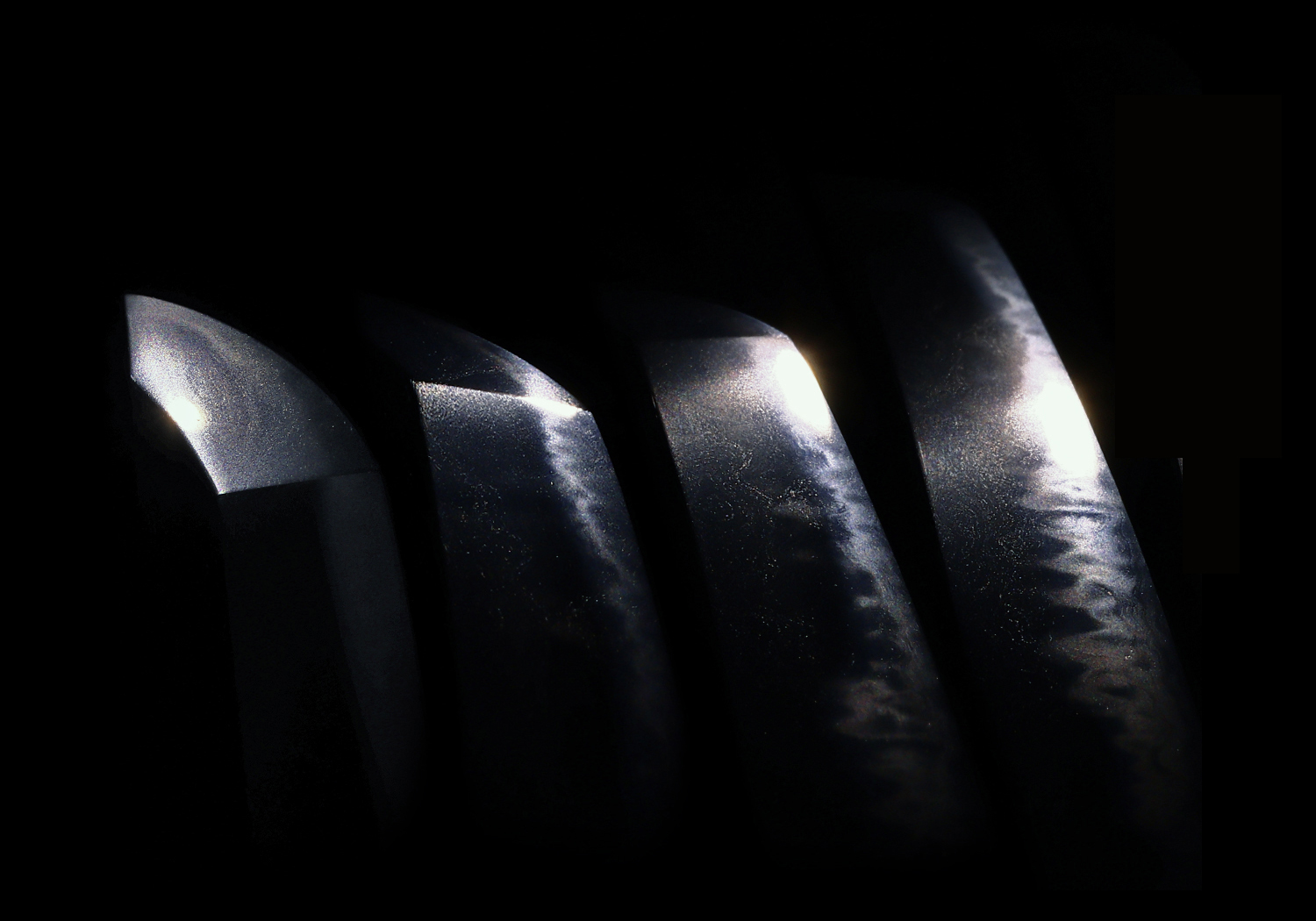

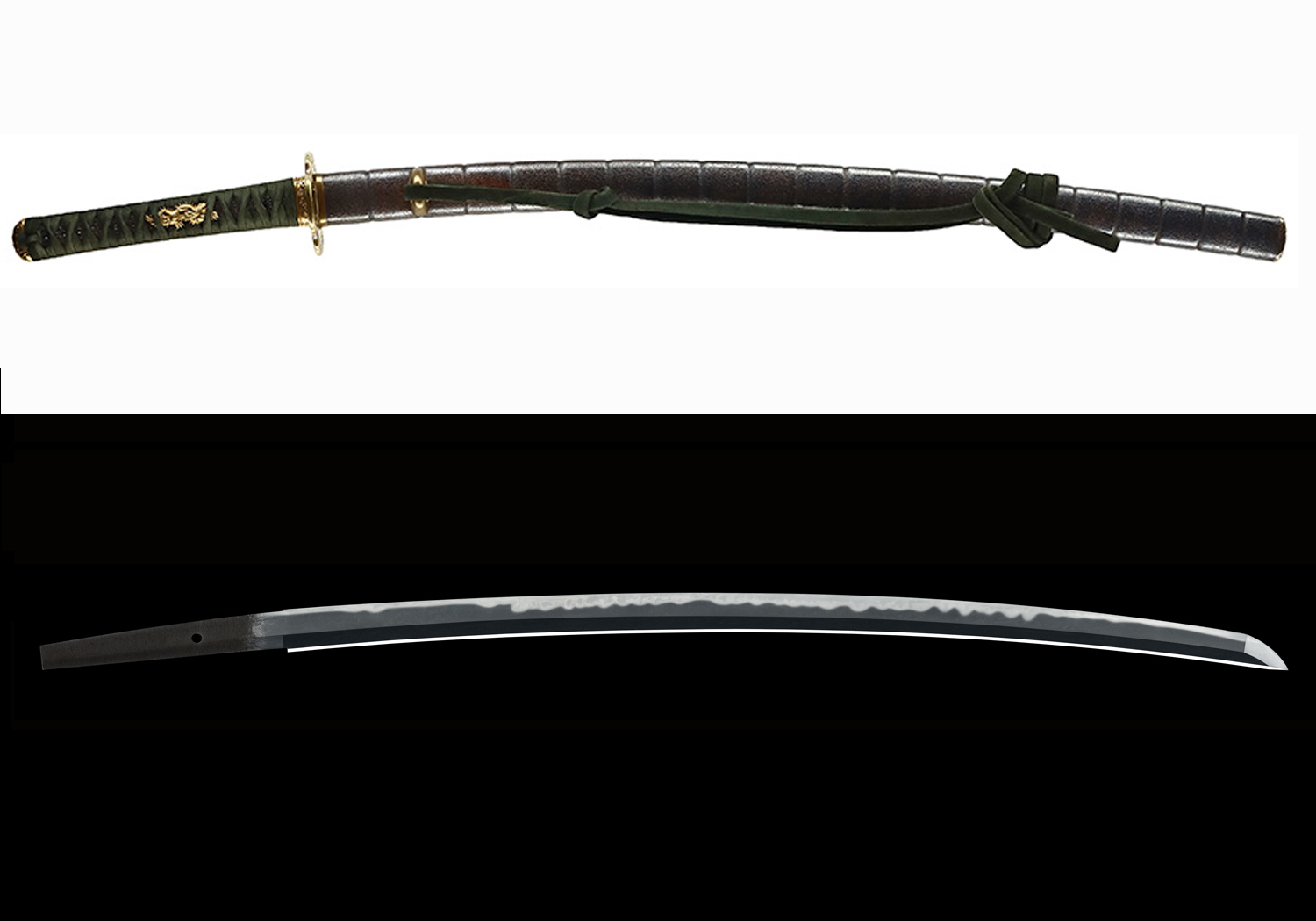
Bizen Nagamitsu (備前長光) was the son of Bizen Mitsutada (備前光忠) who was the founder of the Bizen Osafune School (備前長船). The works by Nagamitsu (長光) closely resemble the craftsmanship developed by Mitsutada (光忠). This is especially true in his early career. While they contain exuberant choji-midare like Mitsutada’s (光忠) works, they differ, however, in that they also contain dominant gunome and more pointed variations of choji than his father’s works.
The thinking in the past was that there were two generations of smiths who used the name Nagamitsu (長光). The first generation Nagamitsu (長光) was thought to have been productive in about the Bunei and Koan eras (1264-1287). The nidai was thought to be a smith who signed Sakon Shogen Nagamitsu with representative works from the Einin and Shoan eras (1293-1301).
The “two generation” theory stems in part from the fact that there was a distinct change in the style of workmanship of blades made around Einin and Shoan eras (1293-1301). That is, prior to the Einin era most of the blades exhibited luxuriant, irregular patterns resembling Mitsutada’s (光忠), but after Einin, his blades have a quieter appearance with a somewhat more subdued irregular pattern occasionally even a straight pattern (suguha).
The “one generation” theory assumes that there was only one generation of smith who used the Nagamitsu (長光) name, and that the former type of blade represents his earlier days and the blades change to the latter type as he went into the last half of his career.
Adding to the “two smith” theory is the fact that there was a slight change in the final stroke of the “mitsu” character when he incised his name on the tang. The style he used in the latter half of his career (or by the second generation depending on which school of thought you adhere to) continued to be used by important Osafune smiths following Nagamitsu (長光), i.e. Kagemitsu (景光), Morimitsu (盛光), Yasumitsu (康光), etc.
As with many areas of the history of the Japanese sword, the research continues and opinions will, without a doubt, be amended or changed in the future. Current opinion tends to lean toward the one-generation theory and a change in working styles by the smith. Irrespective of whether there were two generations or not, blades produced by the Nagamitsu (長光) smith(s) are of exceptional quality having six swords designated as National Treasures and no less than 28 blades designated as Important Cultural Properties.
Further, among the old famous swords which exist today, there is no swordsmith who has left behind a number of outstanding works that surpasses those of Nagamitsu. This shows not only the high esteem in which his swords were held but also that fact that they we so well made as to stand up to the rigors of battle for hundreds of years.
SUGATA: The sugata exhibits the features characteristic of the Kamakura period and is similar to the Ichimonji School of the same time. Generally, blades are shinogi-zukuri, iori mune with koshi-zori. There is a marked tapering approaching the point (funbari). Occasionally among Nagamitsu’s works an unusual sugata may be seen which resembles the works of the early Kamakura period. Others may have a shallow sori and a mihaba (width), which does not vary greatly from the bottom to the point.
JITETSU: The kitae is ko-itame mixed with small mokume, making a fine and beautiful grain. The ji-nie is also fine and the midare-utsuri or choji-utsuri will appear in a pronounced manner.
HAMON: The hamon will be nioi-based, as is the case with Bizen works. Nagamitsu’s hamon is distinctive in that while it resembles that of his father, Mitsutada, having a mixture of various kinds of chojitogether with occasional gunome. In Nagamitsu’s hamon, however, the gunome are much more profuse and will have rounded heads and, in effect, resemble choji. Mitsutada never made hamonwith any portion being suguha in nature, while Nagamitsu was known to make straight hamon on a rare occasion.
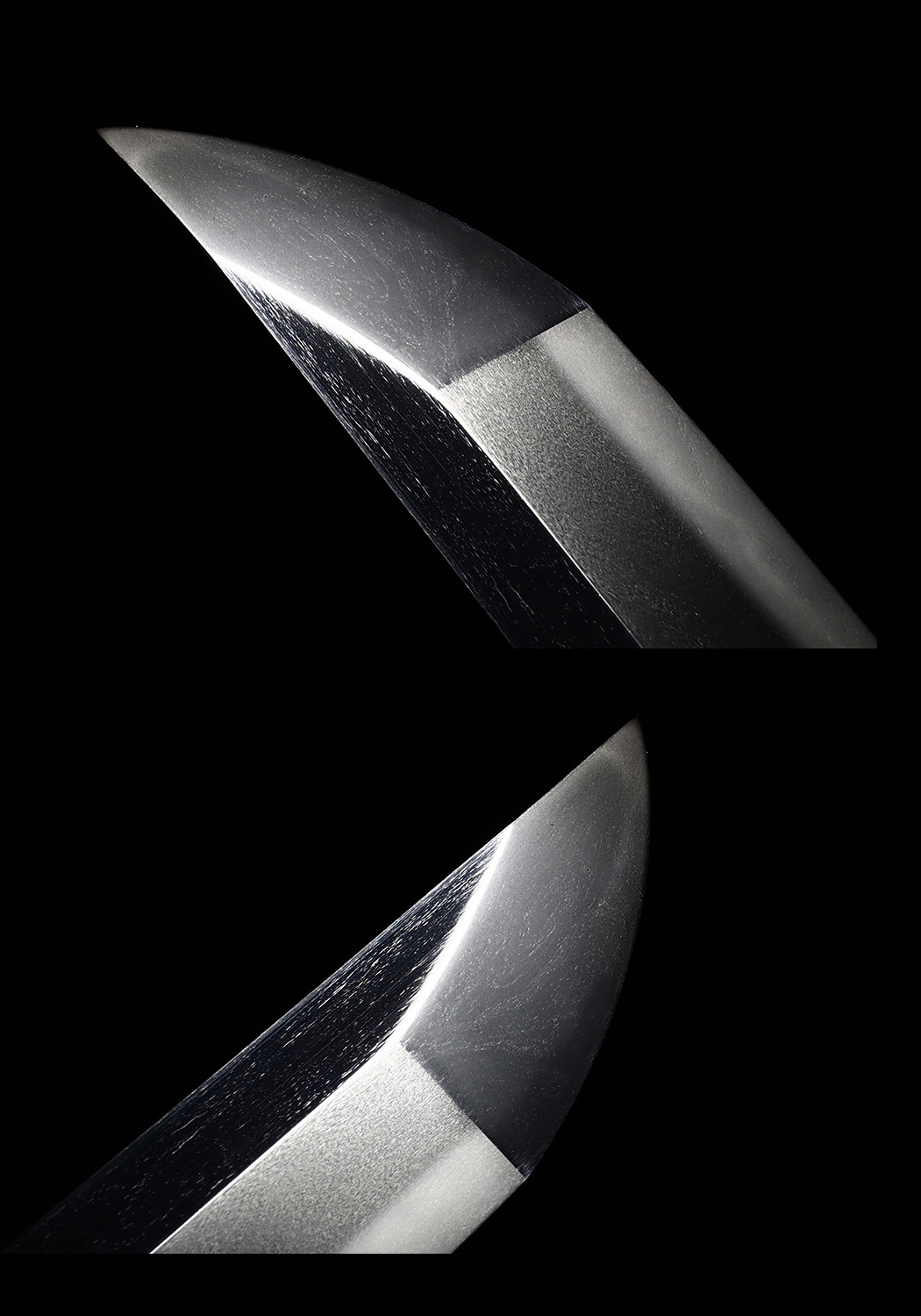
BÔSHI: The bôshi of Nagamitsu is an important kantei point. In most cases (there are always exceptions), he was known for what is called the “san-saku boshi“. This bôshi is called a san-saku boshi since three swordsmiths, Nagamitsu, Kagemitsu, and Sanenaga made it. The characteristics of this type of bôshi are that it is fairly straight when crossing the yokote and then it slightly undulates in the mid point ending in a maru shape with kaeri.
HORIMONO: Bo-hi are commonly seen with the tops of the hi being pointed in nature. Futatsu-hi is also seen. Bonji can be found on his works on occasion.
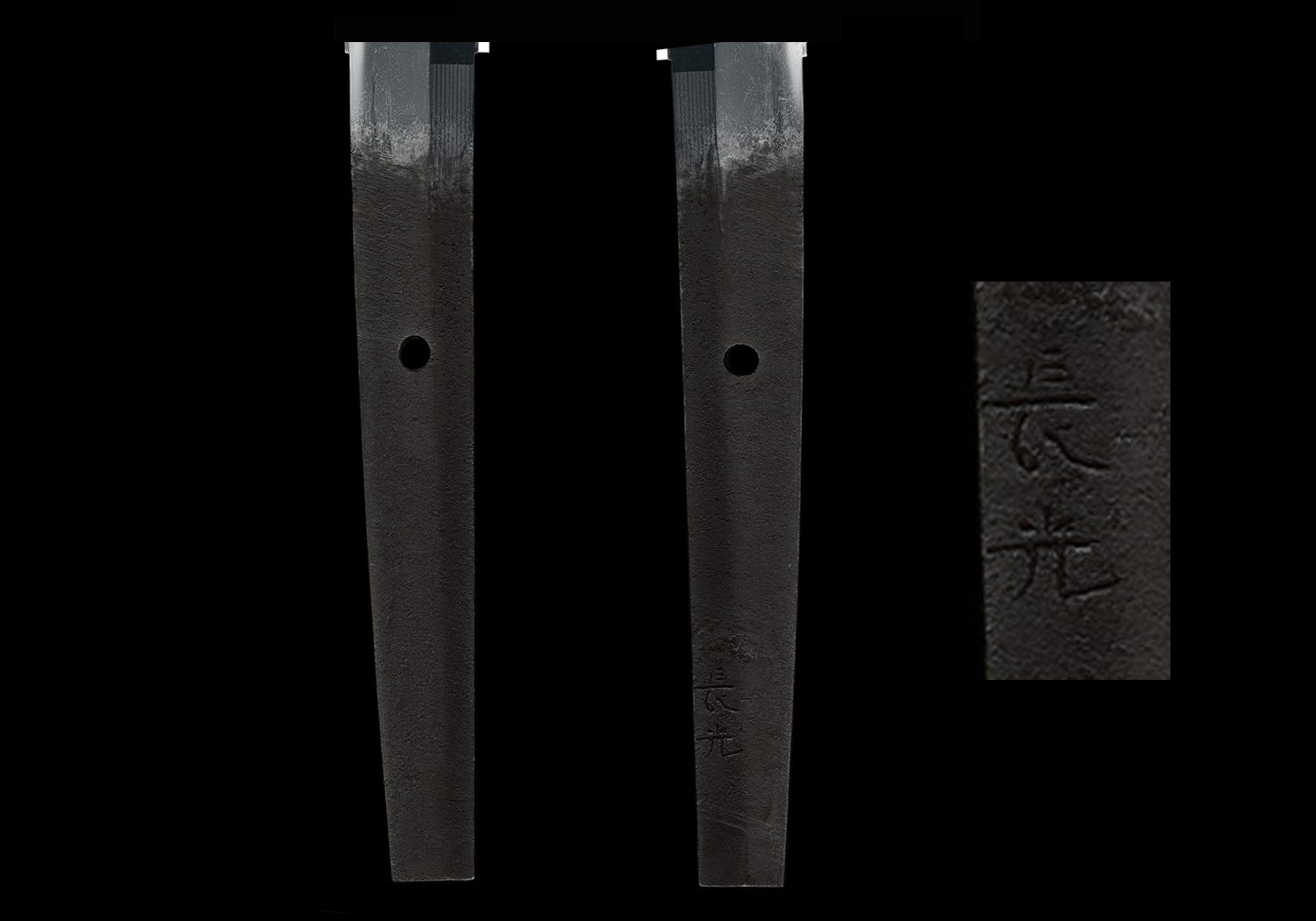
NAKAGO: Not many ubu blades exist, but in general the nakago will be made a little short with the tip in kurijiri or kijimomo. The yasurime will be kuri or sujikai. The mei will generally be given in two characters.
MEI: Nagamitsu has left behind a great number of works. His most common signature is the ni-ji mei, but he also used a few others.
NAGAMITSU 長光
OSAFUNE NAGAMITSU 長船長光
BIZEN KUNI OSAFUNE JÛ NAGAMITSU 備前国長船住長光
BIZEN KUNI OSAFUNE JÛ SAKONSHÔGEN NAGAMITSU TSUKURU 備前国長船住左近将監長光作
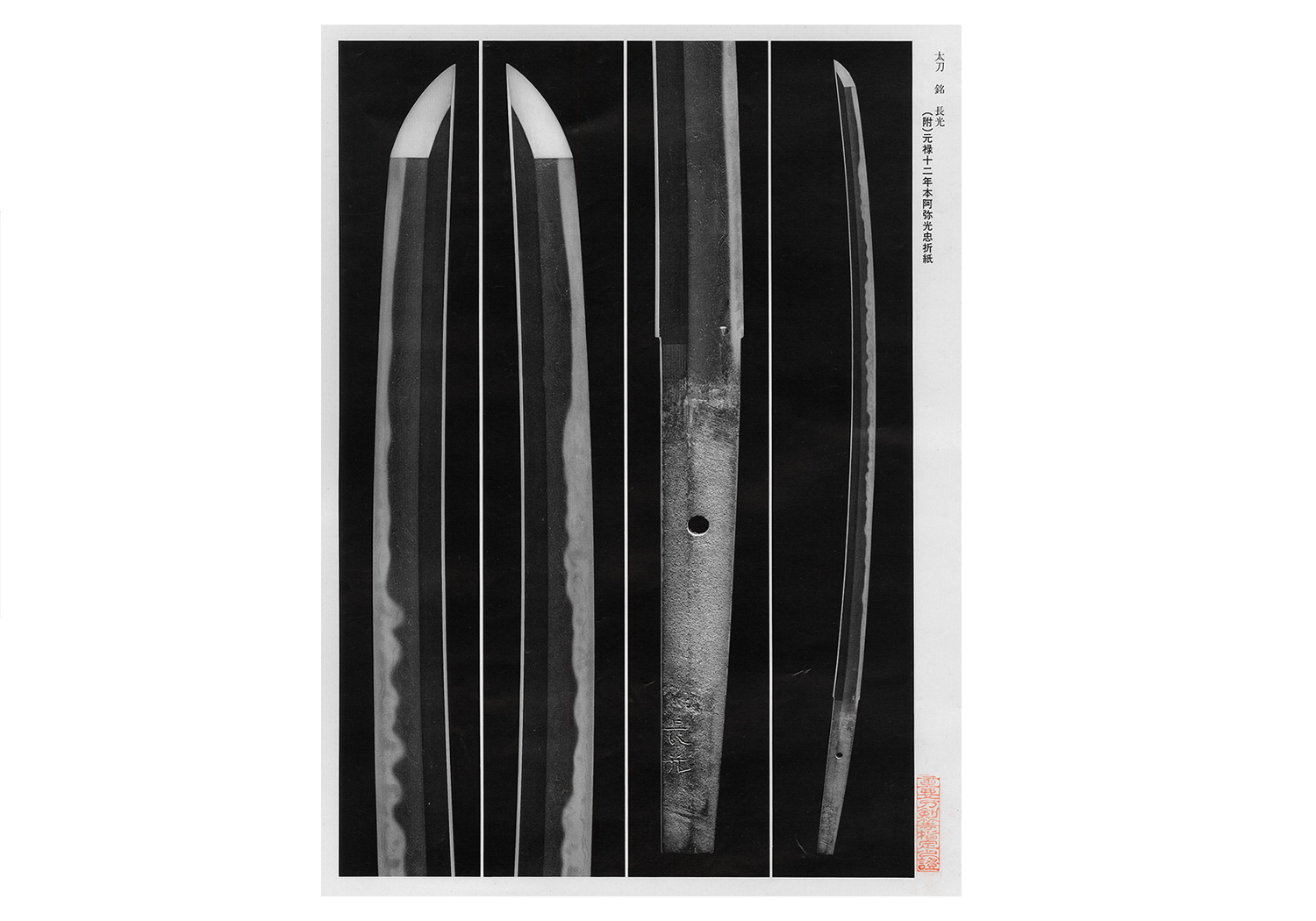
We are pleased to offer for enjoyment and education a truly outstanding recent acquisition. It is recognized as one of the early works of this Bizen Nagamitsuh made at a time when his swords most resembled those of his father, Bizen Mitsutada (備前光忠). It is a zaimei (signed) tachi that was exhibited in the famous Sano Museum in 1989. A full translation of the write-up in the catalog of this exhibit is included later in this paper. An excerpt from that write-up describing this blade is as follows: “This is one of the most nie-laden works of Nagamitsu, with its aesthetic highlights being a strikingly vivid hamon, the tobiyaki between the kawazu no ko-chōji, the sunagashi, and the midare-utsuri, just to name a few.”
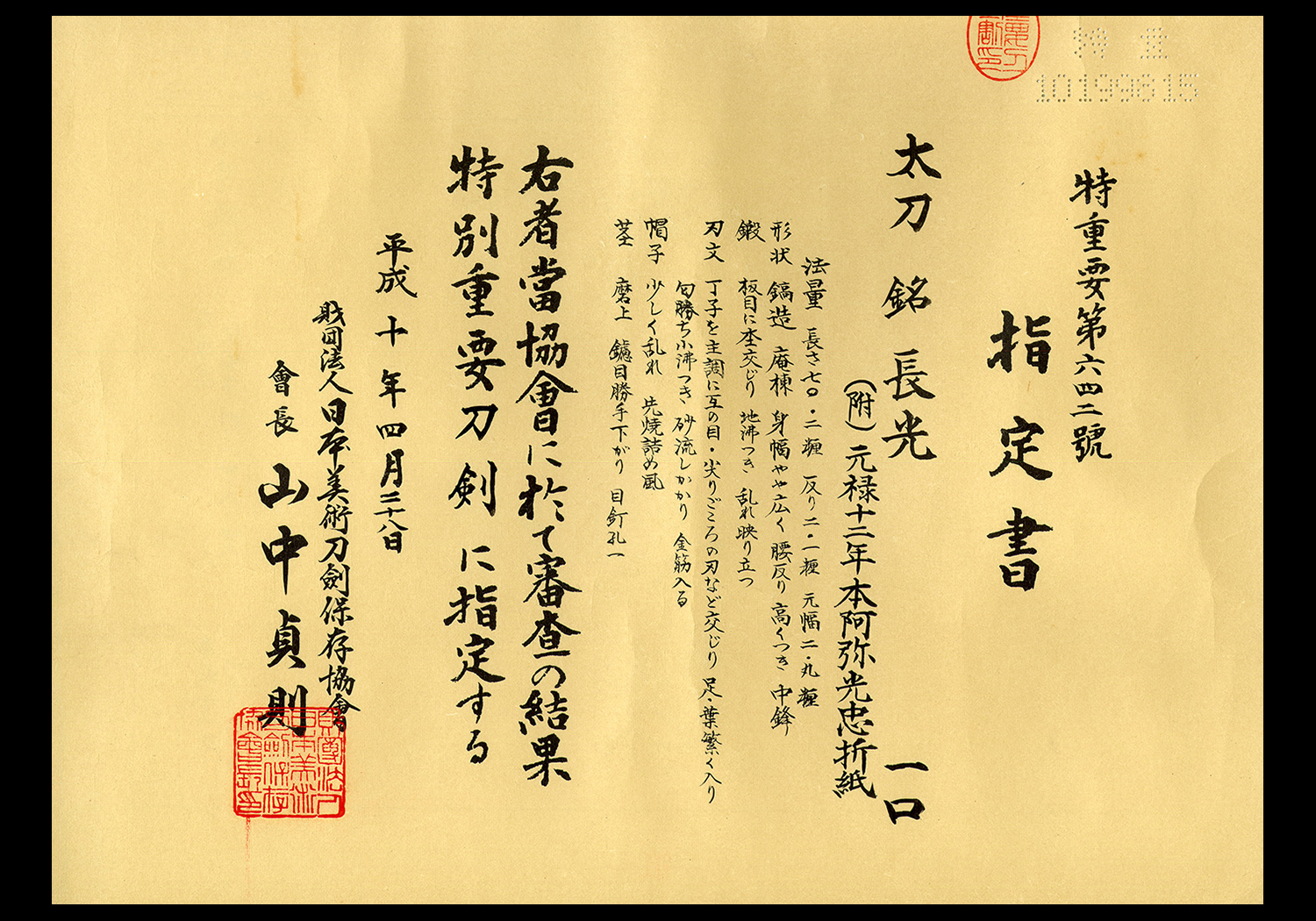
This tachi by Nagamitsu was awarded the rank of Tokubetsu Jûyô Tôken at the 15th Tokubetsu Jûyô Shinsa on April 28, 1998. A translation of the setsume from that shinsa is as follows:
Tokubetsu-Jūyō Tōken at the 15th Tokubetsu-Jūyō Shinsa held on April 28, 1998
Tachi, mei: Nagamitsu (長光)
(w/ Hon’ami Kōchū [本阿弥光忠, ?–1725] origami from Genroku twelve [元禄, 1699])
Measurements:
Nagasa 70.0 cm, sori 2.1 cm, motohaba 2.9 cm, sakihaba 2.1 cm, kissaki-nagasa 2.1 cm, nakago-nagasa 17.3 cm, no nakago-sori
Description:
Keijō: shinogi-zukuri, iori-mune, relatively wide mihaba, hira-niku, deep koshizori, chū-kissaki
Kitae: itame that is mixed with mokume and that features ji-nie, jifu, chikei, and a midare-utsuri
Hamon: chōji-chō in nioi-deki with ko-nie that is mixed with gunome, some togari, many ashi and yō, yubashiri, kinsuji, and plenty of sunagashi, and there is standing-out ha-hada
Bōshi: a little bit midare and tending to run out as yakitsume
Nakago: suriage, kirijiri, katte-sagari yasurime, one mekugi-ana, the haki-omote side retains near the tip of the tang and towards the nakago-mune a niji-mei
Artisan:
Osafune Nagamitsu from Bizen province
Era:
Mid-Kamakura period
Explanation:
Nagamitsu (長光) was the son of the Osafune (長船) School founder Mitsutada (光忠), succeeded him as second generation of this lineage, and was as famous as his father. He is known for having the largest surviving body of work of any smith from the Kamakura period, and the fact that all of his blades are of a uniformly high level of quality speaks for his skill. Nagamitsu worked in a large variety of styles, e.g., in a flamboyant chōji-midare combined with a magnificent sugata continuing so the workmanship of Mitsutada, over a suguha-chō mixed with chōji-ashi combined with a sugataof standard width or a slender sugata, to more unobtrusive interpretations in suguha-chō mixed with ko-chōji and ko-gunome, which can look like works of Sanenaga (真長) or Kagemitsu (景光) at first glance.
This tachi is of a flamboyant deki based on chōji that is mixed with kawazu no ko-chōji, and with its nie, it reminds us of the style of his predecessor Mitsutada. The ha features many ashi and yō and also plenty of kinsuji and sunagashi, and it must be pointed out that overall, the blade is of a more classical appearance than usually seen with Nagamitsu, also having certain characteristics in common with Kunimune (国宗), who was active in the same province of Bizen. Thus, the blade is an important reference for our understanding of the stylistic range of Nagamitsu, which can be identified as an early work of his. The mei is crisply preserved, and despite being suriage, the blade retains its koshizori and its powerful tachi-sugata. Apart from that, the condition of the jiba is excellent as well.
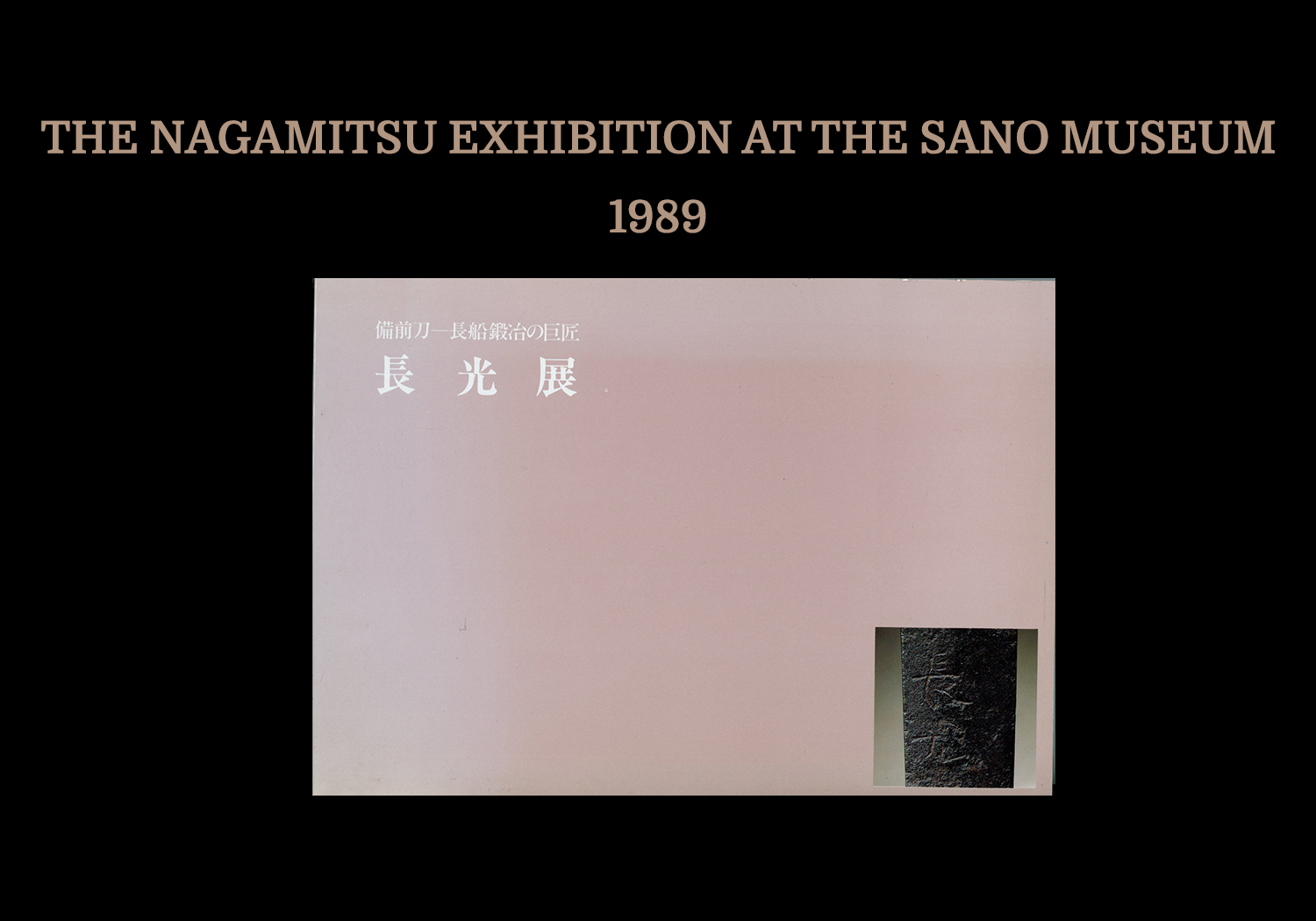
As stated earlier, this tachi was also exhibited at the Sano Museum in 1989 when they held a special exhibition called “Bizen Swords-The Osafune Grandmaster Nagamitsu (Bizen-Tô – Osafune Kaji no Kyoshô 備前刀 – 長船鍛冶の巨匠) Nagamitsu Ten (長光展). See photo below.
The full description on pages 38-39 is as follows:
- Tachi, mei: Nagamitsu (長光)
Measurements: Nagasa 70.2 cm, sori 2.1 cm, motohaba 2.9 cm, sakihaba 2.1 cm, kissaki-nagasa 3.2 cm, nakago-nagasa17.4 cm
Shape: Shinogi-zukuri, iori-mune, chū-kissaki
Kitae: Standing-out itame that is mixed with mokume and nagare and that features ji-nie, yubashiri, jifu, chikei, and a midare-utsuri
Hamon: Noticeably undulating and nie-laden chōji that is mixed with kawazu no ko-chōji-chō, ko-gunome, ashi, yō, kinsuji, and sunagashi
Bōshi: A little bit notare-komi and running out almost completely in yakitsume manner
Nakago: Suriage, kirijiri, katte-sagari yasurime, one mekugi-ana, the haki-omote side bears towards the tip of the tang and towards the nakago-mune a two-character signature
Published: Dai 31 Jūyō Tōken Nado Zufu (1984)
Characteristics: This is one of the most nie-laden works of Nagamitsu, with its aesthetic highlights being a strikingly vivid hamon, the tobiyaki between the kawazu no ko-chōji, the sunagashi, and the midare-utsuri, just to name a few. The character for mitsu in the signature is executed in a horizontally elongated and angular manner.
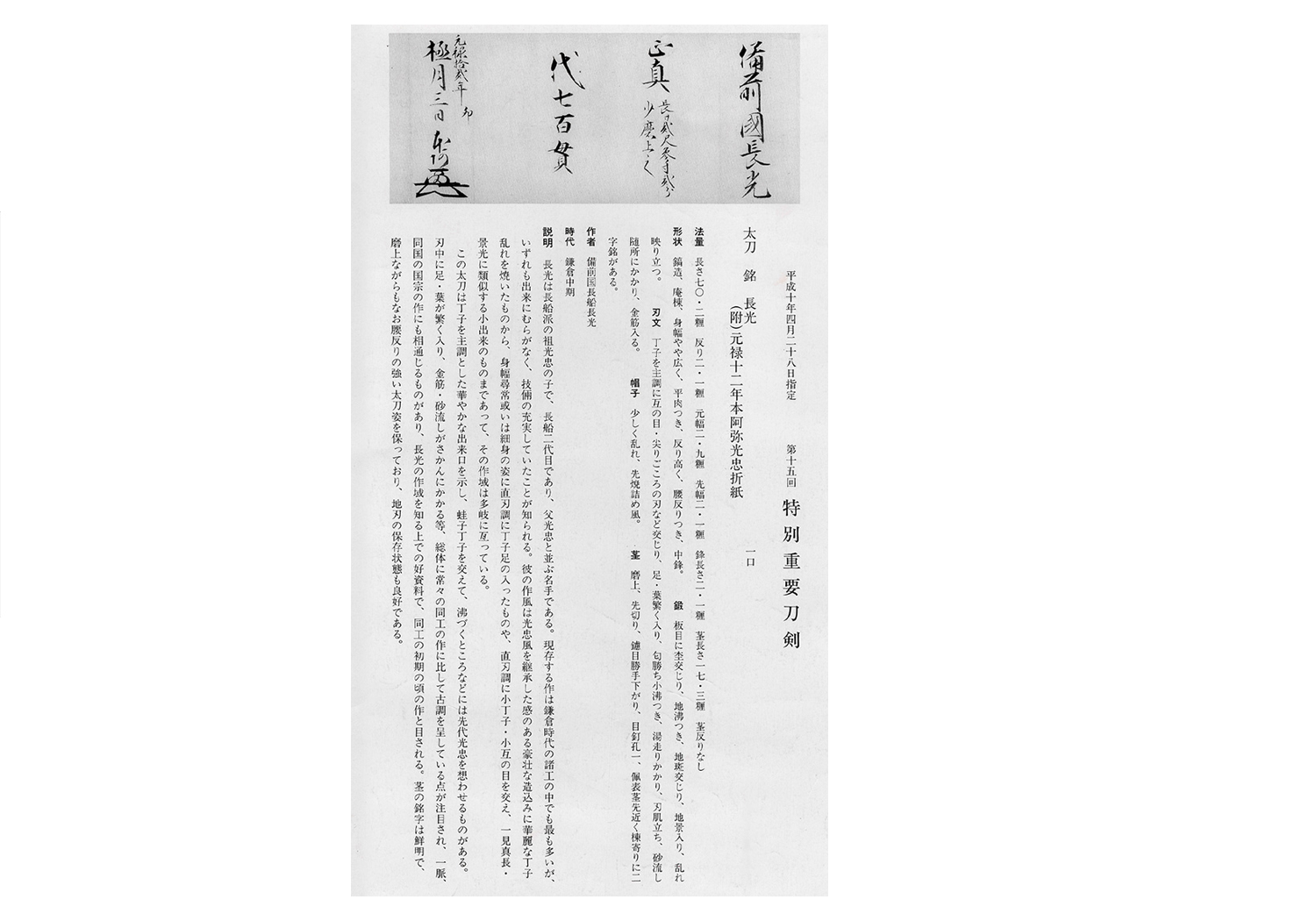
As mentioned in the NBTHK Tokubetsu Jûyô Tôken documents above, this tachi also comes with the original origami (certification of authenticity and value) written by Hon’ami Kôchû in Genroku twelve (元禄 1699) which acknowledges its authenticity and values it at that time at 700 Kan (gold pieces). A copy of this document is also included below.
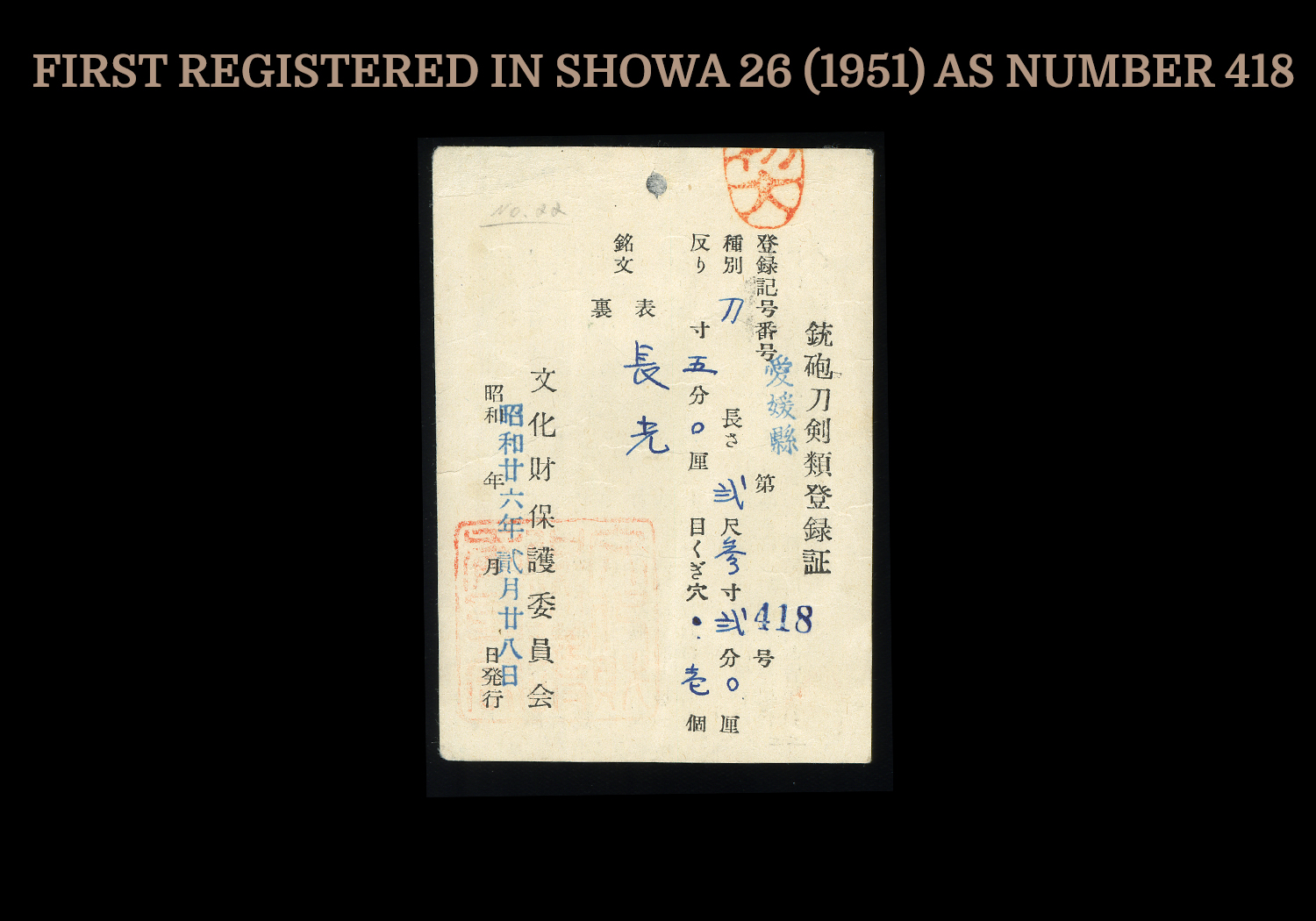
We are also fortunate to have a copy of the original tôrokushô from when this sword was first registered with the Japanese government. This registration process was established in 1951. It is generally considered a fact that the most important former Daimyo families got to register their swords first and thus they obtained the lowest registration numbers. You can see that the registration number on this Nagamitsu is number 418 and issued in 1951, very low number and early date thus indicating that this sword was owned by one of the big Daimyo families at that time.
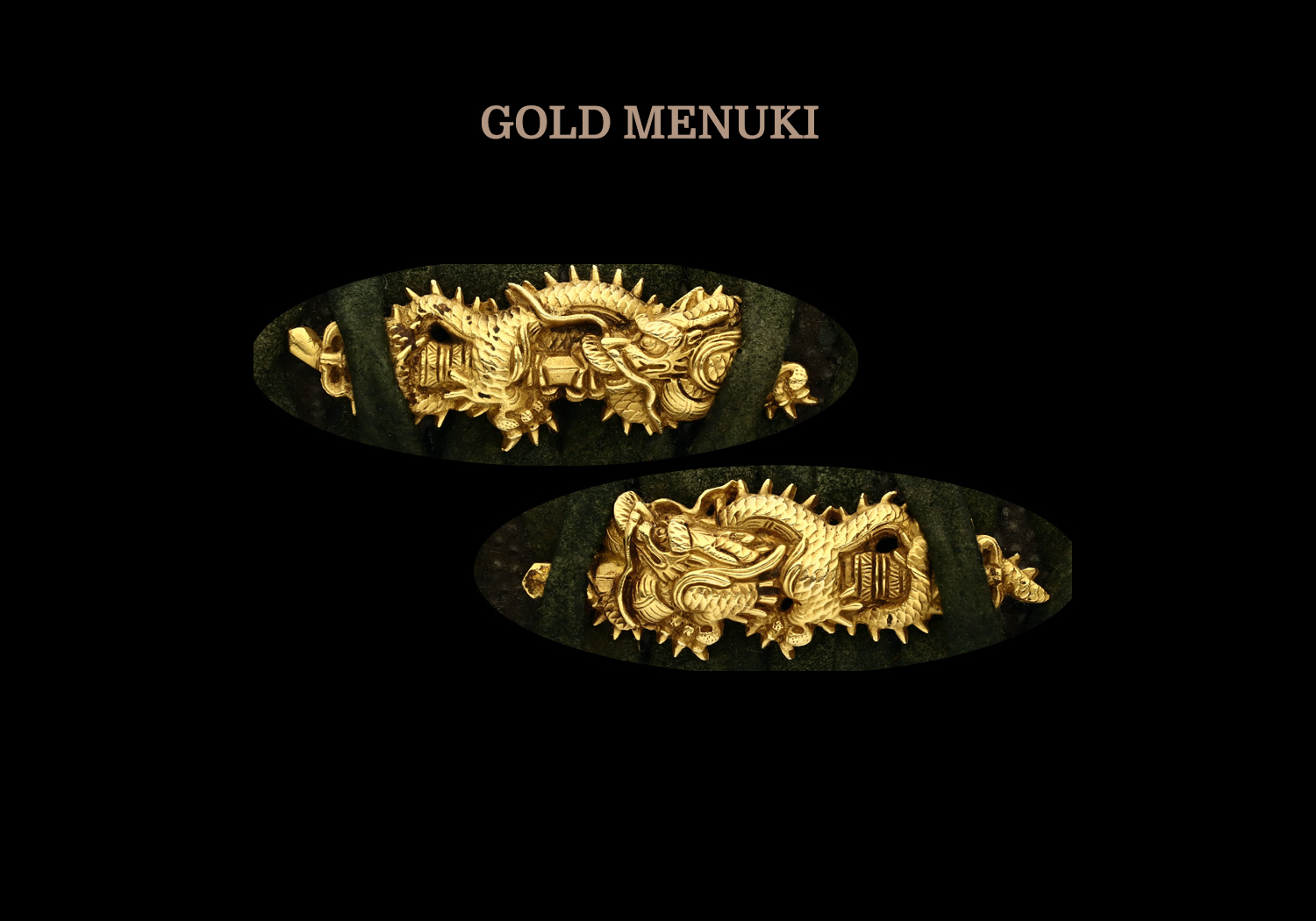
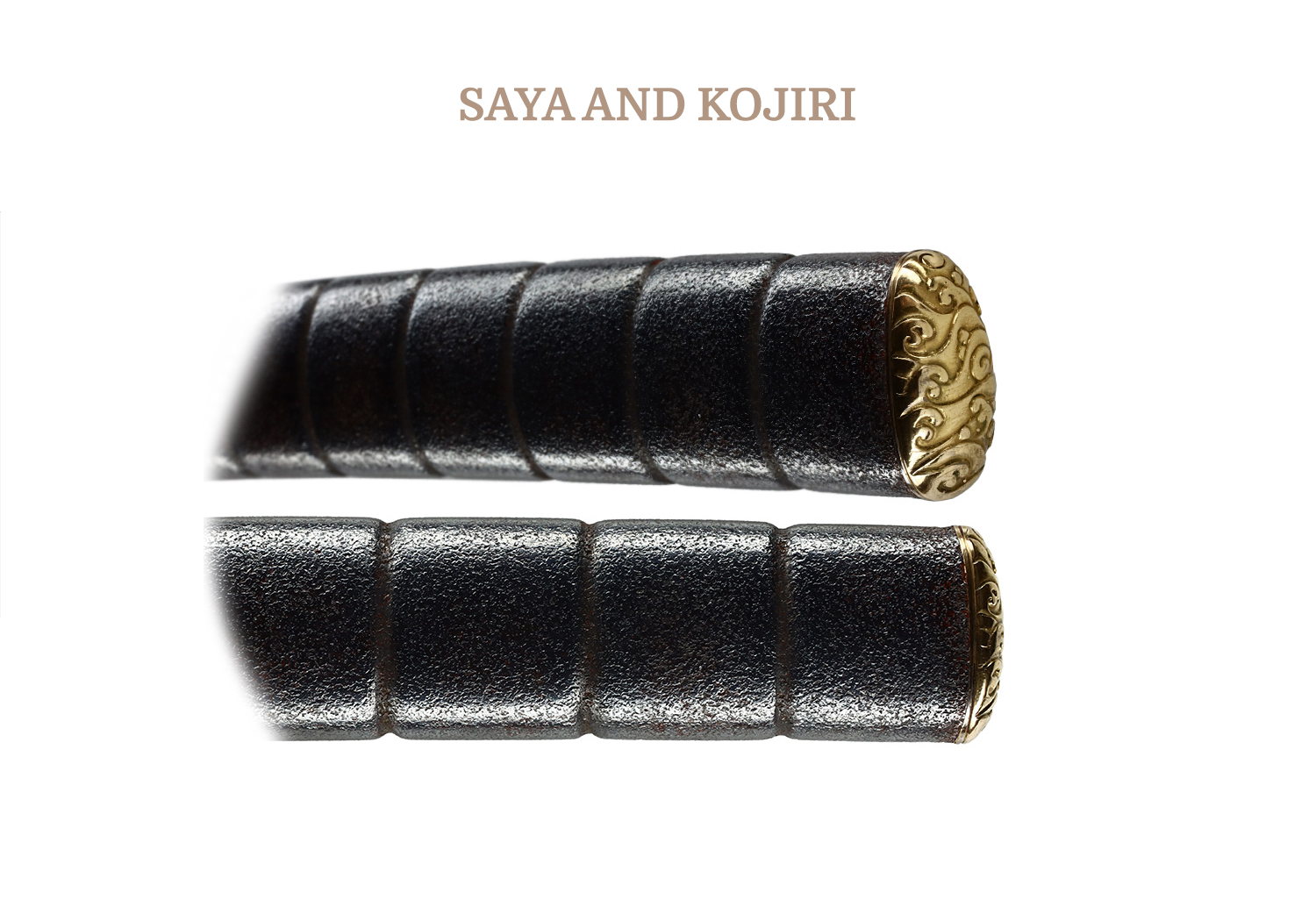
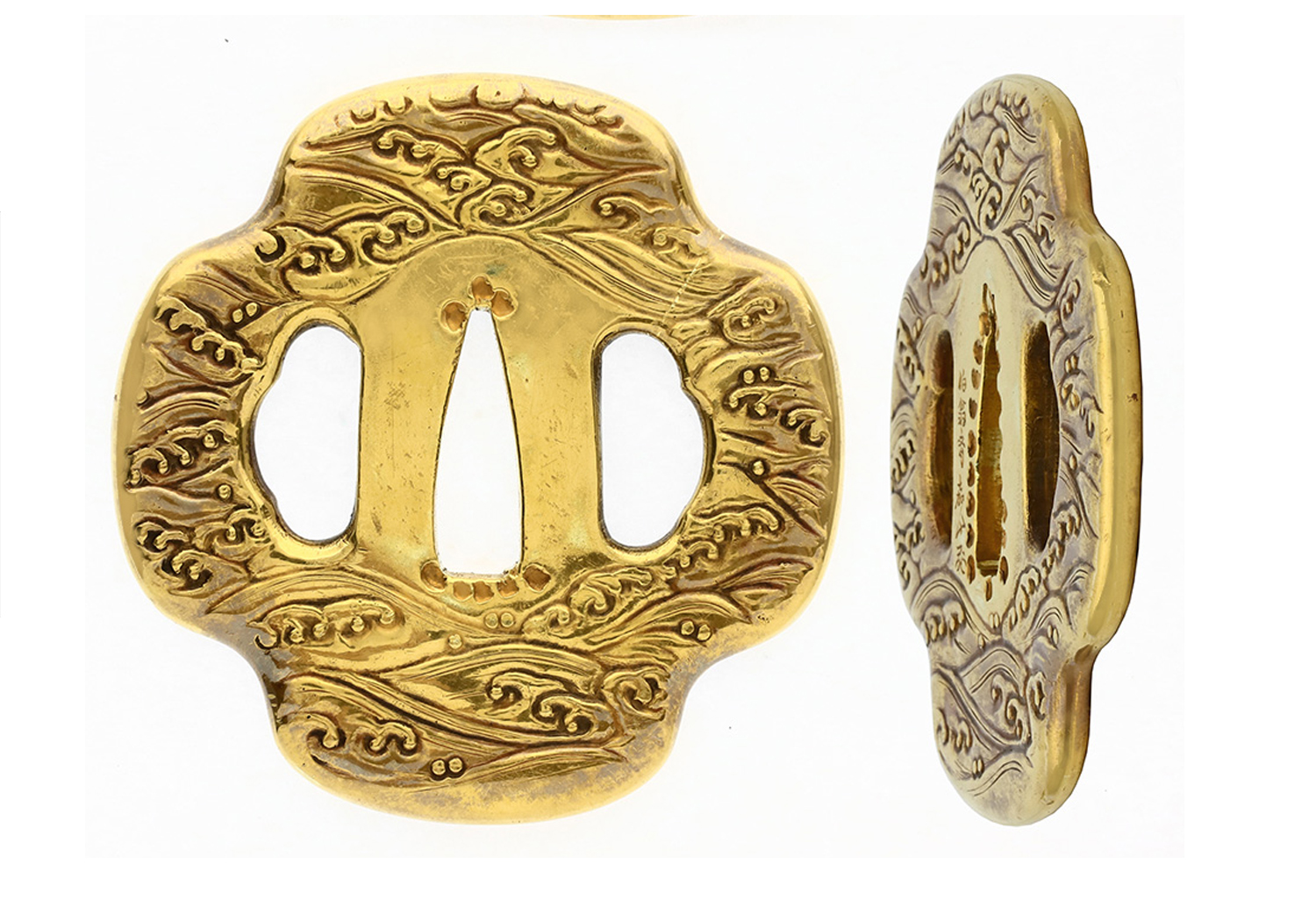
This tachi is currently mounted in an ornate katana koshirae with gold fittings. It is a very lavish koshirae with the tsuba, fuchi and kashira, and kojiri all appearing to be made of solid gold and signed by their maker Hakuôsai Kajû 伯翁斉嘉山. These fittings are carved in wave patterns. The menuki are of dragons and are also made of solid gold. The tsuka same has been lacquered black and the saya is done in a wide ribbed pattern and lacquered in an off-black color.
The inscription on the tsuba reads “Hakuosai Kaju (Kaou)”. This is the art name of the maker Iimura Kasho. Iimura Kasho was a sword dealer, researcher, and also worked as a metalworker. He is also well known as the publisher of three well-known sword reference books, KOTÔ TAIKAN, SHINTÔ TAIKAN and SHINSHINTÔ TAIKAN. Iimura-san said he was taught by Miyata Nobuaki.