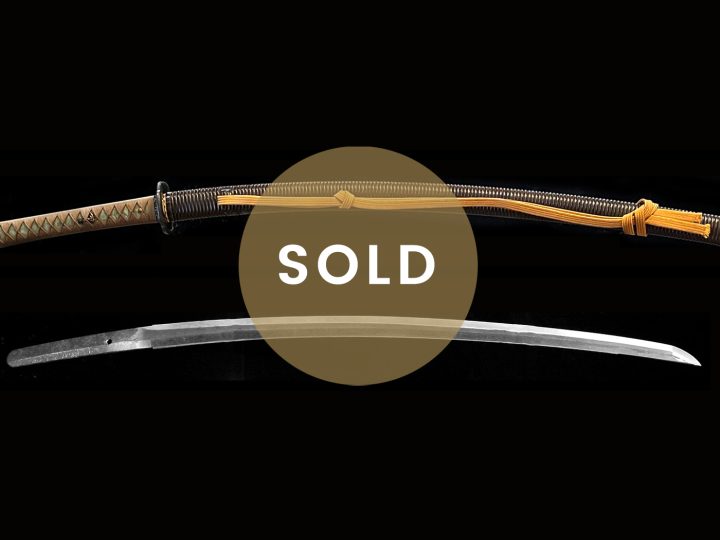


During the middle of the Kamakura period, Bizen-Den swordmaking was dominant, and saw the rise of great smiths in Fukuoka Ichimonji (福岡一文字) school , as well as Mitsutada (光忠) and Moriie (守家) in the Osafune Bizen (備前長船)school. Mitsutada (光忠) is considered the founder of the Osafune (長船) school which would last into the Shinto period. Moriie (守家) is the founder of the Hatakeda (畠田) Bizen Hatakeda school though he seems to have worked in Osafune as well. Hatakeda (畠田) is a town adjacent to Osafune (長船) or else a subdivision of Osafune itself. Moriie is ranked atsaijo-saku (grand-master skill level) by Fujishiro putting him on par with Mitsutada (光忠) and Nagamitsu (長光)and other top quality smiths.
Moriie (守家) is also called Hatakeda Moriie (畠田守家) since he lived in Hatakeda of Bizen Province. Though there is no extant work of Moriie of which signature includes Hatakeda-jū (畠田住), there are some extant works with Osafune-jū (長船住) as part of his signature. For this reason, it appears that Hatakeda could have been considered to have been a section of Osafune Village or the Hatakeda School was merged with the Osafune School at some point. Without a doubt, Moriie (守家) demonstrated a similar (and gorgeous) workmanship to those of Mitsutada (光忠) and Nagamitsu (長光)of the Osafune School. According to the NBTHK, however, his work differs from theirs’ in that his gunome and distinctkawazu-no-ko chôji are more emphasized in his hamon.
The first generation Hatakeda Moriie (畠田守家) working time corresponds around 1259. As has been stated, this would make him a contemporary of Bizen Mitsutada (備前光忠)who was born in the first half of the 13th century and who’s production period is said to have begun when he founded the Osafune School (長船) around Ryaku-nin (1238). There are dated works ascribed to the second generation Moriie (守家) which place him close to 1280. The second generation Moriie’s (守家) work can also be singled out by a slender shape to the sword as well as a hamon based more on gunome than on choji. These are features more similar to Nagamitsu (長光), with the Shodai’s work being more similar to Mitsutada (光忠). The NBTHK has in the past separated Moriie (守家) generations by denoting works of Shodai Moriie (implicitly the first generation), then explicitly noted second generation, and all others are marked as a group of “later generation” works.
Both Moriie (守家) and Mitsutada (光忠) worked in similar forms to the Fukuoka Ichimonji (福岡一文字) smiths. They made a florid chôji midare hamon with utsuri, and the sugata is masculine with a squarish ikubi kissaki and a wide body throughout the blade. Moriie (守家) is famous for a particular style of chôji where the head of the chôji separates off from the body underneath it (tadpole chôji, or kawazu-no-ko). His forging follows a style of itame that stands out clearly.
Moriie’s (守家) father is said to be a smith called Morichika (守近) of the Fukuoka Ichimonji school, but this smith’s works are now lost. Moriie (守家) would give his name to several following generations, as well as teaching other master smiths such as Sanemori (真守) and Morishige (守重). Sanemori (真守) left dated work of 1277 and 1289, and is supposed to be a son or grandson of Moriie (守家). Morishige’s (守重) student was Motoshige (元重), the second generation of which would also be very famous and is thought to be one of the Sadamune Santetsu (貞宗三哲) (three great students of Sadamune).
As for Moriie (守家), there are some differing opinions between first and second generation work, with some advocating for one smith and others for a two smith theory. The difference is that the second generation is sometimes thought to mostly sign in a smaller signature. Tanobe sensei does not necessarily agree with this partitioning only on the size of the signature. However it is more strongly held that a long signature style starting with Osafune ju is certainly work of the second generation.
It is said that the large mei are the shodai, and the small mei are the nidai, but even if it is one with a small mei like the one in the Tokyo National Museum, they are splendid works that are not inferior to those with a large mei. As for the mei on the pieces that are thought to be by the shodai, there are three types: Moriie (守家) , Moriie Tsukuru (守家造), and Moriie (kao)(守家) (花押). – Nihonto Koza
“It seems evident, therefore, that the size of the mei does not necessarily determine as to which generation Moriie’s works belong to. Some say the different sizes all represent one and the same smith at different times. This point needs clarification pending further research.” – Tanobe Michihiro, NBTHK Token Bijutsu.
There are 50 Juyo works by Moriie (守家). Six of those that passed Juyo went on to pass Tokubetsu Juyo. Another 9 works are Juyo Bijutsuhin. Three works of his were Kokuho before the war, and are now included amongst 12 total Juyo Bunkazai. All of this says that Moriie (守家) is deeply respected, and his work is quite difficult to come by as the total existing that are legal to export from Japan is relatively small.
The following according are some notes on the work style of Hatakeda Moriie (畠田守家):
Sugata: Tachi are the most common, tantô are extremely rare. In fact there is believed to be only one signed tantôby Moriie in existence. (It will be described in detail later in this paper)- Editor’s note. Remember, tantômade in the middle Kamakura era are extremely rare as a whole. Tachi are koshizori, and there are pieces in which the sori is fairly shallow, ones in which the kissaki is elongated, and ones in which the mihaba is slender and are ko-kissaki.
Jitetsu: Itame hada is tight, with ji-nie, and are splendid works. There is ji-utsuri, but it is not as remarkable as that of Nagamitsu (長光). On some tachi the itame will be mixed with outstanding nagare-hada (partially straight grain) and also contain some mokume is places. As noted, midare-utsuri will be present.
Hamon: It is usually o-chôji midare. It looks like that of Mitsutada (光忠) or Nagamitsu (長光), but Moriie’s chôjiis called kawazuko chôji (tadpole shaped chôji). While the hamon will be basically nioi based chôji, there will be a sprinkling here and there of ko-nie and gunome will also be found. Generally speaking, the nioiline is wide (nioi fukai), there are also some with nie, and there is an abundance of nioi ashi in the midareba. There are also ashi as well as the fore-mentioned kawazu-no-ko-chôji appearing anywhere but most outstandingly near the koshi-moto (the area just above the nakago).
Bôshi: Those that are midarekomi and return in ko-maru are the most common, and rarely, there is one that is yakizume style. Also the appearance of hakikake will be found on occasion.
Nakago: They are of excellent quality, long, have niku, and there are also kiji momo. The yasuri is katte sagari.
Mei: Moriie (守家) or Moriie Saku (守家作) are the most common and they are inscribed in large tachi mei. There are very few with a nengo mei.
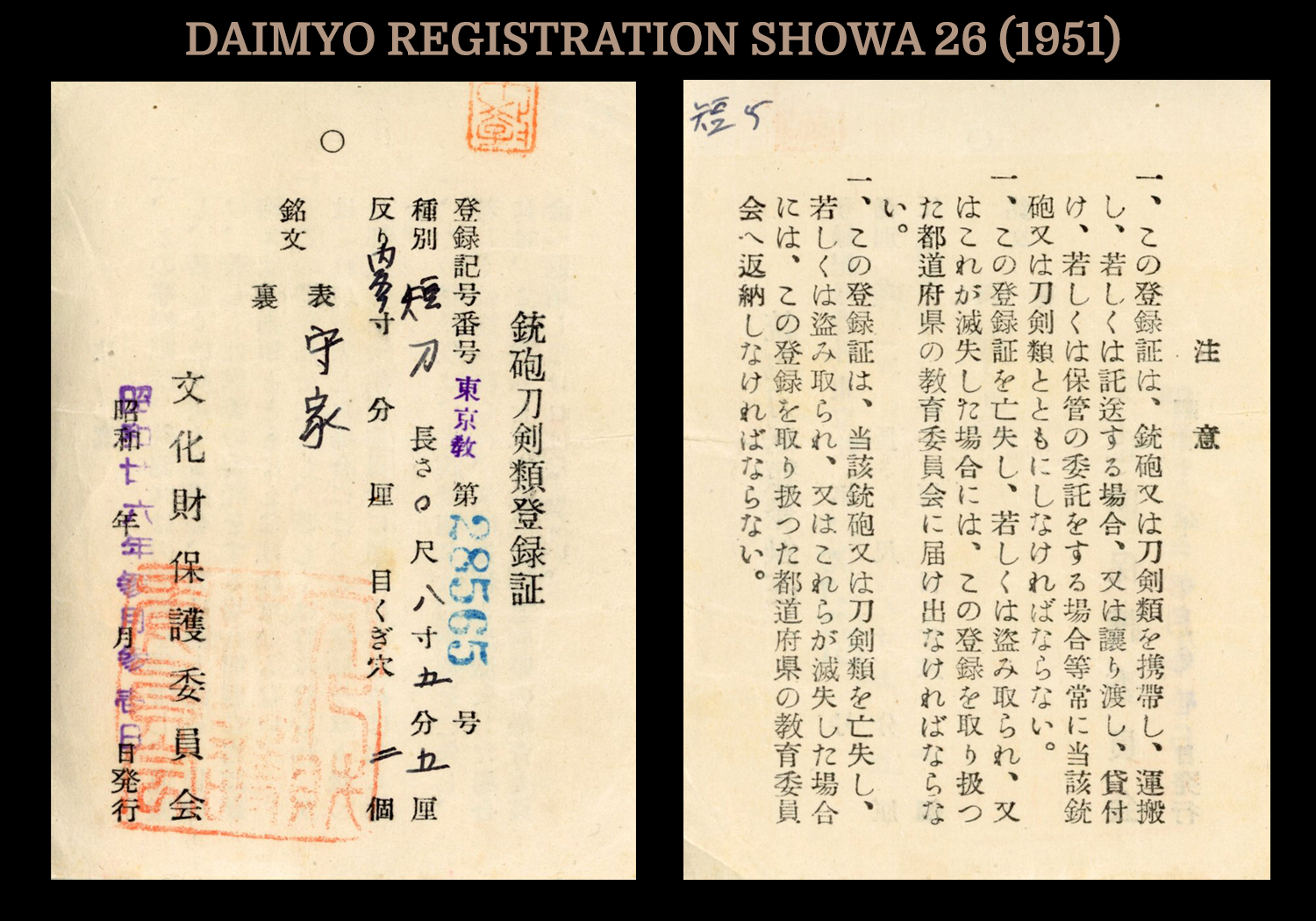
Of special note is the fact in 1951 when the government required that all swords must be registered, they began by registering all the swords that were in the possession of the former Daimyô families. This tantô was, in fact, one of the swords that was registered in that very year which is a testament to the high ranking of its owner at that time. A copy of the original registration document is shown below.
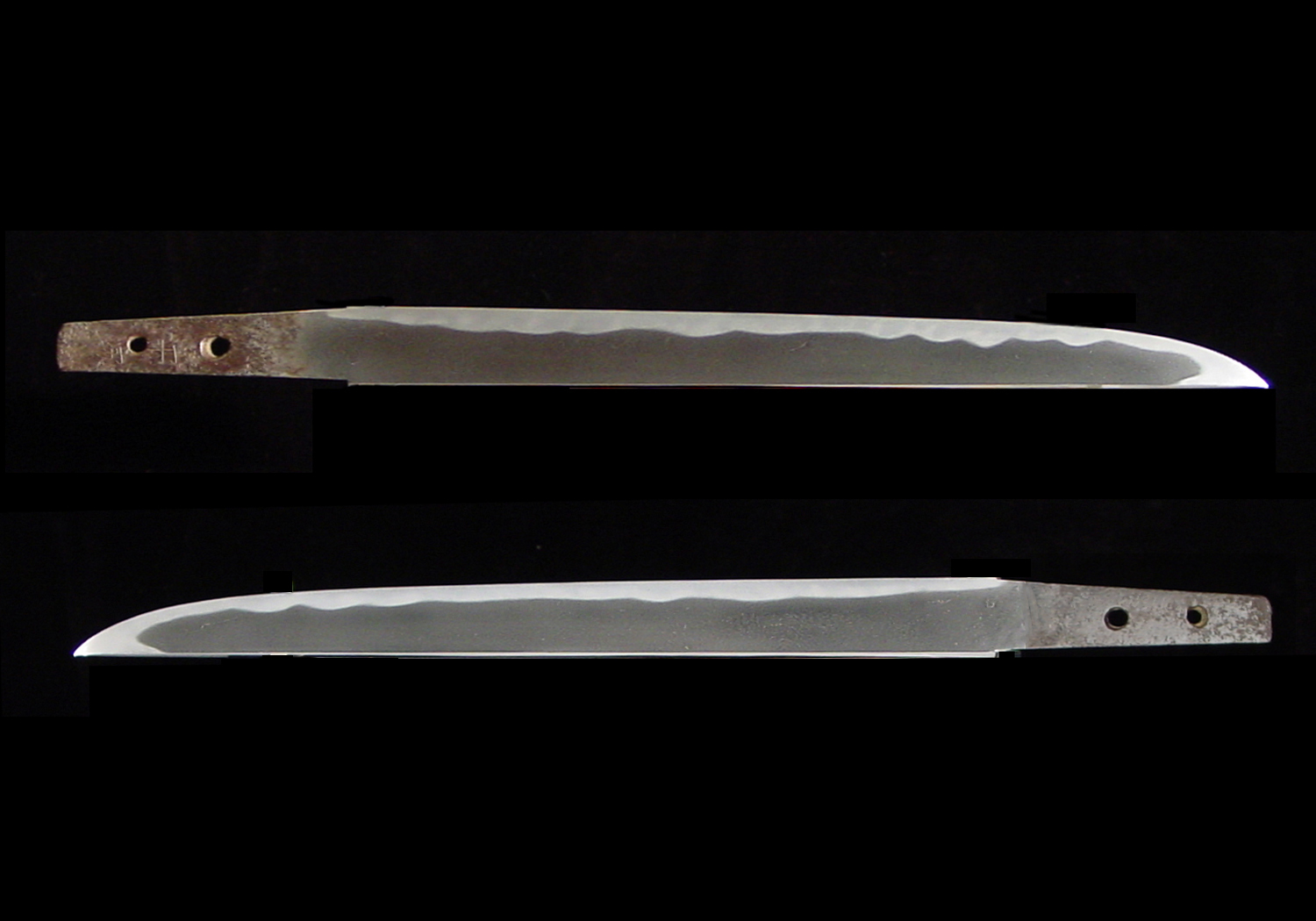
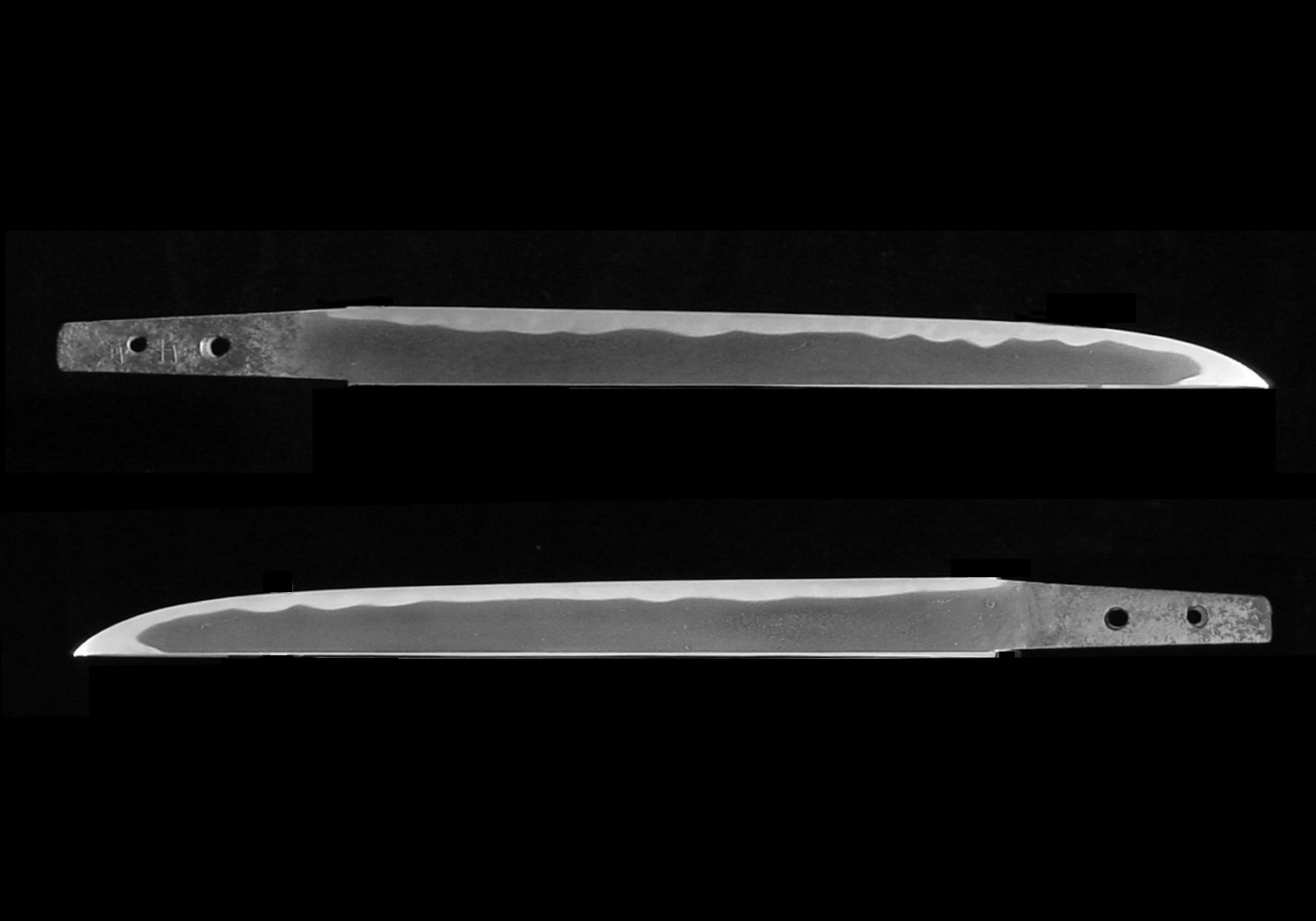
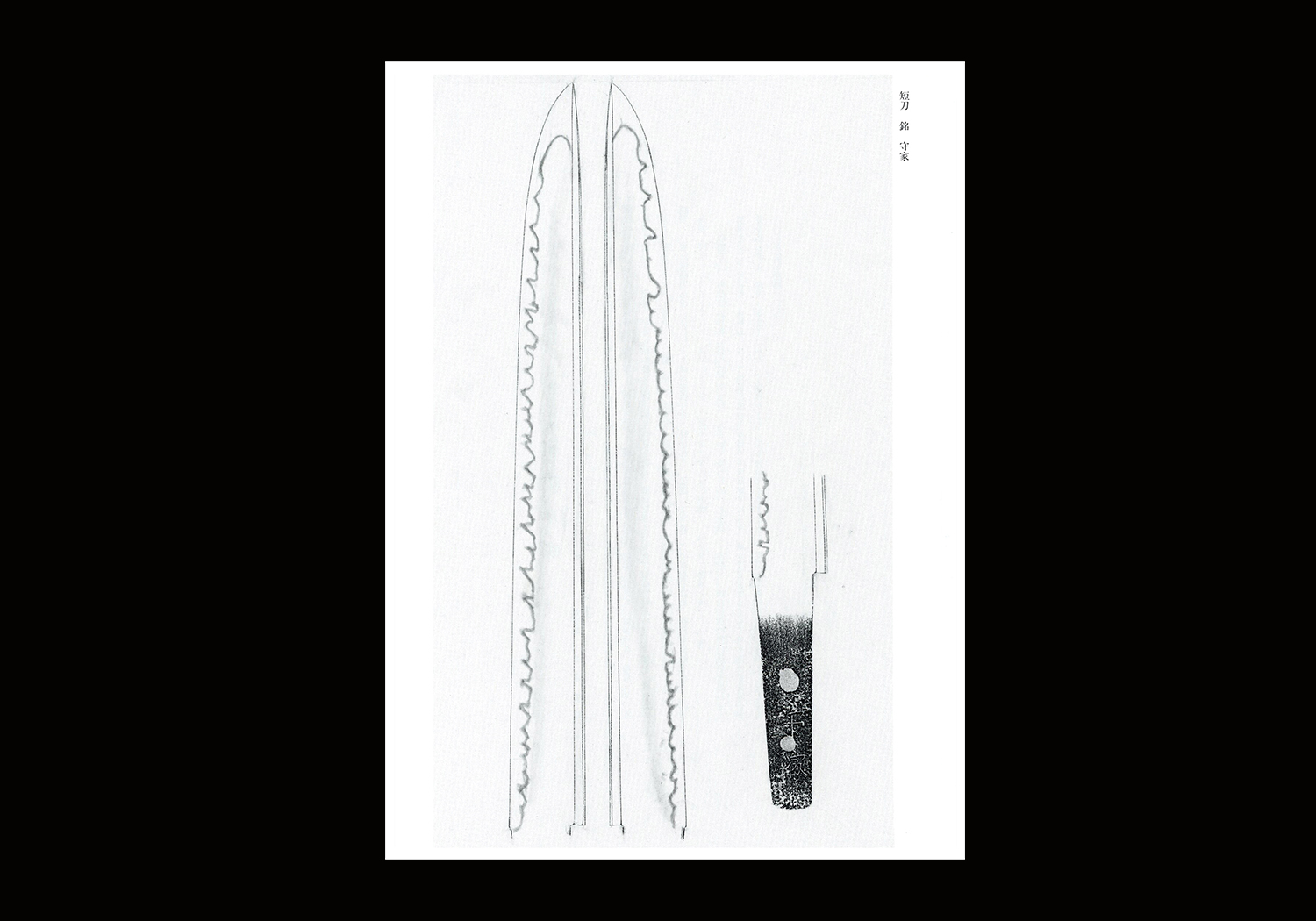
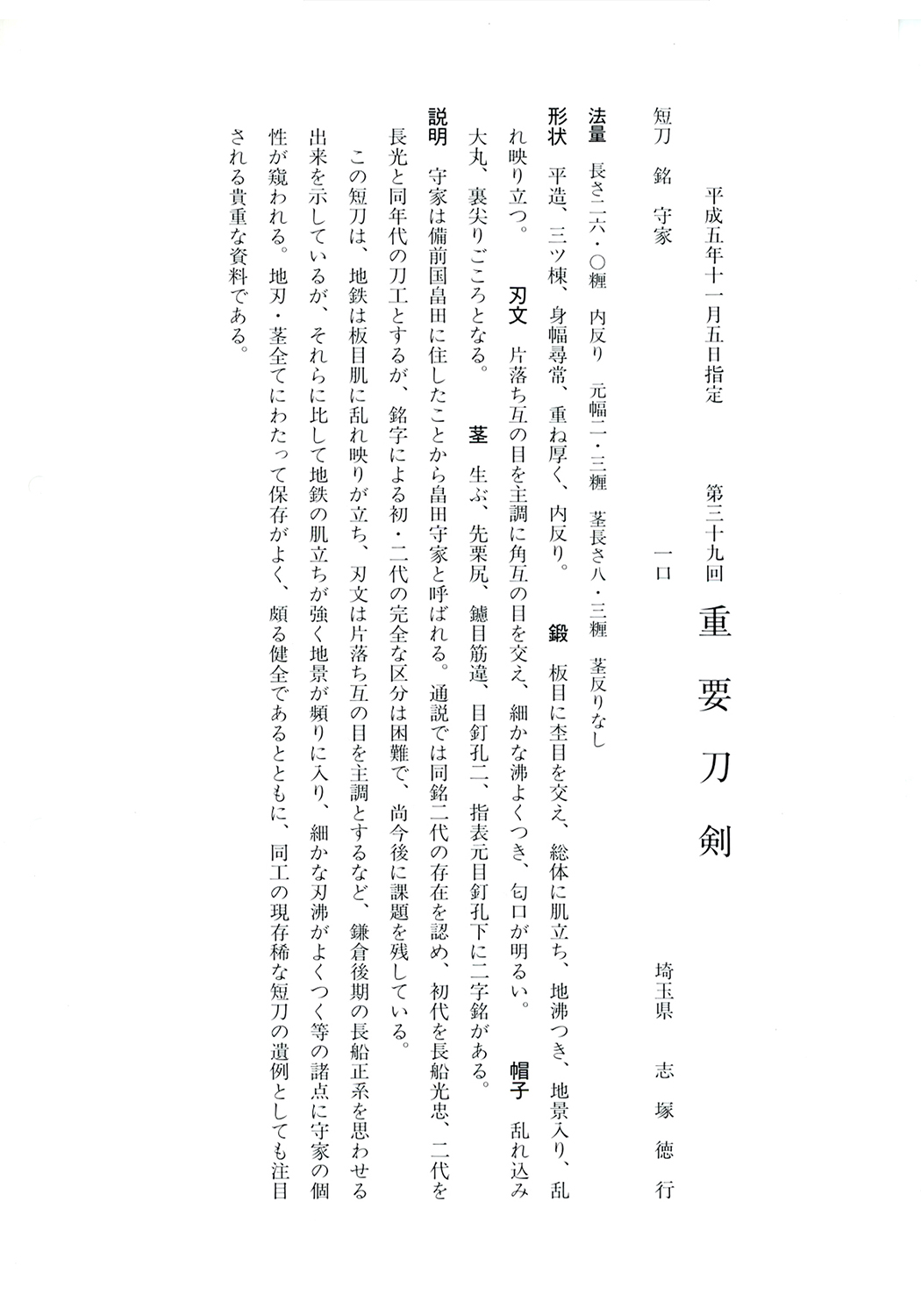
The tantô offered here blade is reputedly the only existing signed tantô by Moriie. It once belonged to the Yamanouchi (⼭内) family, who were the Daimyō of the Tosa fief on Shikoku. It was awarded the coveted rank of Jûyô Tôken (Important Sword) at the 39th Jûyô shinsa in 1993. The translation of the Jûyô certification is as follows:
Jūyō-Tōken at the 39th Jūyō Shinsa from November 5, 1993
Tantō, mei: Moriie (守家)
Measurements:
Nagasa 26.0 cm, uchizori, motohaba 2.3 cm, nakago-nagasa 8.3 cm, no nakago-sori
Description:
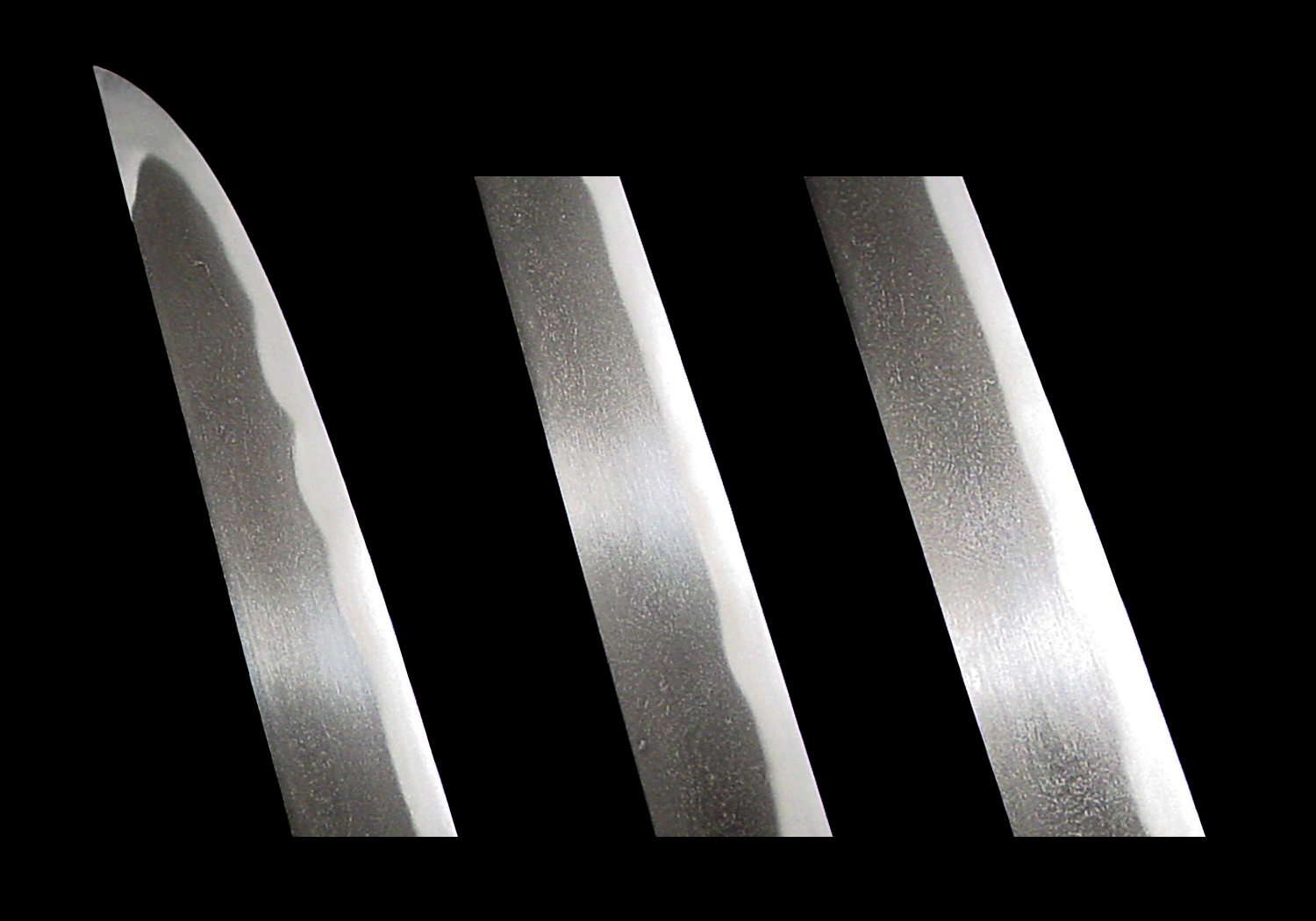
Keijō: Hira-zukuri, mitsu-mune, normal mihaba, thick kasane, uchizori
Kitae: Overall standing-out itame that is mixed with mokume and that features ji-nie, chikei, and a midare-utsuri
Hamon: Finely nie-laden kataochi-gunome-chō with a bright nioiguchi that is mixed with angular Gunome
Bōshi: Midare-komi with an ō-maru-kaeri that is somewhat pointed on the ura side
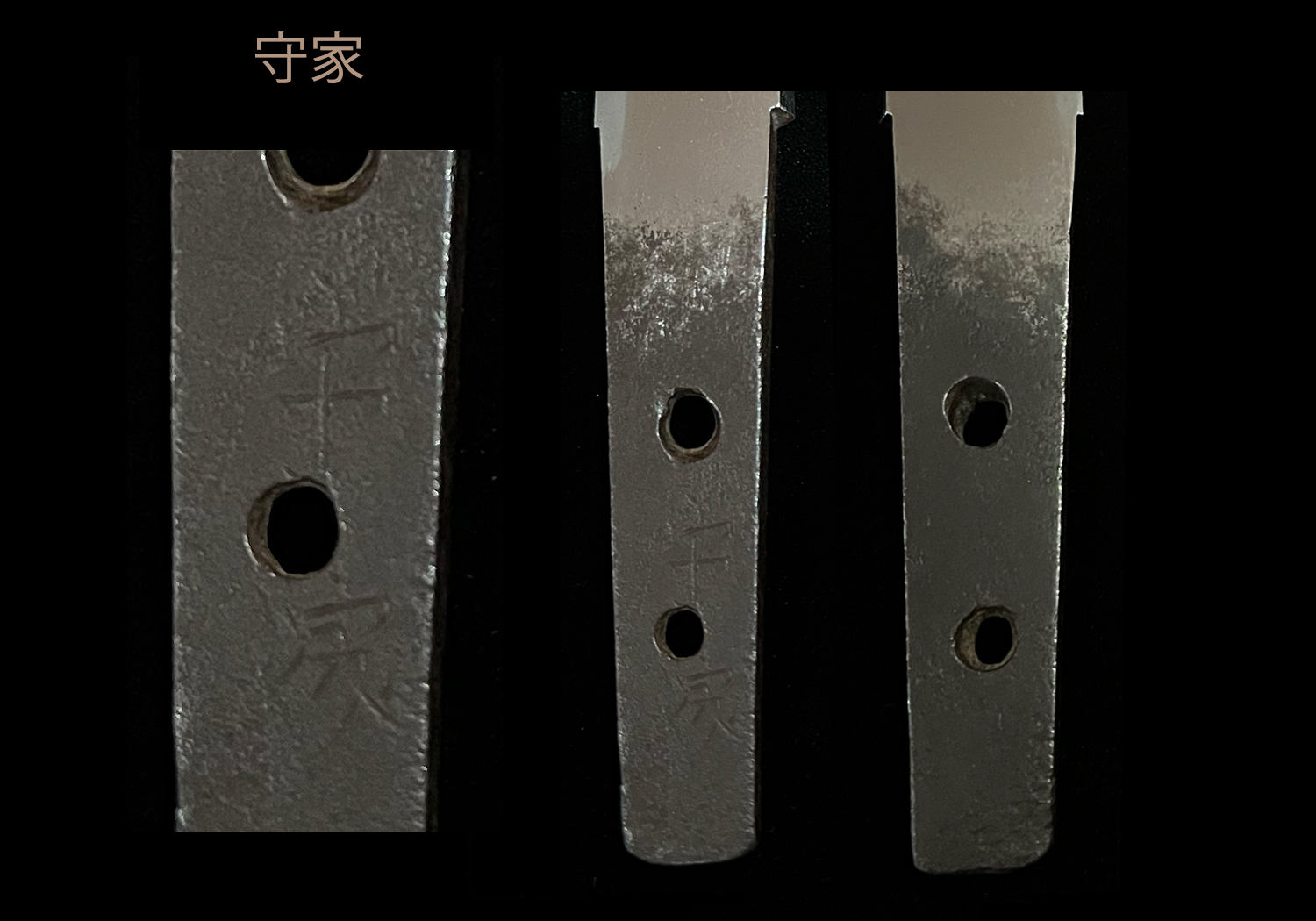
Nakago: Ubu, kurijiri, sujikai-yasurime, two mekugi-ana, the sashi-omote side bears below of the first mekugi-ana aniji-mei
Explanation:
As Moriie (守家) was residing in Hatakeda (畠⽥) in Bizen province, he is referred to as Hatakeda Moriie. It istraditionally believed that there were two generations, with the first master being a contemporary of Osafune Mitsutada(光忠), and the second a contemporary of Nagamitsu (⻑光). However, it is difficult to distinguish between the first and the second generation on the basis of signature style, hence further study is necessary on this issue.
This tantō displays a jigane in itame with a midare-utsuri, and a hamon that is based on kataochi- gunome, an interpretation that suggests the Osafune main line from the end of the Kamakura period. However, the hada stands more out and there is more prominent chikei, and with the abundance of fine ha-nie and other elements, the blade does alsoreflect the typical characteristics of Moriie. The condition of the jiba and of the tang is excellent and the blade isstrikingly healthy (kenzen), and it must also be pointed out that we have here a very important reference as tantō by this smith are very rare.
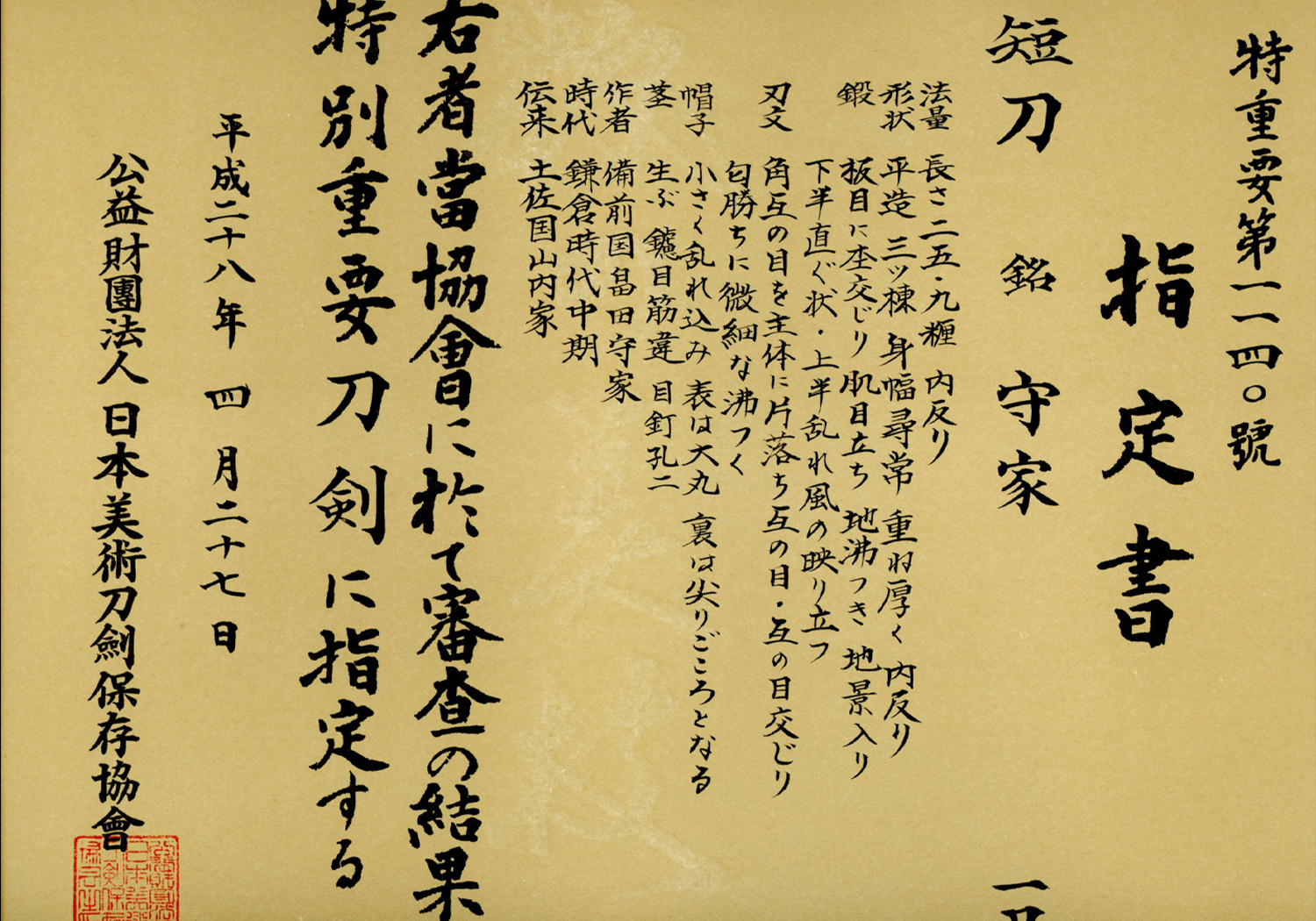
In April of 2016, this tantô was submitted to the NBTHK for elevation to their highest rank of Tokubetsu Jûyô Tôken (Especially Important Sword) and it passed. The translation of the Tokubetsu Jûyô Tôken certification is as follows below:
Tokubetsu-Jūyō Tōken at the 24th Tokubetsu-Jūyō Shinsa held on April 27, 2016
Tantō, mei: Moriie (守家)
Measurements:
Nagasa 25.8 cm, uchizori, motohaba 2.2 cm, nakago-nagasa 8.3 cm, no nakago-sori.
Description:
Keijo: Hira-zukuri, mitsu-mune, normal mihaba, thick kasane, uchizori.
Kitae: Standing-out itame that is mixed with mokume and that features ji-nie, chikei, along the bottom half a sugu-utsuri, and along the upper half a midare-like utsuri.
Hamon: Based on angular gunome in nioi-deki with fine nie and mixed with kataochi-gunome and regular gunome.
Bōshi: A little bit midare-komi with an ō-maru-kaeri on the omote side and with a somewhat pointed kaeri on theura side.
Nakago: Ubu, tip slightly cut off, very shallow kurijiri, sujikai-yasurime, two mekugi-ana, there is a finely chiseled niji-mei positioned towards the nakago-mune and having the second mekugi-ana between the two characters.
Artisan: Hatakeda Moriie from Bizen province
Era: Mid-Kamakura period
Provenance: Yamanouchi family from Tosa province
Explanation:
As Moriie (守家) was residing in Hatakeda (畠⽥) in Bizen province, he is referred to as Hatakeda Moriie. It istraditionally believed that there were two generations, with the first master being a contemporary of Osafune Mitsutada(光忠), and the second a contemporary of Nagamitsu (⻑光). However, further study is necessary to differentiate the two generations with certainty, and also the theory has been forwarded that there was actually one maker with this name. The workmanship of Moriie is in general similar to the style of Osafune swordsmiths of that time period, but withcharacteristic features being a standing-out jigane and a hamon that is mixed with a prominent amount of kawazu-no-ko-chōji.
Neither mihaba, kasane, or nagasa of this blade is exaggerated, which means the tantō is of a harmonious sugata. The kitae clearly stands out and features much chikei and an abundance in hataraki in general. Particular notice must be taken of the interpretation of the hamon. That is, Moriie usually hardened a ha with prominent undulations that is mixed with kawazu no ko-chōji with narrow bases, but in case of this blade, the ha is based on an angular gunome that is usually seen with Osafune works from the late to the end of the Kamakura period. A close resemblance can be seen withtantō of Nagamitsu dated with the eras Kōan (弘安, 1278–1288) and Einin (永仁, 1293–1299), which means that we arefacing here a work from the late phase of Moriie that is truly an important reference in terms of representing a forerunner of said Osafune style.
Apart from that, not only is a signed tantô by this maker very, very rare, but also it is an inevitable reference for corroborating the traditional succession of smiths that is believed to have been Moriie (守家) → Morishige (守重) → Motoshige (元重). Also, during the Edo period, this tantō was a heirloom of the Yamanouchi (⼭内) family, who were the Daimyō of the Tosa fief.
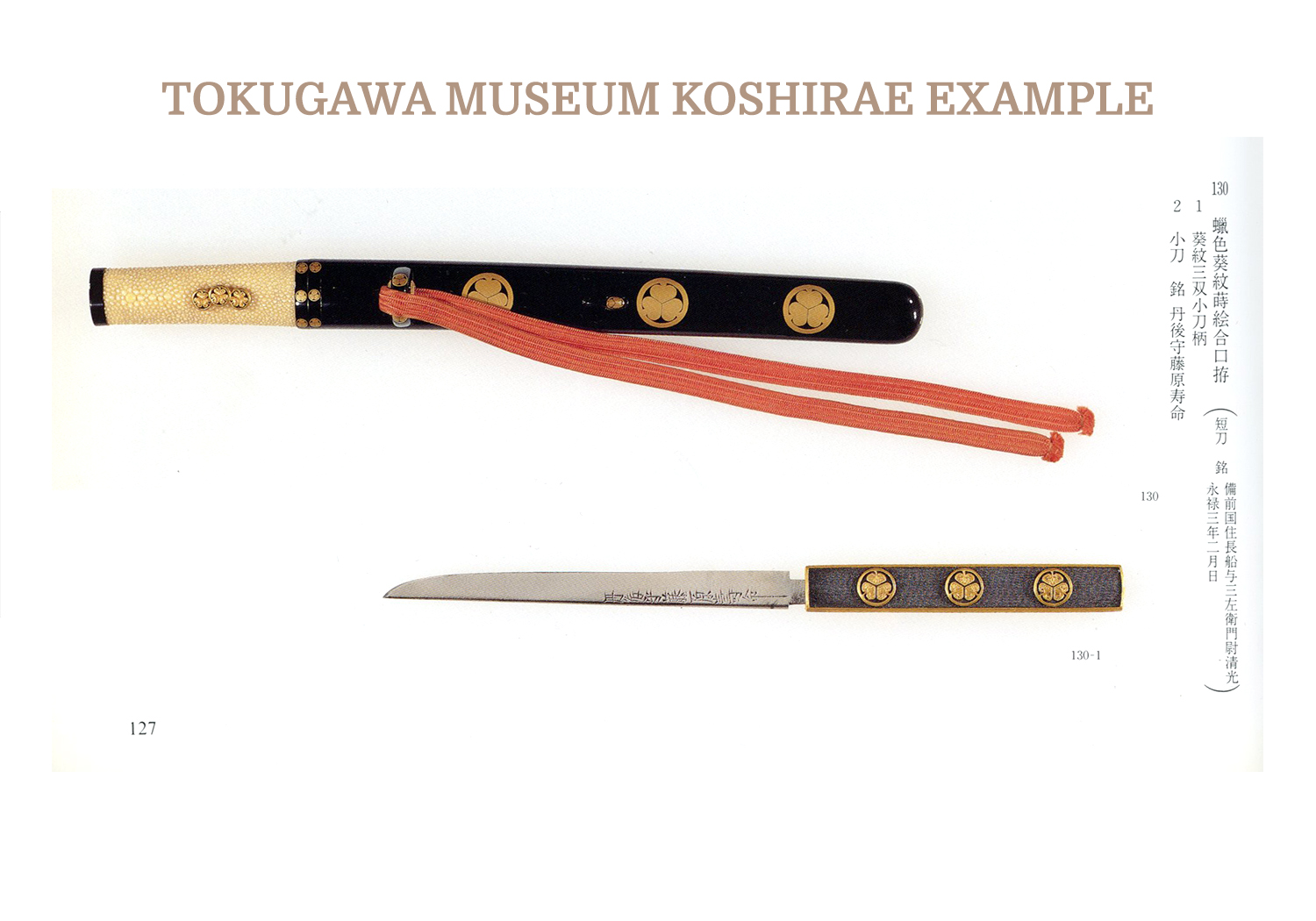
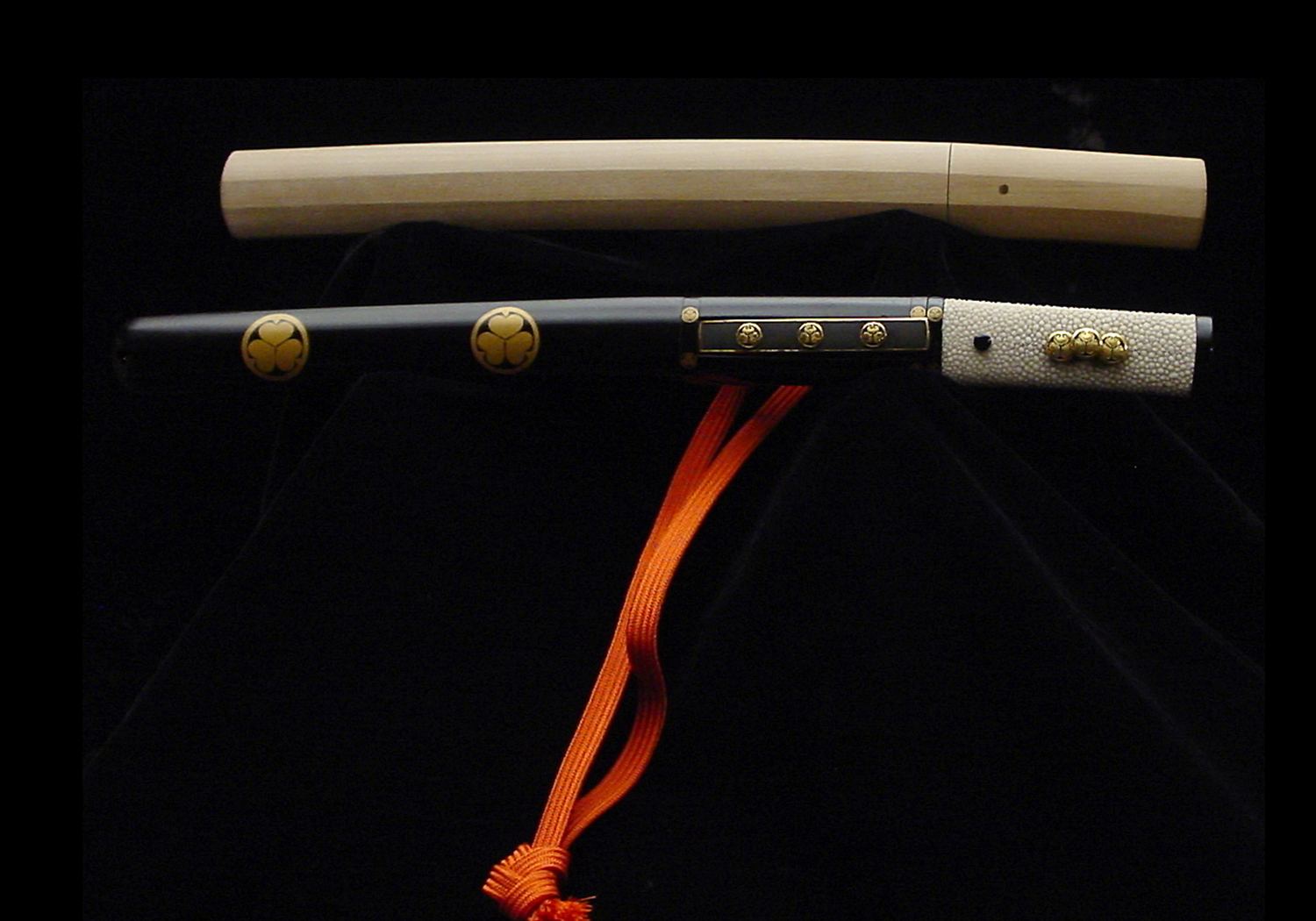
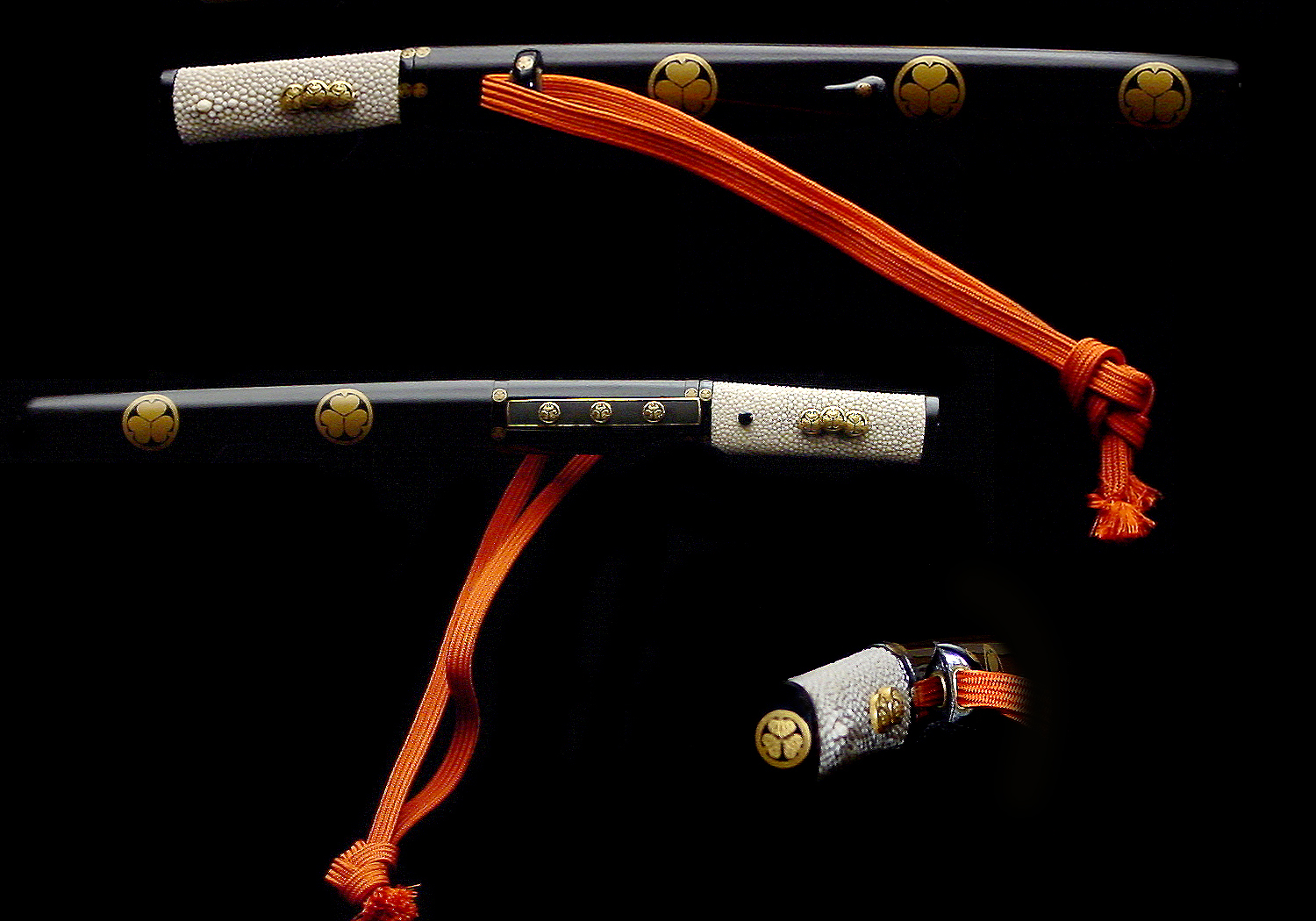
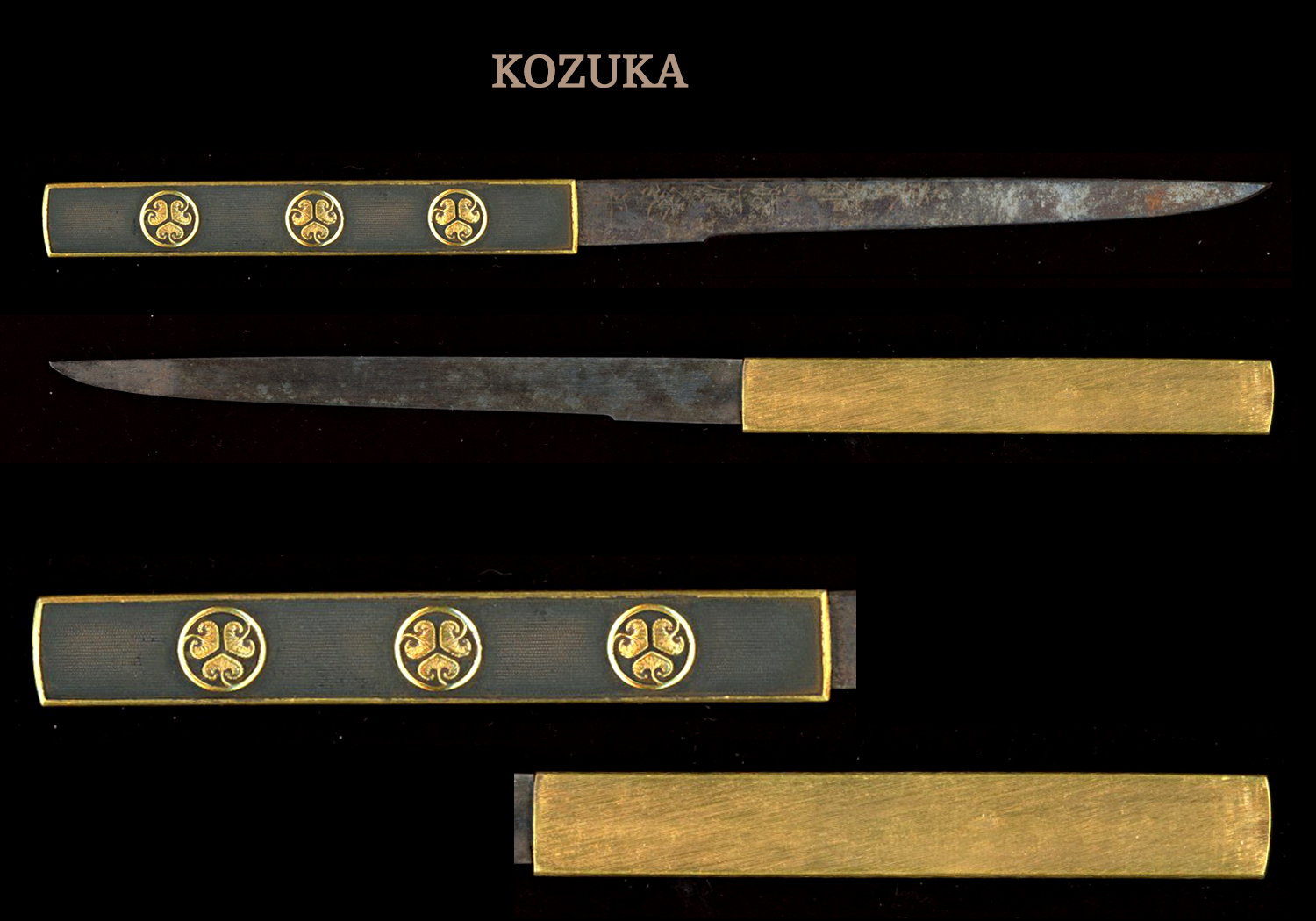
This tantô comes with a lovely koshirae. That is an exact duplicate for a tantô koshirae shown on a blade in the Owari Tokugawa collection. It is simple yet tasteful with 21 Tokugawa mon in gold lacquer on a black lacquer background. Each of the two gold menuki on the same wrapping the tsuka (handle) are also comprised of three Tokugawa mon. This makes a total of 27 Tokugawa mon on this tantô koshirae. Since the two tantô koshirae are exactly the same, it is logical to conclude that this Moriie tantô also, at one time, belonged to the Owari Tokugawa family and was, during the Edo era, gifted by the Tokugawa to the Yamanouchi Daimyô family of Tosa where it remained until after the Meiji Restoration when it went into private hands.
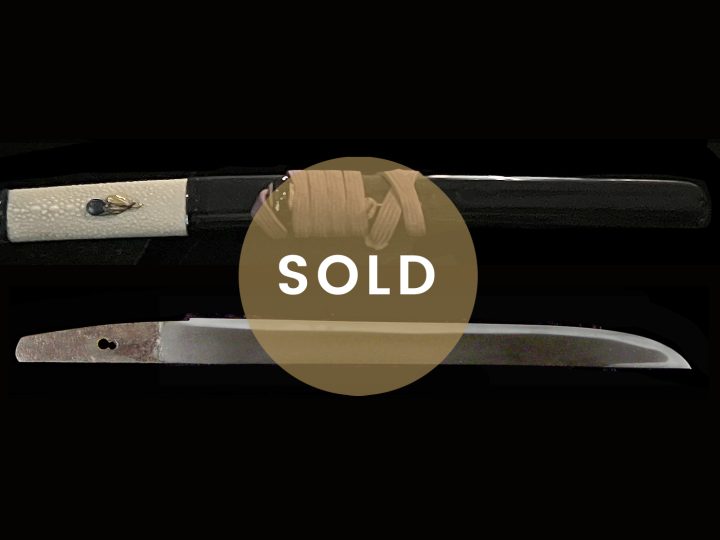
SOLD




KOSHIRAE
NBTHK JÛYÔ TÔKEN CERTIFICATION DOCUMENTS
NBTHK TOKUBETSU JÛYÔ TÔKEN CERTIFICATION DOCUMENTS