
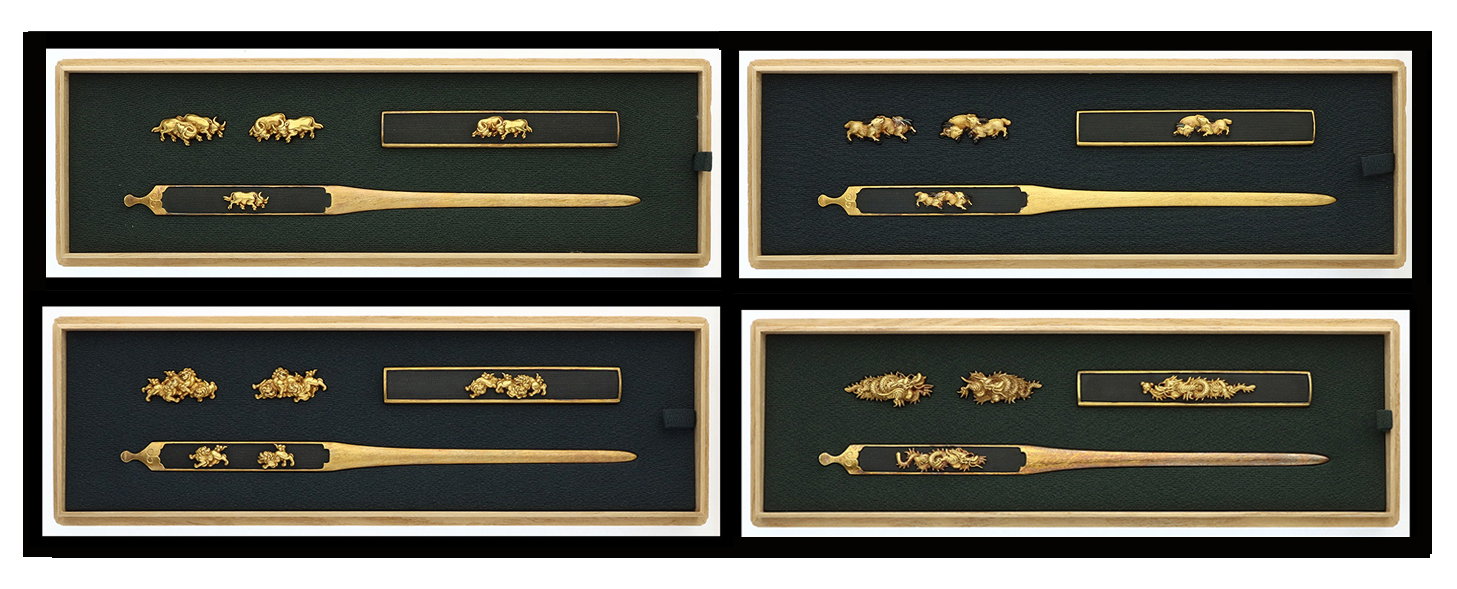
Nihonto.com is proud to present for sale a superb collection of four gold and shakudo mitokoromono each one by one of the Shirôbei mainline Gotô masters. They are as follows:
Gotô Kôjô 4th generation
Gotô Tokujô 5th generation
Gotô Teijô 9th generation
Gotô Jujô 12th generation
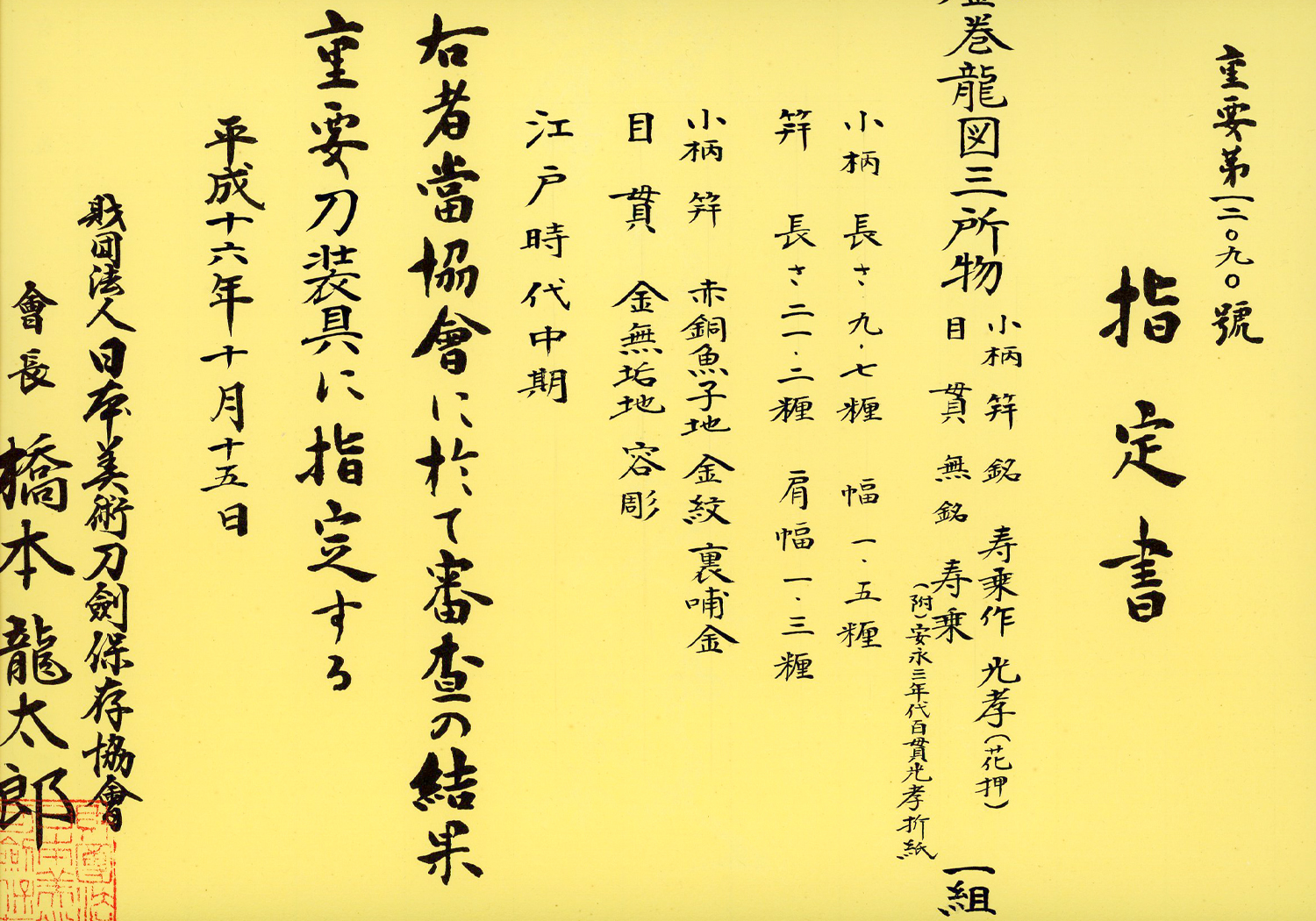
All of these sets have been awarded the rank of Jûyô tôsogu by the NBTHK and all were formally in the former collection of the famous Kônoike family. They come not only with the appropriate Jûyô certification from the NBTHK, but also the original certification (origami) by the 13 generation mainline Gotô master Mitsutaka (光孝), also known as Gotô Enjô (延乗). These origami are dated 1774-1776 and have the well known outer blue paper marking them as part of the collection of the Kônoike family, famous Edo period merchants for hundreds of years.
GOTÔ KÔJÔ (1529-1620) 後藤光乗
4th Mainline Master
Gotô Kôjô was born in the second year of Kyôroku (1529). He was the son of the third generation master of the mainline Gotô family, Gotô Jôshin (乗真). His childhood name was Koichirô (小一郎), followed by (亀市), and Shirobei; his civilian first name was later Mitsuie (光家). There are works extant which are signed both Kôjô and Mitsue. Kôjô, like his father, held the rank of Hôgen in his later years. He died on the 14th day of the third month of the sixth year of Genna (1620), at the age of 92. Interestingly, Nobunaga ordered Kôjô to take on the production of oban coins, a task which shortly thereafter turned into an official post to be held by the Gotô main line until the end of the Edo period. It was also at the time of Kôjô when the family code left by his father, Jôshin, the Sadame Jôjô Hatto (定条条法度), was exactly defined. It is assumed that the uncertainty right after the end of the Shogunate era and the shift between powers; forced the then head of the Gotô to guide his family through this difficult time. It regulated precisely the big system Gotô by defining in detail hierarchy and relationships. Kôjô had three children: his first son and heir, Tokujô (also known as Shimo-Gotô (下後藤), his second son, Chôjô (also known as Kami-Gotô (上後藤), and his daughter, Myôchi (妙智), who died on the twentieth day of August in the second year of Keichô (1597).
Unlike his father, Joshin’s, large and magnificent interpretations, Kôjô turned towards smaller, more picturesque but nevertheless excellently worked motifs. Another specialty of his was the inclusion of figures and warriors in his work, something that was unusual for the Gotô and rarely seen from his three predecessors. As for color, he started with the traditional mechanical uttori-iroe, but later he worked more in the new technique of thermal iroe with soldering (rô 鑞). Menuki of pure gold are thin but those of shakudo are thick, as was the case with the kami-sandai (the first three generations of Gotô). The backs usually have an inyô-kon (stems) but work without stems are also known. As his menuki are smaller, the stems on the back look larger and are usually quite short. Dragons and shishi are delicately worked and a bit smaller than those of Yûjô (the first generation). In the case of dragons, the horns, the area around the mouth and the paws of the front and hind legs are accentuated by numerous triangular carvings. The distribution of niku is skillfully done.[1]
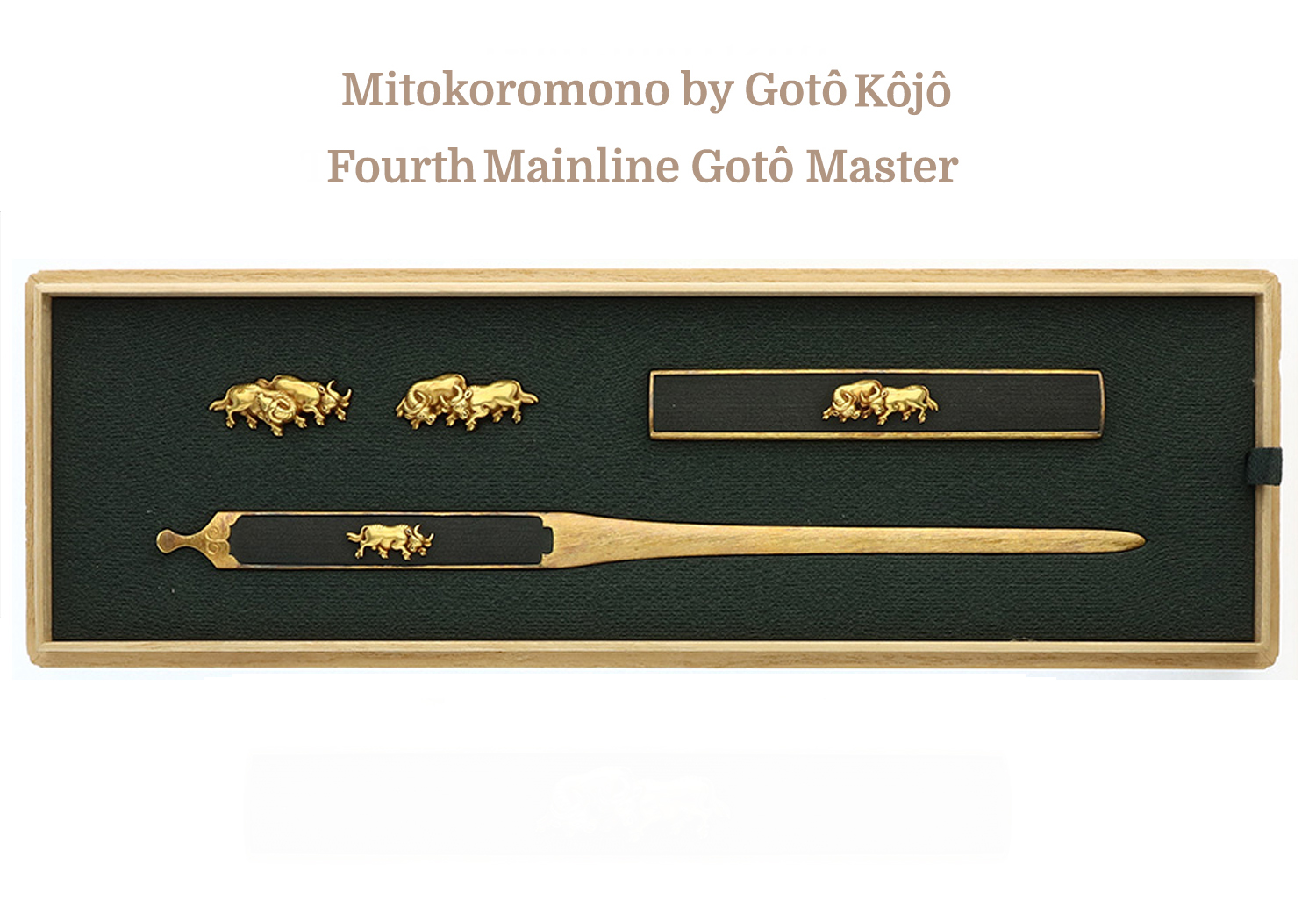
This outstanding mitokoromono set being offered for sale was made Jūyō-Tōsōgu at the 53rd Jūyō Shinsa held on October 24, 2007. A full translation of the Jûyô setsumei is as follows:
Jūyō-Tōsōgu at the 53rd Jūyō Shinsa from October 24, 2007
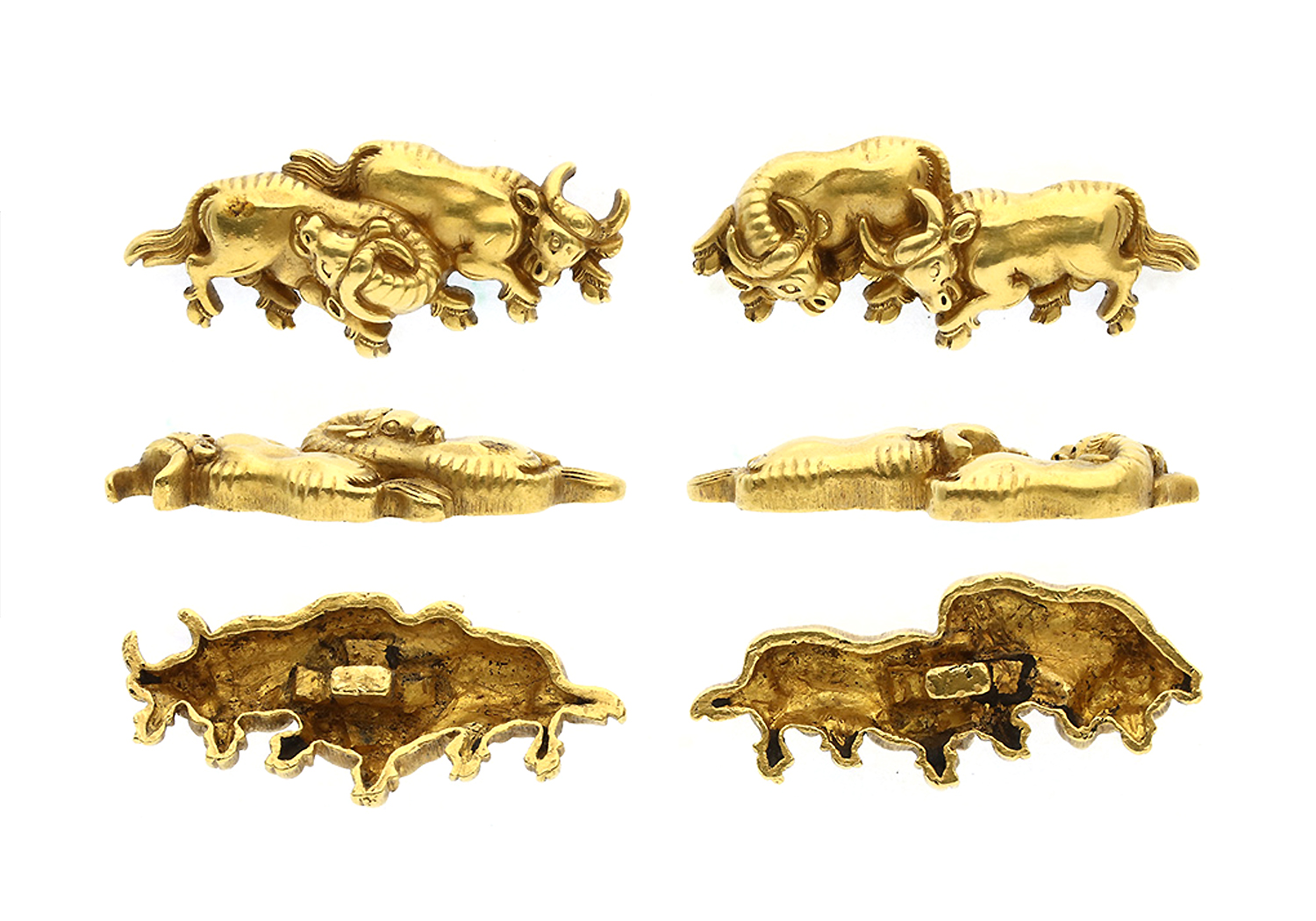
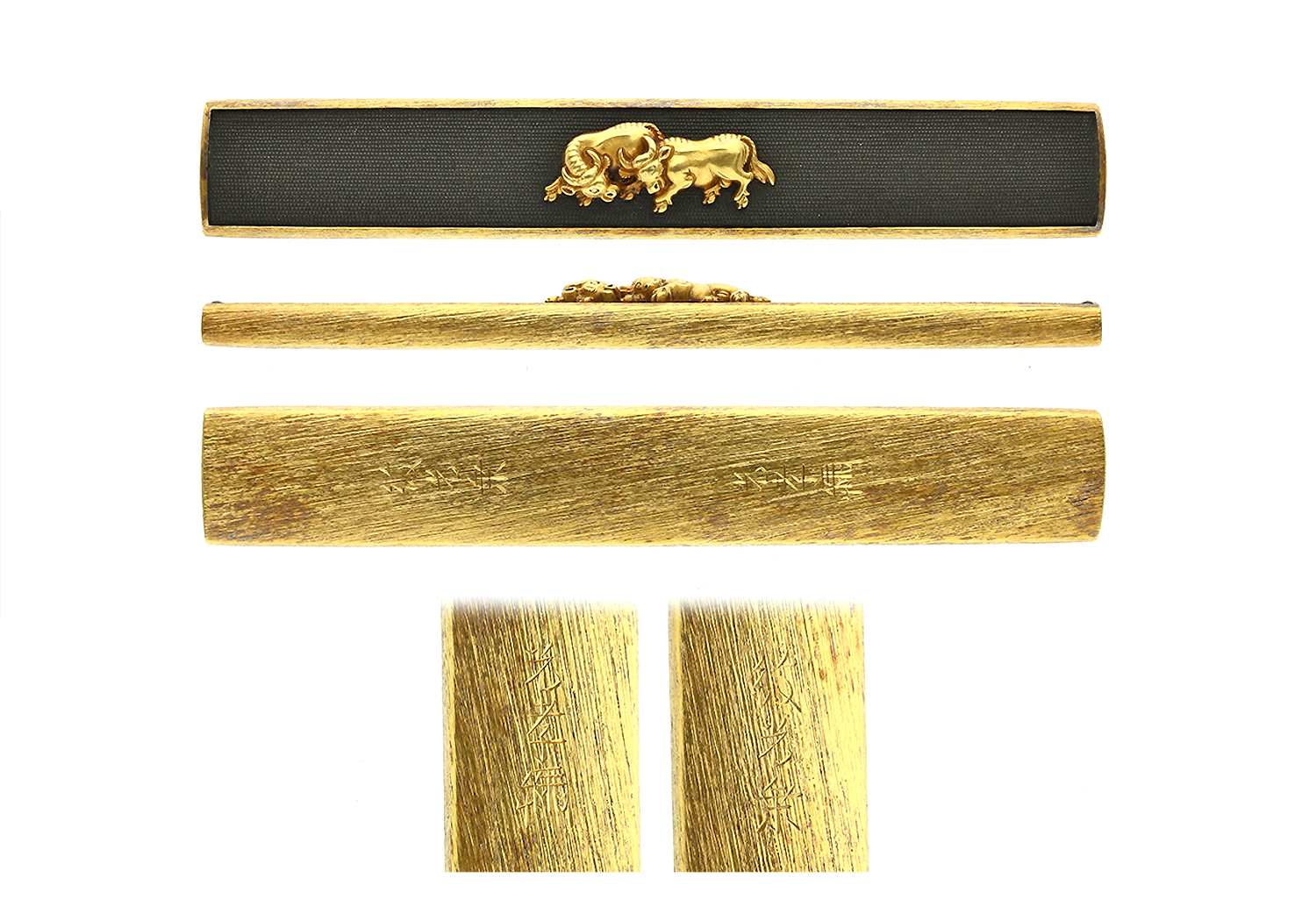
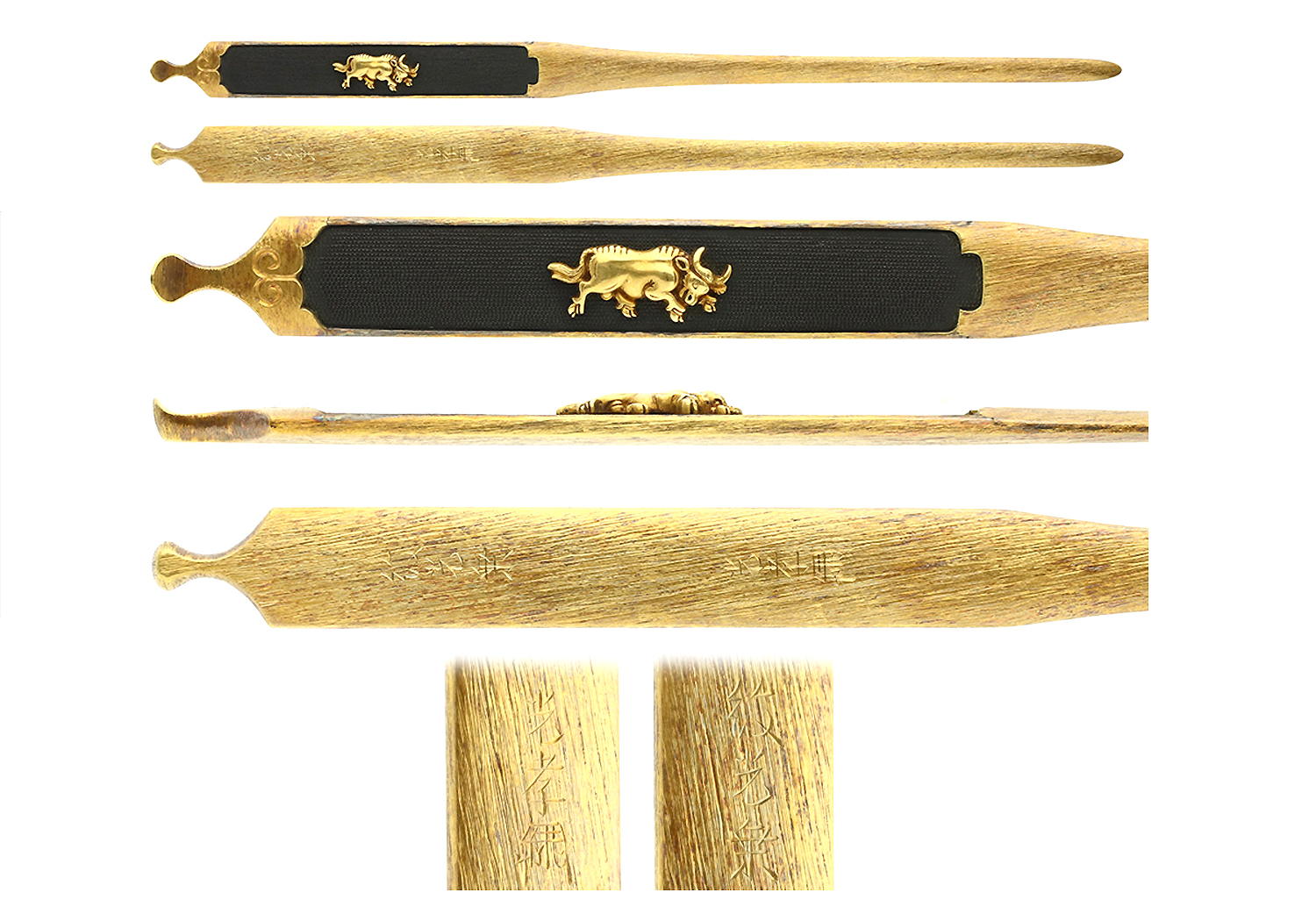
Ushi no zu mitokoromono (牛図三所物) – Mitokoromono depicting oxen
Kozuka and kōgai, mei: Mon Kōjō Mitsutaka + kaō (紋光乗 光孝「花押」) – “Motif elements by Kōjō, [authenticated so by] Mitsutaka + monogram” Menuki, mumei: Kōjō (光乗) (w/ Mitsutaka origami from An’ei five [1776] evaluating it with 200 kan)
Measurements
Kozuka length 9.73 cm, width 1.5 cm; kōgai length 21.2 cm, width at shoulder 1.34 cm
Interpretation
Kozuka and kōgai of shakudō with nanako ground, kinmon motif elements, and gilded reverses; menuki of solid gold and in katachibori
Era
Momoyama period
Explanation
Kōjō (光乗), the fourth mainline generation of the Gotō (後藤) School, was the eldest son and heir of the third generation Jōshin (乗真) and was born in Kyōroku two (享禄, 1529). His childhood name was Kameichi (亀市), his first name was Koichirō (小一郎), and his legal name was Mitsuie (光家). Kōjō worked for the family of the Ashikaga Shōgun and later for Oda Nobunaga. In Tenshō nine (天正, 1581), on orders of Nobunaga, he and his son and heir, Tokujō Mitsumoto (徳乗光基), were minting unmarked ōban (worth ten ryō), the world’s largest gold coin. Kōjō was highly skilled and is often ranked right after the first Gotō master Yūjō (祐乗).
The kōgai of this motokoromono set depicts one ox, the kozuka two, and the menuki two each. Each of them have firm figures and are rendered in a vivid manner that is referred to as “tall mountains and deep valleys,” alluding to their accentuated three-dimensionality, which is truly gorgeous, with the small dimension of the motif elements contributing to the impression of seeing them in swift motion. As indicated in the origami, the bases for kōgai and kozuka were made by an artist other than Kōjō, and judging from the shape of the warabite of the kōgai and other factors, it is likely that the foundations go back to the 13th Gotō generation Enjō Mitsutaka (延乗光孝), who issued the origami and authenticated the work via above quoted inscription on kozuka and kōgai. This mitokoromono was once a heirloom of the wealthy Ōsaka merchant family Kōnoike
(鴻池).
[1] Taken from Fukushi Shigeo’s TOSOGU CLASSROOM VOLUME 3 with some editing by the author.
NBTHK JÛYÔ TÔSOGU AND COPY OF GOTÔ ORIGAMI (original to follow)


GOTÔ TOKUJÔ (1550-1631) 後藤徳乗
5th Mainline Master
Tokujô (徳乗) was the eldest son of Gotô Kôjô (光乗). He was born in the 19th year of Tenbun (天文 (1550)) and before he took over the first name Shirôbei, he was called Genjirô (源次郎). He bore the names Mitsumoto (光基), Masafusa (正房), and Masaie (正家) but, unfortunately, there is no work extant signed with any of these names; most of his work was left unsigned. The Gotô family worked since their ancestor, Yujô (祐乗), for the Ashikaga family but at the time of Tokujô, the once mighty clan experienced its end. Due to their outstanding skill, the Gotô masters were able to continue and were subsequently employed by the Ashikaga’s successors, Oda Nobunaga (織田信長), Toyotomi Hideyoshi (豊臣秀吉) and Tokugawa Ieyasu (徳川家康).
Not only did the Gotô continue making exquisite sword fittings for these powerful successors to the Ashikaga, they were also exclusively making gold ôban (large gold coins) and fundô (standardized copper weights used as measurement throughout the country). In fact, the production and use of copper weights made by anyone other than the Gotô family was strictly forbidden by the Bakufu. This Gotô control of the making of gold coinage continued when, in Bunroku four (1595), the smaller gold koban was introduced into the monetary system with a value of one tenth of an ôban.
Due to their employment with Toyotomi Hideyoshi, the Gotô sided with Ishida Mitsunari (石田三成 1560-1600) at Sekigahara and later at the siege of Ôsaka. Since Tokujô and his heir, Eijô sided with the Toyotomi faction, they were consequently placed under house arrest for a while by Ieyasu, a common form of mild punishment for bushi. At that time, Tokujô’s younger brother, Chôjô, was a close friend of Ieyasu so there was a real risk that the Gotô Shirôbei main line of succession and responsibilities would be discontinued by the Bakufu; and all offices transferred to Chôjô and his line of succession. However, Chôjô managed, one year after the fall of Ôsaka in 1616, through negotiation with Ieyasu’s successor, Tokugawa Hidetada (徳川秀忠, 1579-1632), to ensure that the Gotô main line regained all of their land and their annual salary of 250 koku. Unfortunately, he died right after this success, on the 26th day of the third month of the very same year. It is assumed that the strict Gotô family code, Sadame Jôjô Hatto, also played an important role in the Bakufu’s decision to stick with the Shirobei main line.
Tokujô’s motif elements and menuki are a hint larger than those of his father Kôjô and most of his work reflects the grandeur of the Momoyama era (1573-1600). At that time, kôgai and menuki were still most common but kozuka gained greater importance as used in matching mitokoromono sets. This rise in the use of a kozuka was probably in part due to the rise in the use of wearing a daisho of swords which typically contained both a I and a wakizashi (with a kozuka). Tokujô also started to produce tsuba. The iroe coloring is now by default done with soldier. Dragon and shishi interpretations remain unchanged and display a magnificently distributed niku, made a hint larger than before. Menukiwere made the same as before but not as often with in’yo-kon (pegs in the back, one male and the other female). It is assumed that this was due to changes in tantô and/or koshigatana koshirae; menuki became over time detached from their original function as visible, ornamental tops of the mekugi. Also, I should mention that Hideyoshi had a preference for Tokujô’s special interpretation of Hideyoshi’s family crest, the gosan no kiri (五三の桐), which explains its nickname: Tokujô-kiri (徳乗桐) or Taiko-kiri (太閤桐). From extant kiri interpretations by Tokujô on kozuka with attributions by his second son, Kenjô, and his grandson, Teijô, we learn that he added punch marks with a peculiar barley grain shaped chisel at certain areas as shown below.[1]

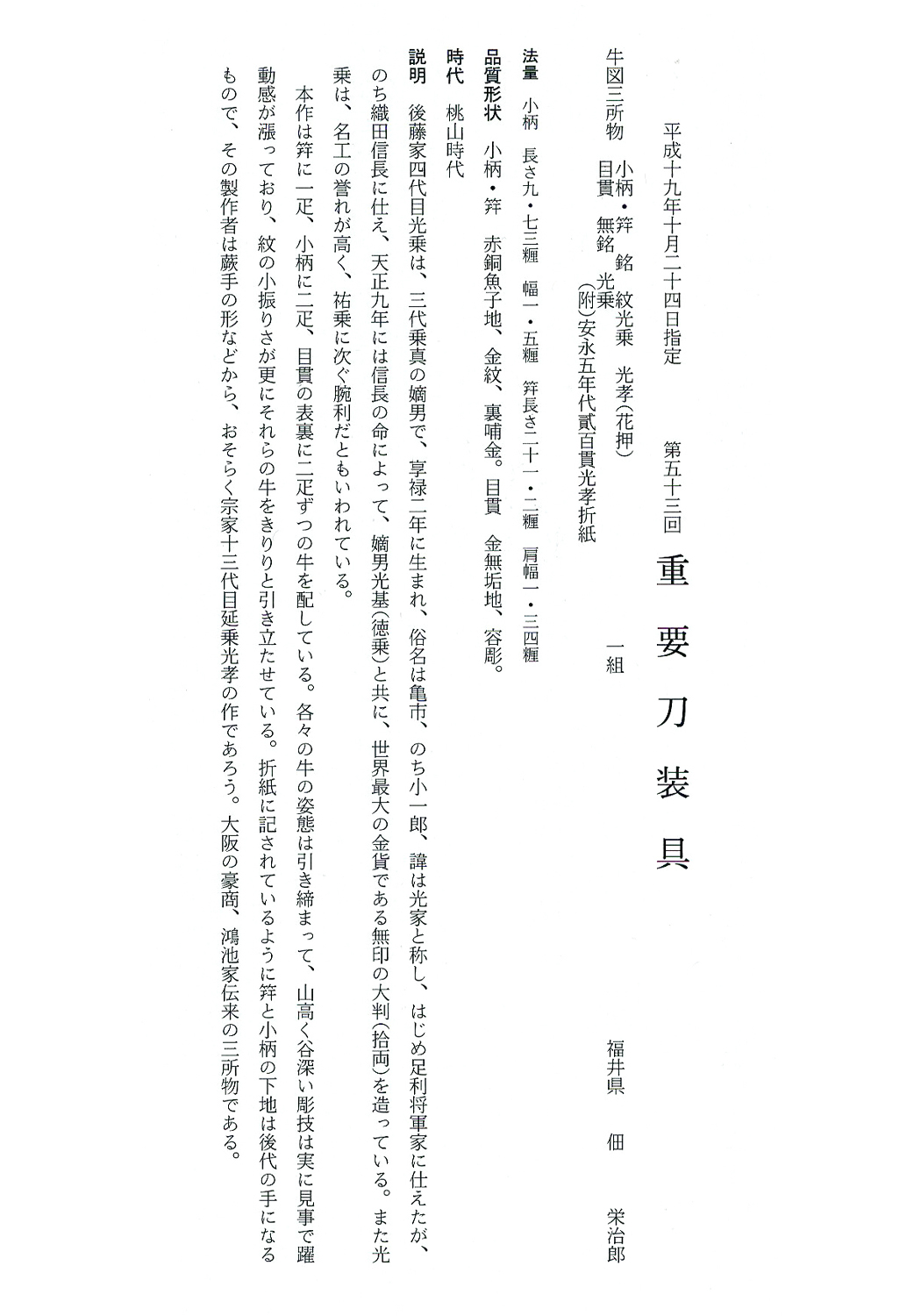
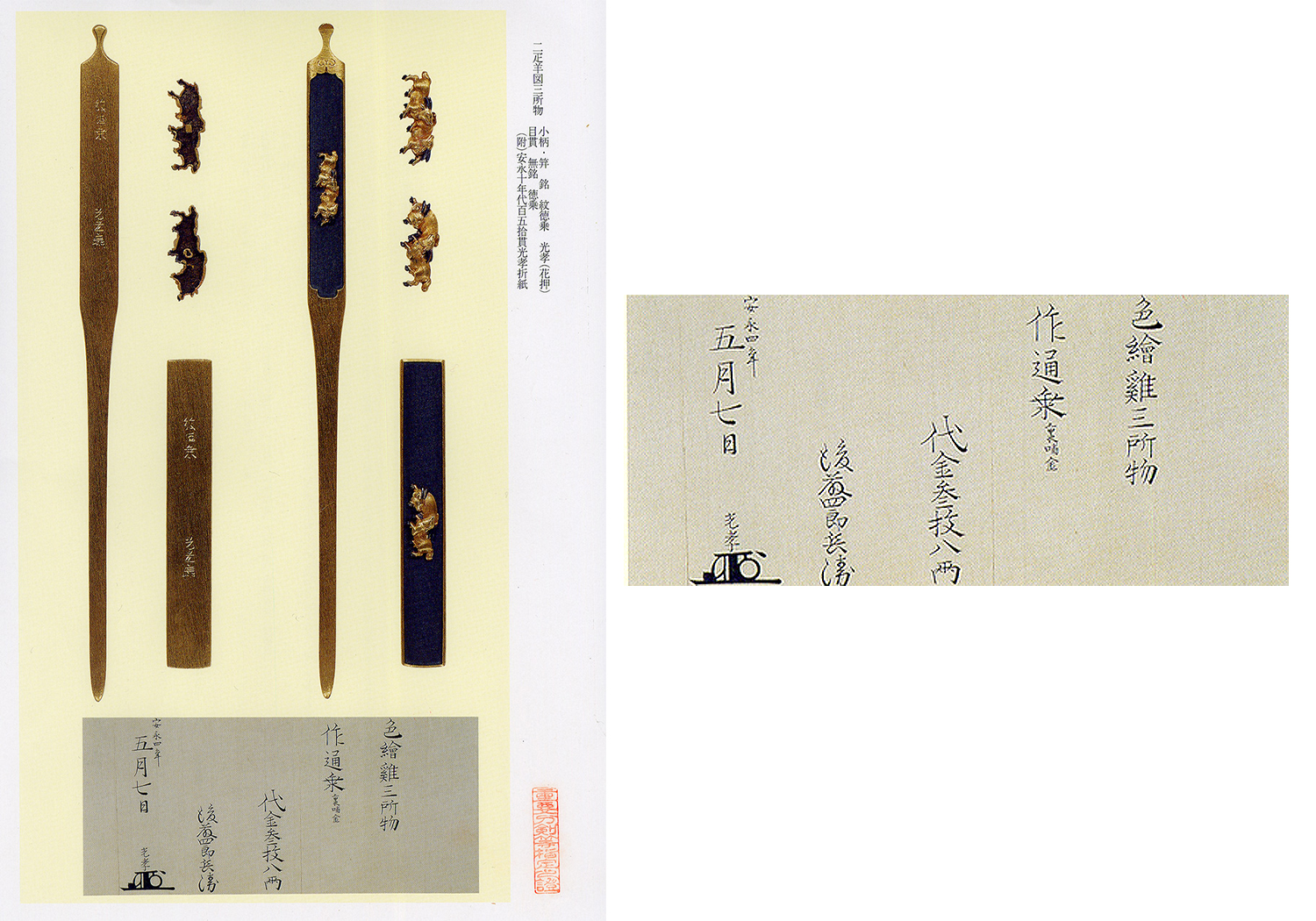
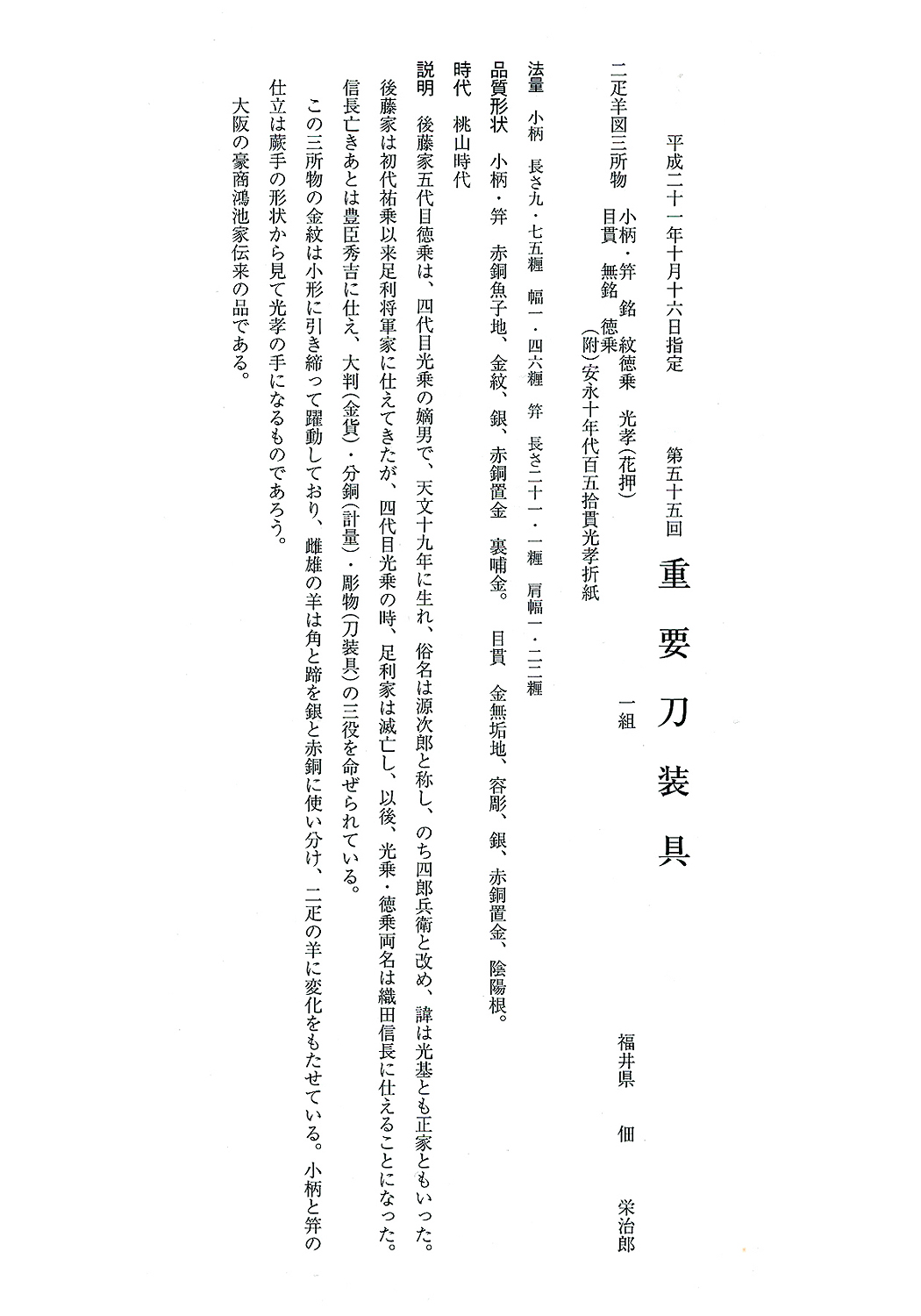
This outstanding mitokoromono set being offered for sale was made Jūyō-Tōsōgu at the 55th Jūyō Shinsa held on October 16, 2009. A full translation of the Jûyô setsumei is as follows:
Jūyō-Tōsōgu at the 55th Jūyō Shinsa held on October 16, 2009
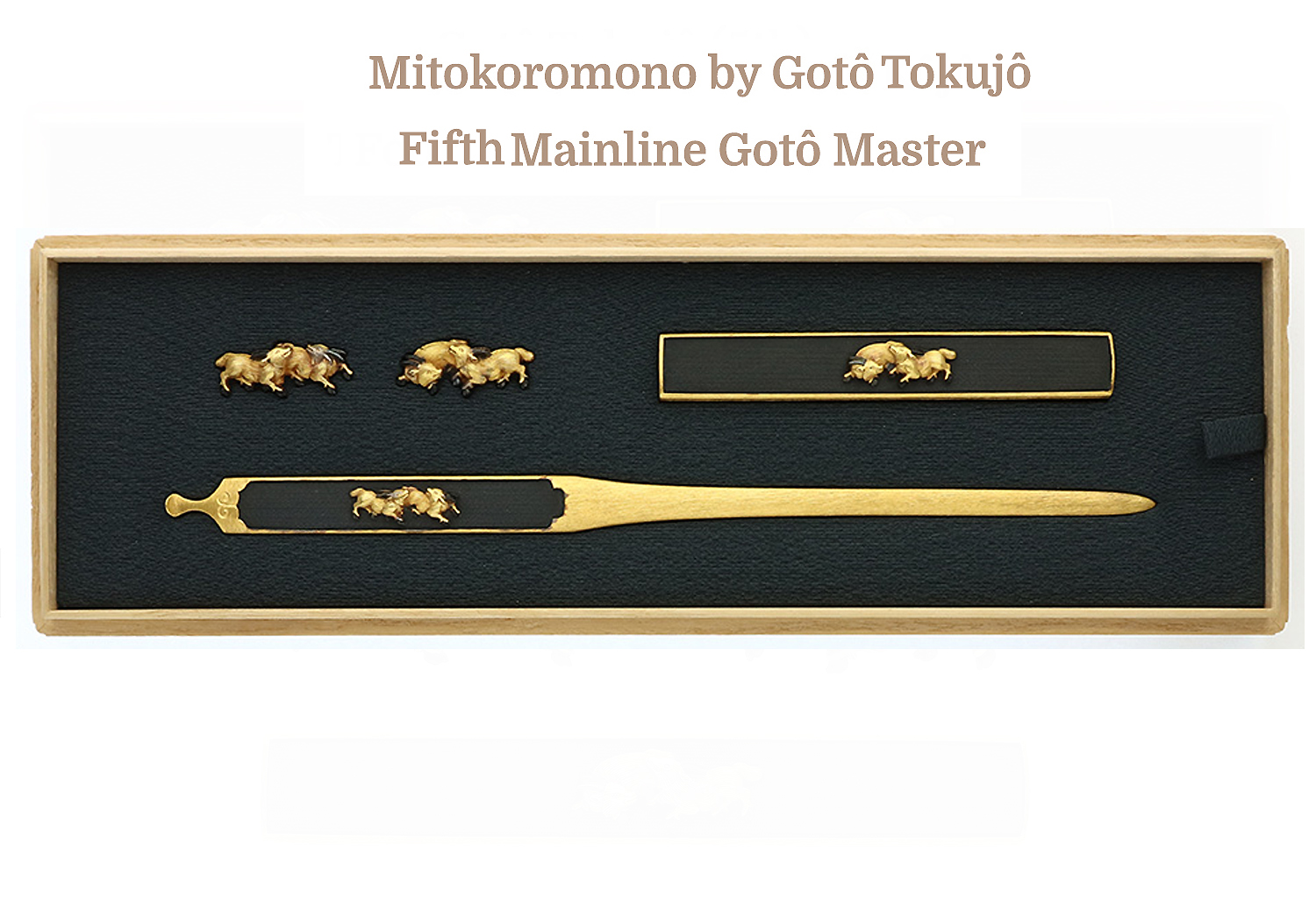
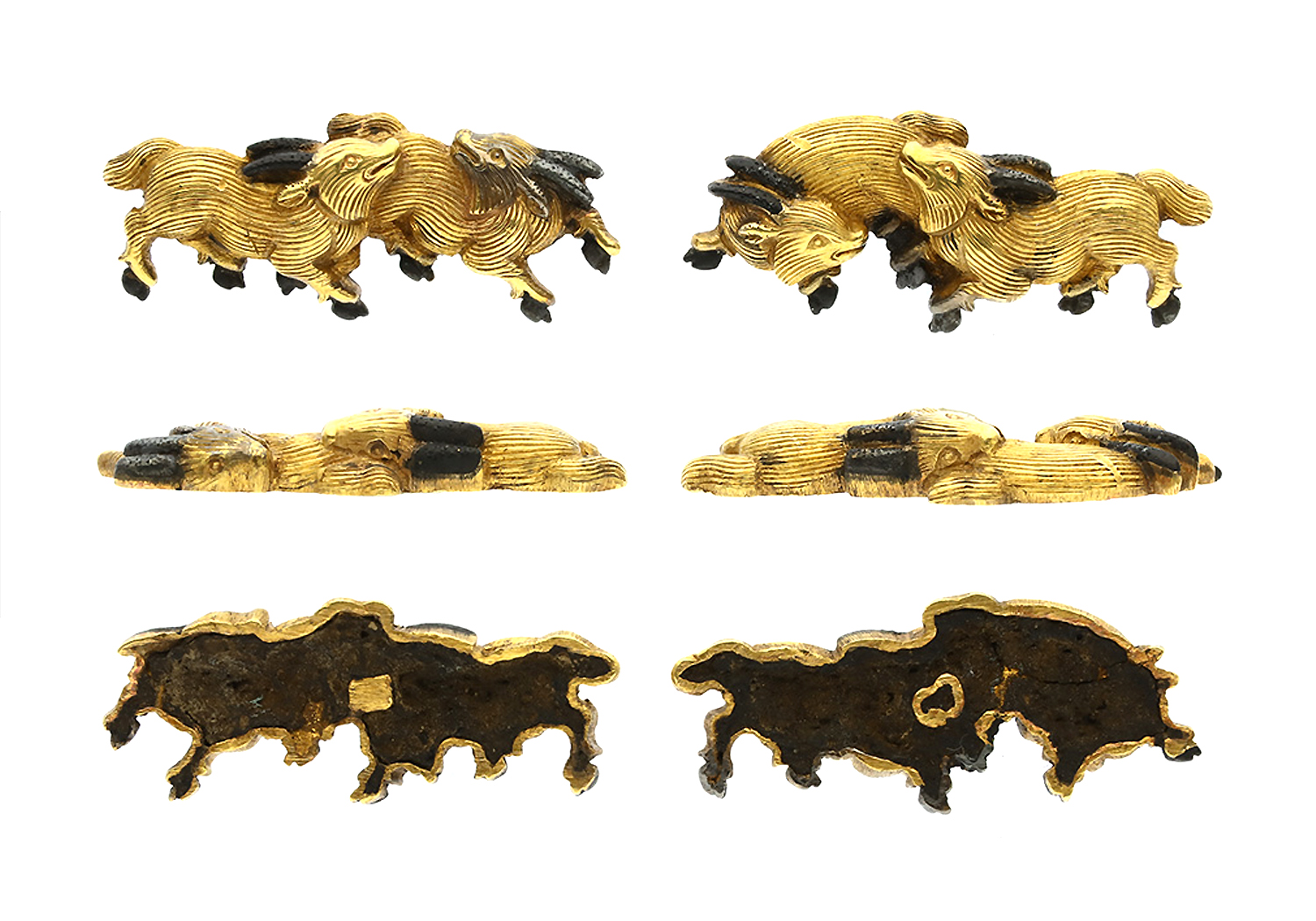
Nihiki hitsuji no zu mitokoromono (二疋羊図三所物) – Mitokoromono depicting two sheep each
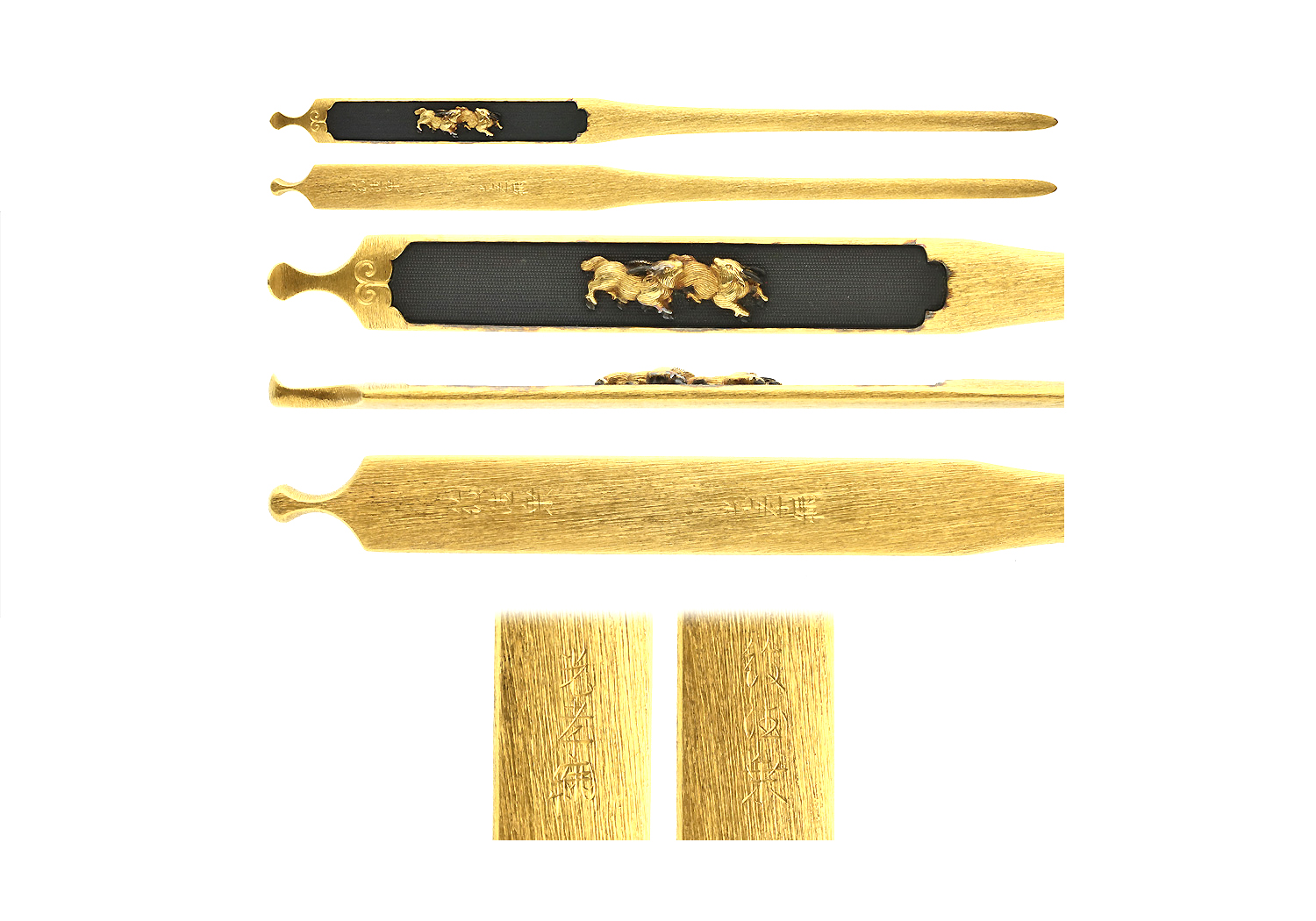
Kozuka and kōgai, mei: Mon Tokujō Mitsutaka + kaō (紋徳乗 光孝「花押」) – “Motif elements by Tokujō, [authenticated so by] Mitsutaka + monogram”
Menuki, mumei: Tokujō (徳乗) (w/ Mitsutaka origami from An’ei ten [1781] evaluating it with 150 kan)
Measurements
Kozuka length 9.75 cm, width 1.46 cm; kōgai length 21.1 cm, width at shoulder 1.22 cm
Interpretation
Kozuka and kōgai of shakudō with nanako ground, kinmon motif elements, silvr and shakudō okigane, and gilded reverses; menuki of solid gold, in katachibori, and with shakudō okigane and negative and positive pins
Era
Momoyama period
Explanation
Tokujō (徳乗), the fifth mainline generation of the Gotō (後藤) School, was the eldest son and heir of the fourth generation Kōjō (光乗) and was born in Tenbun 19 (天文, 1550). His childhood name was Genjirō (源次郎), his first name was Shirōbei (四郎兵衛), and his legal names were Mitsumoto (光基) and Masaie (正家). From the first Gotō generation Yūjō (祐乗) onwards, the family had worked for the Ashikaga Shōguns, but which had been vanquished by the time of the fourth generation Kōjō. Thus, from thereafter, Kōjō and Tokujō both worked for Oda Nobunaga, and after his passing for Toyotomi Hideyoshi, and that in the three functions of minting ōban coins, producing official fundō weights, and of course sword fittings.
The motif elements of this mitokoromono set are small and concise, yet very vivid. Depicted are male and female sheep, with their horns and hooves highlighted in silver and shakudō, and with all of them being rendered in individual postures. Judging from the shape of the warabite of the kōgai, it is likely that the foundations go back to the 13th Gotō generation Enjō Mitsutaka (延乗光孝), who issued the origami and authenticated the work via above quoted inscription on kozukaand kōgai. This mitokoromono was once a heirloom of the wealthy Ōsaka merchant family Kōnoike (鴻池).

NBTHK JÛYÔ TÔSOGU AND COPY OF GOTÔ ORIGAMI (original to follow)

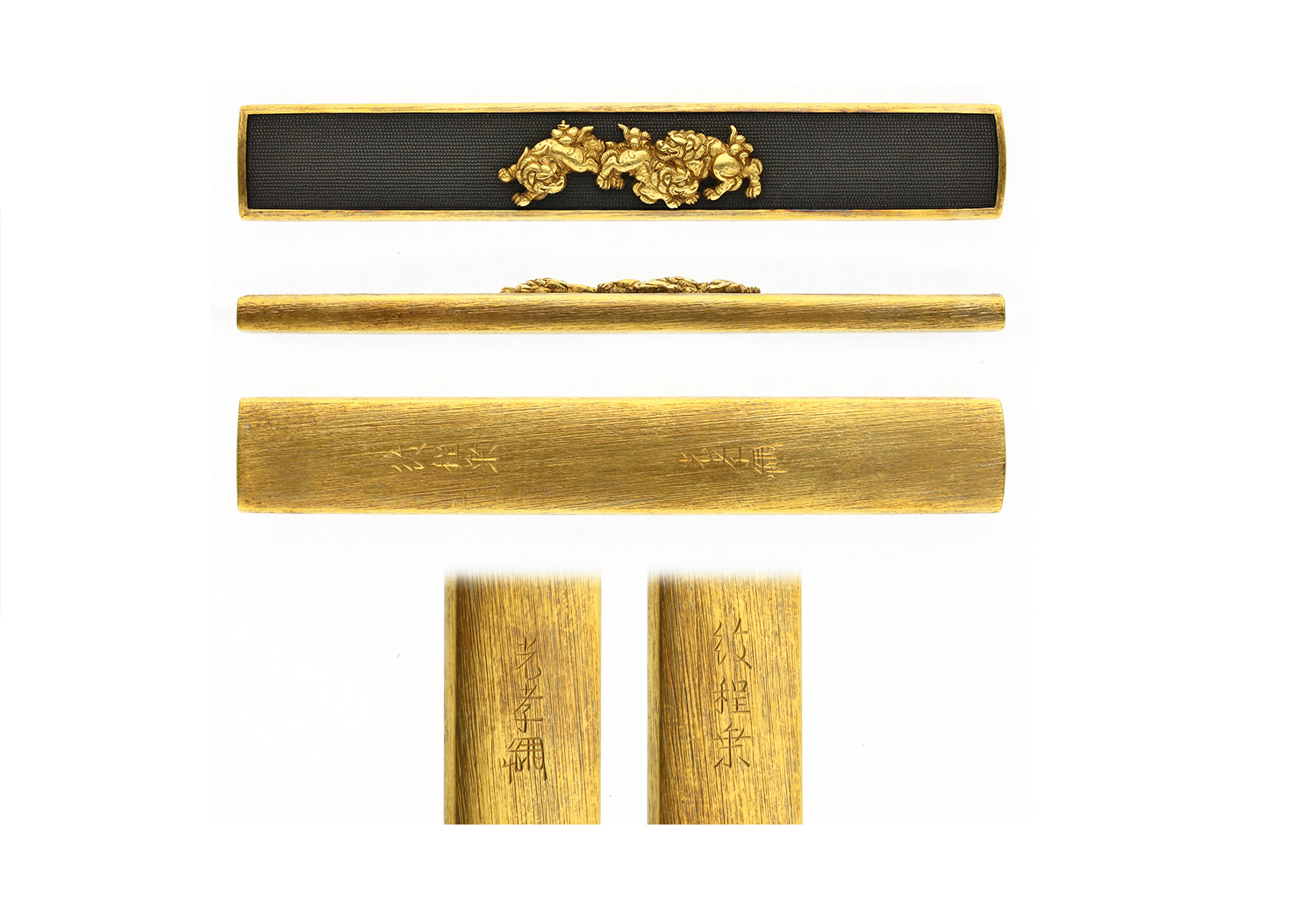
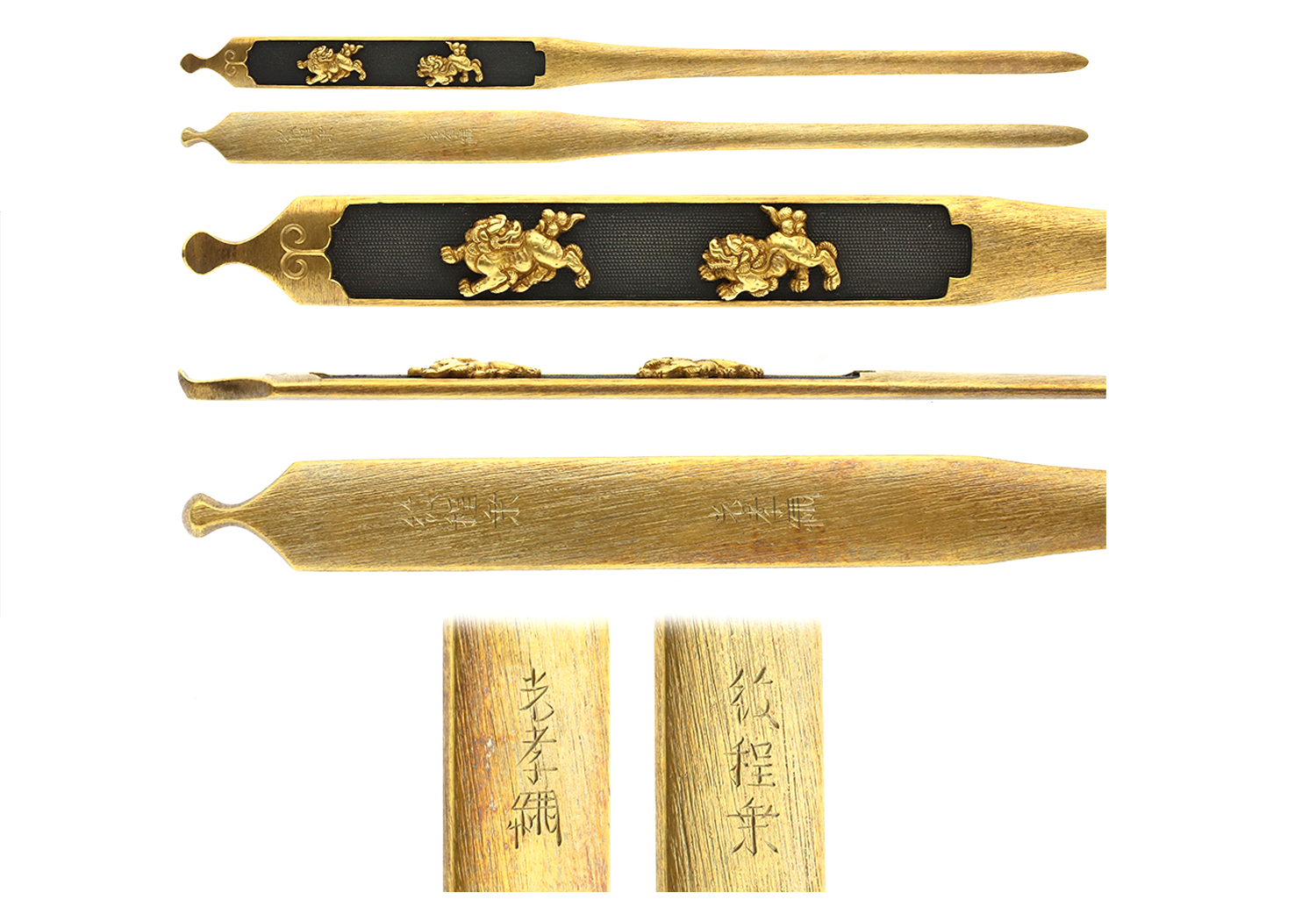
GOTÔ TEIJÔ(1603-1673) 後藤程乗
9th Mainline Master
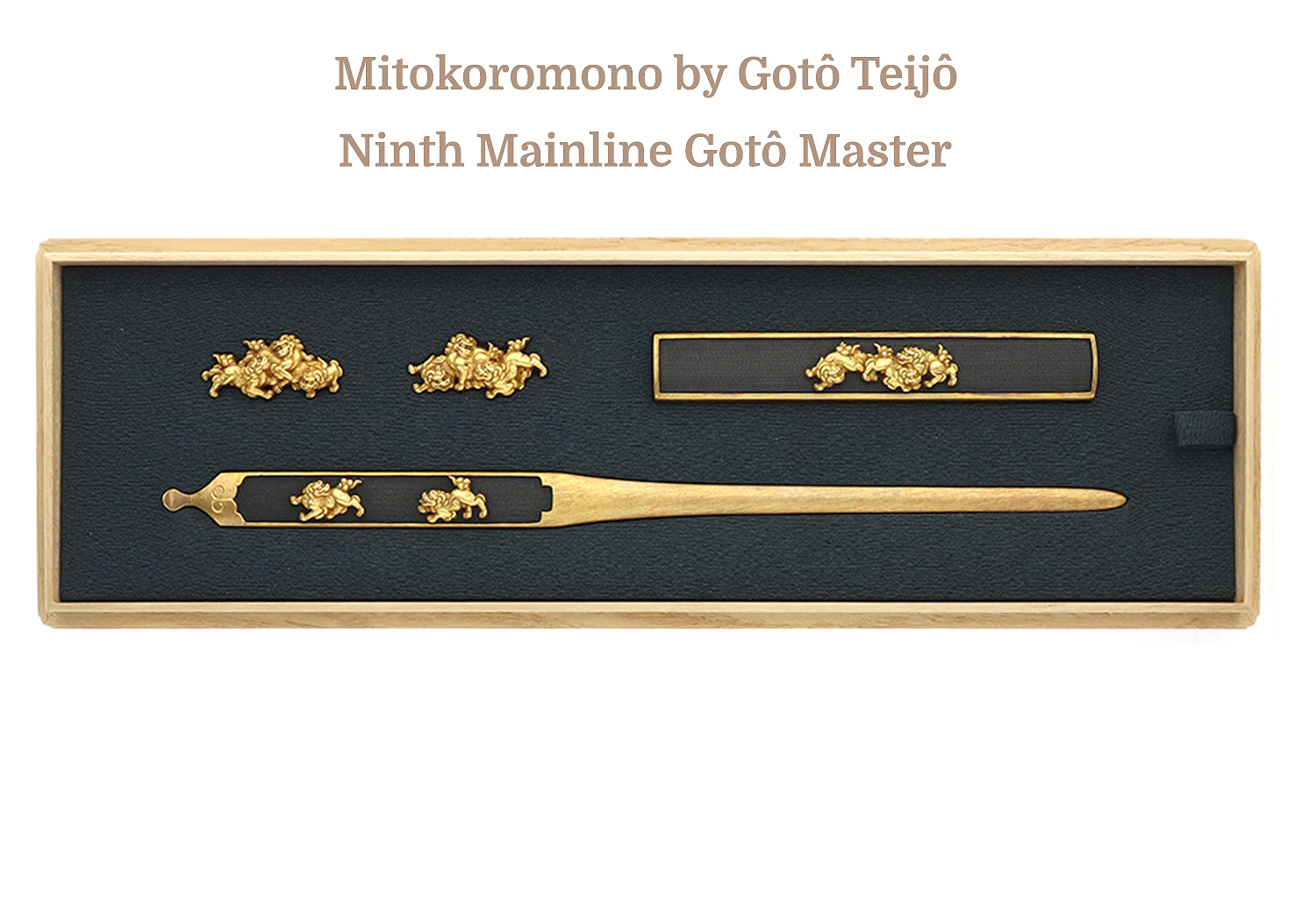
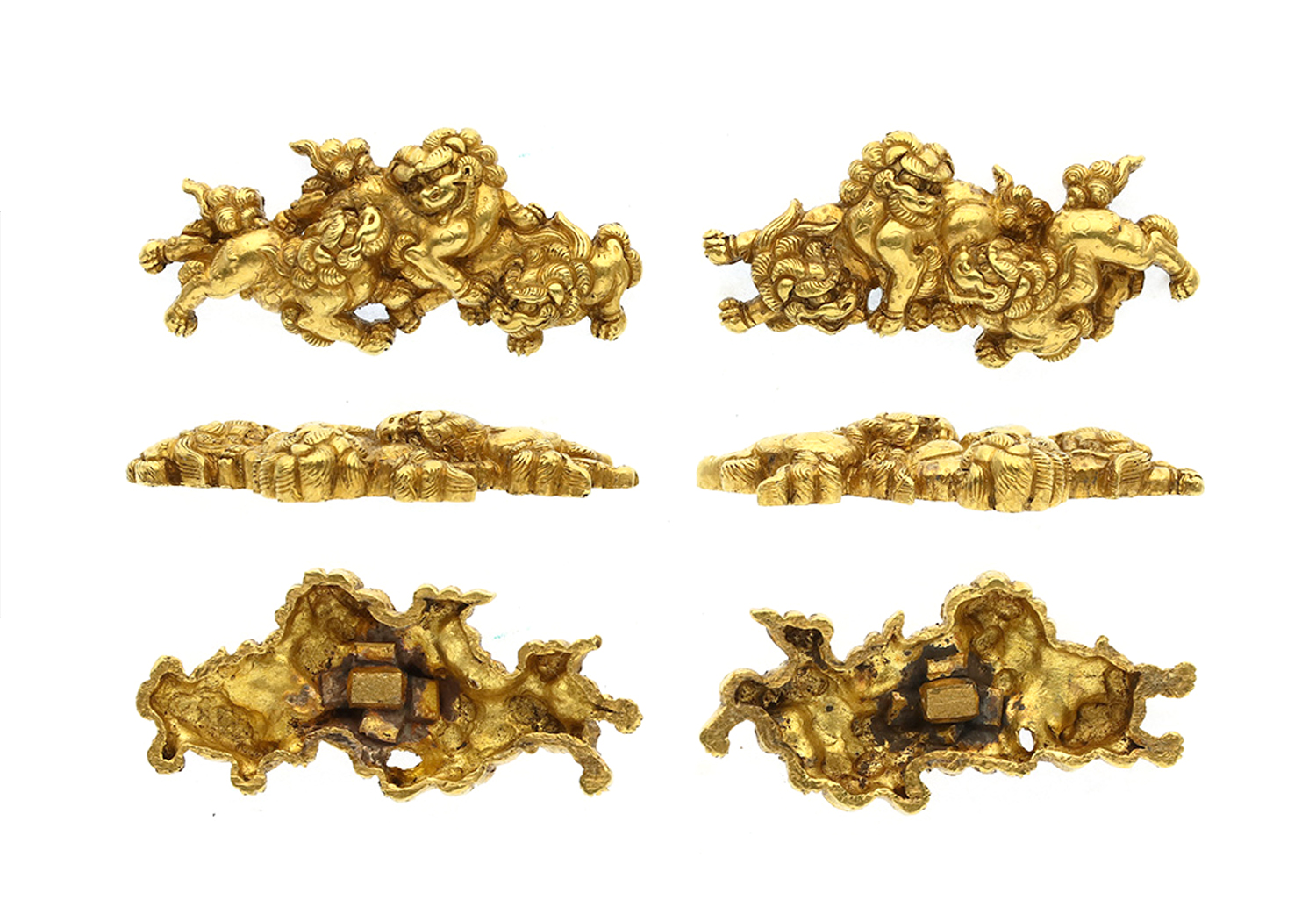
Teijô was born on the 18th day of the second month of Keichô (1603) as the first son of Kenjô. He bore the same childhood and first names as his father, Toraichi (寅市) and Gen’ichiro (源一郎) respectively. His official name was Mitsutada (光伊). When his father entered the priesthood in the first year of Kan’ei (1624,), Teijô, who was then named Gen’ichirô Mitsutada and was 22 years of age, succeeded as the second generation of the Ribei branch, whereupon he changed his name to Ribei Mitsumasa (理兵衛光昌). When Sokujô (the 8th Shirôbei mainline master) died seven years later at the early age of 32, his heir Kameichi (亀市), later Renjô, was only four years old and thus not yet able to succeed as the tenth generation head of the Gotô family; therefore Ribei Mitsumasa was chosen to step in as 9th generation of the mainline Gotô family. In the third year of Shôhô (1646) when he was 44 years old, Mitsumasa entered the priesthood under the name Teijô (程乗). When Kameichi (亀市) turned 25 in the first year of Jôô (1652), Teijô handed over leadership of the family to him, allowing him to take over the main Shirôbei line as the 10th Gotô generation under the name of Shirôbei Mitsumoto (Renjô 廉乗).
Like his father, Kenjô, Teijô worked for the Kaga Maeda family and contributed greatly to the development of the Kaga-kinkô school of fittings. He was supported by his cousin, Enjô (演乗). In the seventh year of Kanbun (1667), he was also contracted by the Bakufu, which earned him an additional 100 hyô of rice plus a stipend for the support of twenty people. Teijô received the Buddhist rank of Hokkyô and in the thirteenth year of Kanbun, he died at the age of 71.
Teijô had three sons and six daughters. His first born son, Yoshishige (良重) was adopted by the Shôzaburô branch of the Gotô in order to succeed as head of the mint. His second son, Etsujô (悦乗), succeeded as head of the Ribei branch, and his third daughter Myôen (妙円) was married to Senjô (仙乗), who was actually her uncle. The couple then gave birth to Mitsuo (光雄) who later became the 11th generation master of the Shirobei main line. Unfortuntely, Teijô’s other son and five daughters all died young.[1]
This outstanding mitokoromono set being offered for sale was made Jūyō-Tōsōgu at the 55th Jūyō Shinsa held on October 16, 2009. A full translation of the Jûyô setsumei is as follows:
Jūyō-Tōsōgu at the 55th Jūyō Shinsa held on October 16, 2009
Nihiki hitsuji no zu mitokoromono (二疋羊図三所物) – Mitokoromono depicting two sheep each.
Kozuka and kōgai, mei: Mon Tokujō Mitsutaka + kaō (紋徳乗 光孝「花押」) – “Motif elements by Tokujō, [authenticated so by] Mitsutaka + monogram”
Menuki, mumei: Tokujō (徳乗) (w/ Mitsutaka origami from An’ei ten [1781] evaluating it with 150 kan
Measurements
Kozuka length 9.75 cm, width 1.46 cm; kōgai length 21.1 cm, width at shoulder 1.22 cm
Interpretation
Kozuka and kōgai of shakudō with nanako ground, kinmon motif elements, silvr and shakudō okigane, and gilded reverses; menuki of solid gold, in katachibori, and with shakudō okigane and negative and positive pins
Era
Momoyama period
Explanation
Tokujō (徳乗), the fifth mainline generation of the Gotō (後藤) School, was the eldest son and heir of the fourth generation Kōjō (光乗) and was born in Tenbun 19 (天文, 1550). His childhood name was Genjirō (源次郎), his first name was Shirōbei (四郎兵衛), and his legal names were Mitsumoto (光基) and Masaie (正家). From the first Gotō generation Yūjō (祐乗) onwards, the family had worked for the Ashikaga Shōguns, but which had been vanquished by the time of the fourth generation Kōjō. Thus, from thereafter, Kōjō and Tokujō both worked for Oda Nobunaga, and after his passing for Toyotomi Hideyoshi, and that in the three functions of minting ōban coins, producing official fundō weights, and of course sword fittings.
The motif elements of this mitokoromono set are small and concise, yet very vivid. Depicted are male and female sheep, with their horns and hooves highlighted in silver and shakudō, and with all of them being rendered in individual postures. Judging from the shape of the warabite of the kōgai, it is likely that the foundations go back to the 13th Gotō generation Enjō Mitsutaka (延乗光孝), who issued the origami and authenticated the work via above quoted inscription on kozukaand kōgai. This mitokoromono was once a heirloom of the wealthy Ōsaka merchant family Kōnoike (鴻池).
[1] Taken from Fukushi Shigeo’s TOSOGU CLASSROOM VOLUME 3 with some editing by the author.
NBTHK JÛYÔ TÔSOGU AND COPY OF GOTÔ ORIGAMI (original to follow)

GOTÔ JUJÔ (1689-1742) 後藤寿乗
12th Mainline Master
Gotô Jujô (後藤寿乗) was the son and heir of the 11th generation Tsûjô (通乗); according to records of the 16th generation Mitsuakira (光晃), he was born in the second year of Genroku (1689). His childhood name was Kameichi (亀市), later he bore the first name Gennojô (源之氶), and his official first name was Mitsuyuki (光幸). When his father entered the priesthood in Kyôhô five (1720), he succeeded as the head of the Gotô mainline and took the name Shirôbei Mitsumasa(四郎兵衛光理). However, records of the 14th generation Mitsunori (光儔) state that he did not succeed until two months after his father had died, in the second month of Kyôhô seven (1722). Be that as it may, in Kyôhô ten (1725) the Bakufucommissioned him with the minting of new ôban coins, the Kyôhô-ôban. Mitsumasa (光理) died at the relatively young age of 54, on the ninth day of the second month of Kanpô two (1742). His posthumous Buddhist name is Kôi’in Jujô Nichiriyô (光理院寿乗日量) and he is also buried at Myôkôji. Mitsumasa left behind four sons and two daughters. His eldest son and heir, Mitsunari (光成) succeeded as the 13th main line generation. His second son was named Kyôkichi Mitsusuke (兄吉光佐), and his third son Mitsunori (光儔) later took over as 14th main line generation. His fourth son, Kichijirô (吉次郎), was adopted into the Tachi (舘) family, the leader of the Edo merchants.
At the time of Mitsumasa the machibori movement was continuing to grow and Edo had become a bustling metropolis, accommodating a large number of Daimyô and ever more residences of bushi. It was still customary for higher ranking warrior families to present sets of Gotô made fittings at auspicious occasions, such as weddings or adoptions. The prevalence of kiwame-mono (attributed pieces) increased. These are either unsigned work of earlier generations to which a kiwame-mei was added or motif elements or plates taken from an extant Gotô work, reworked into new kozuka/kogai, also with a kiwame-mei added. What’s more existing fittings were supplemented to complete mitokoromono, and all of this was increasingly backed by origami.[1]
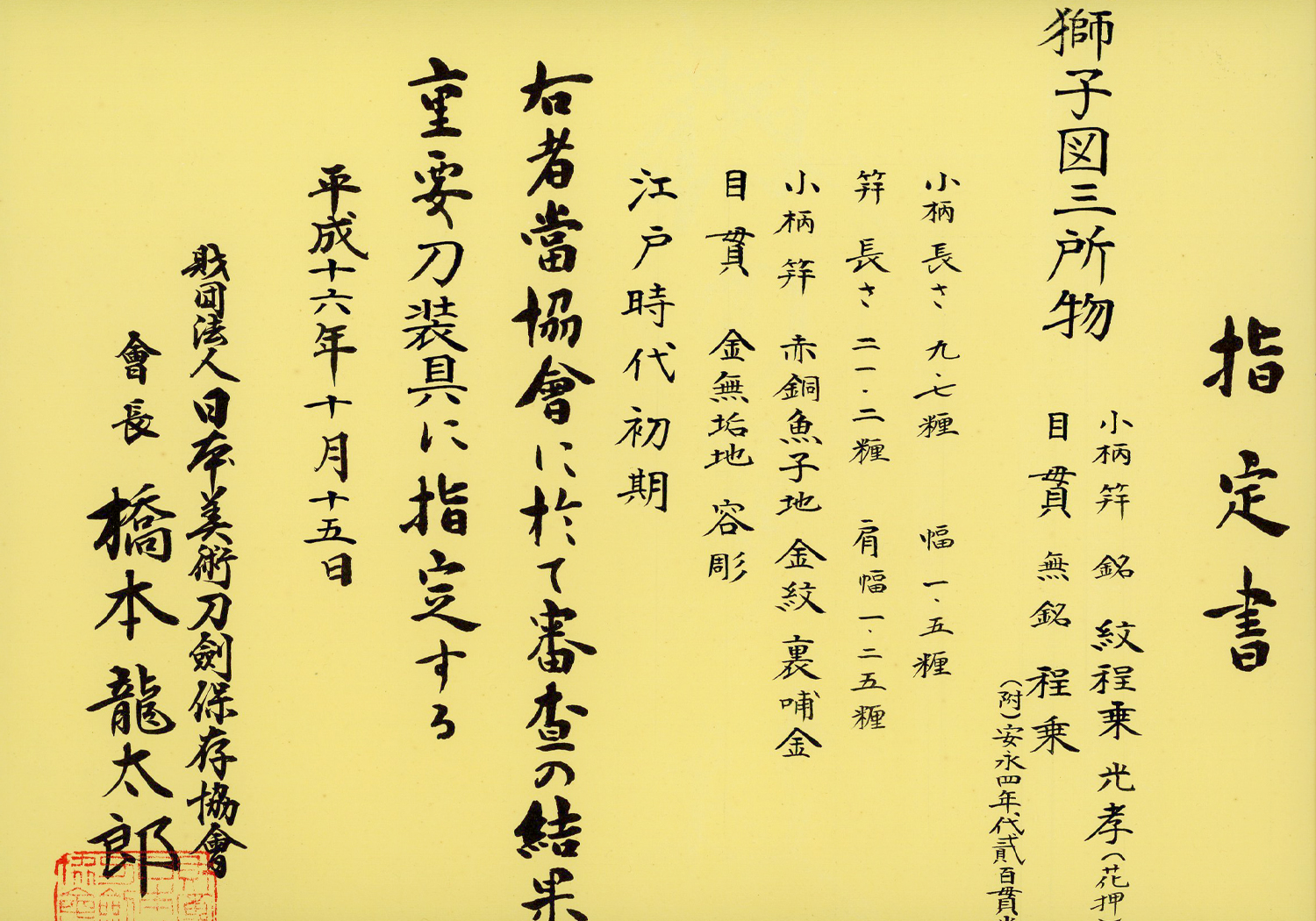
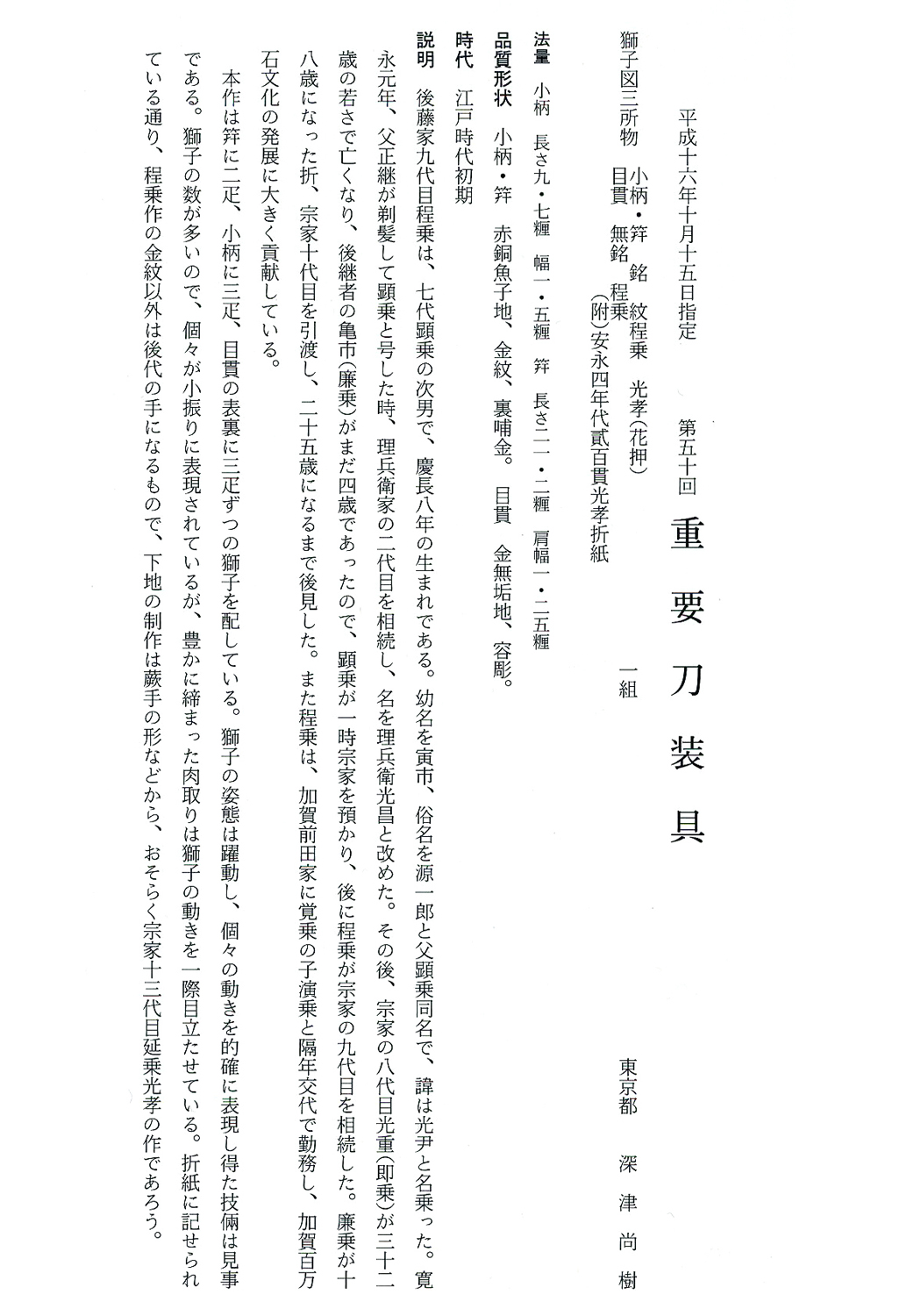
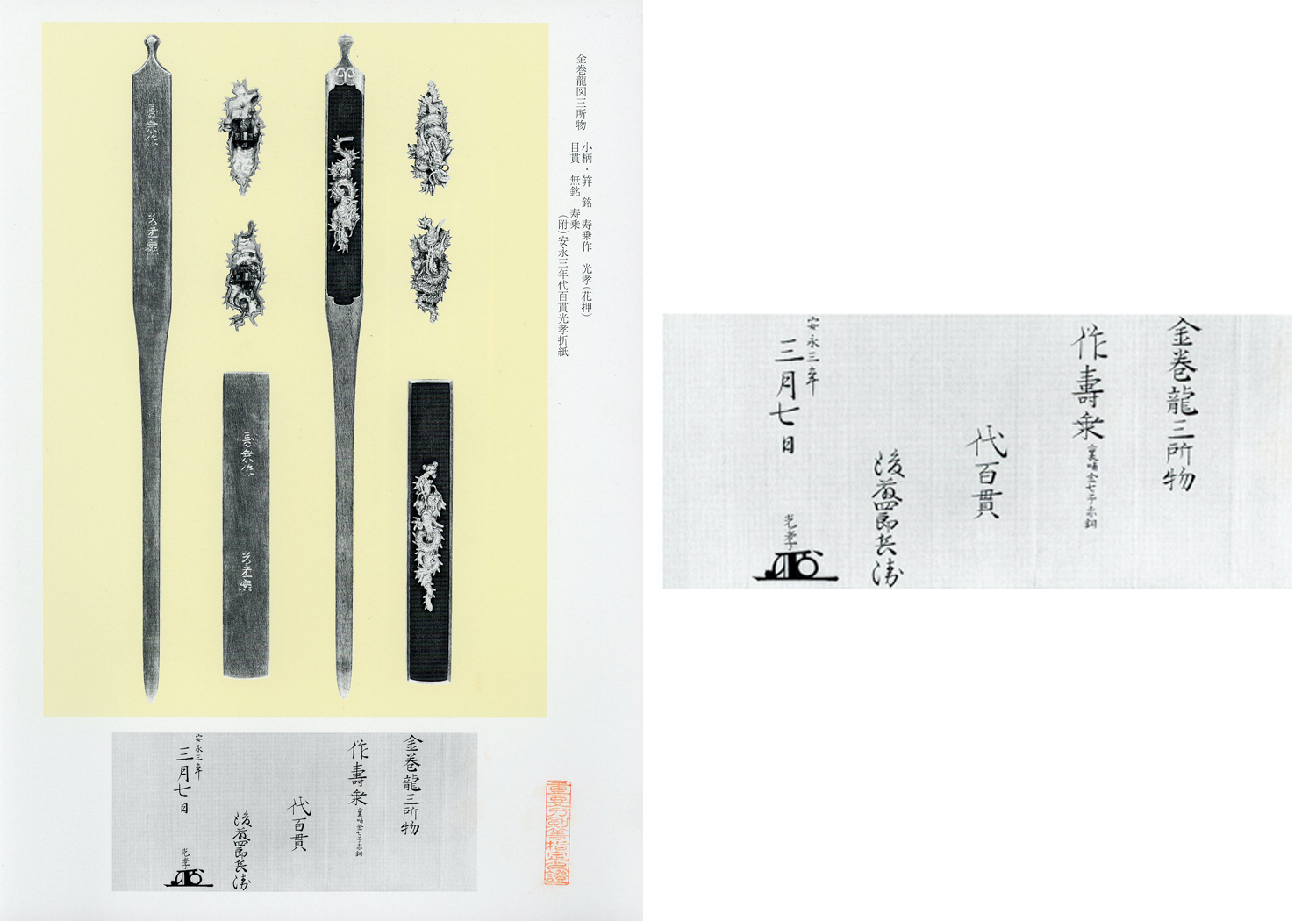
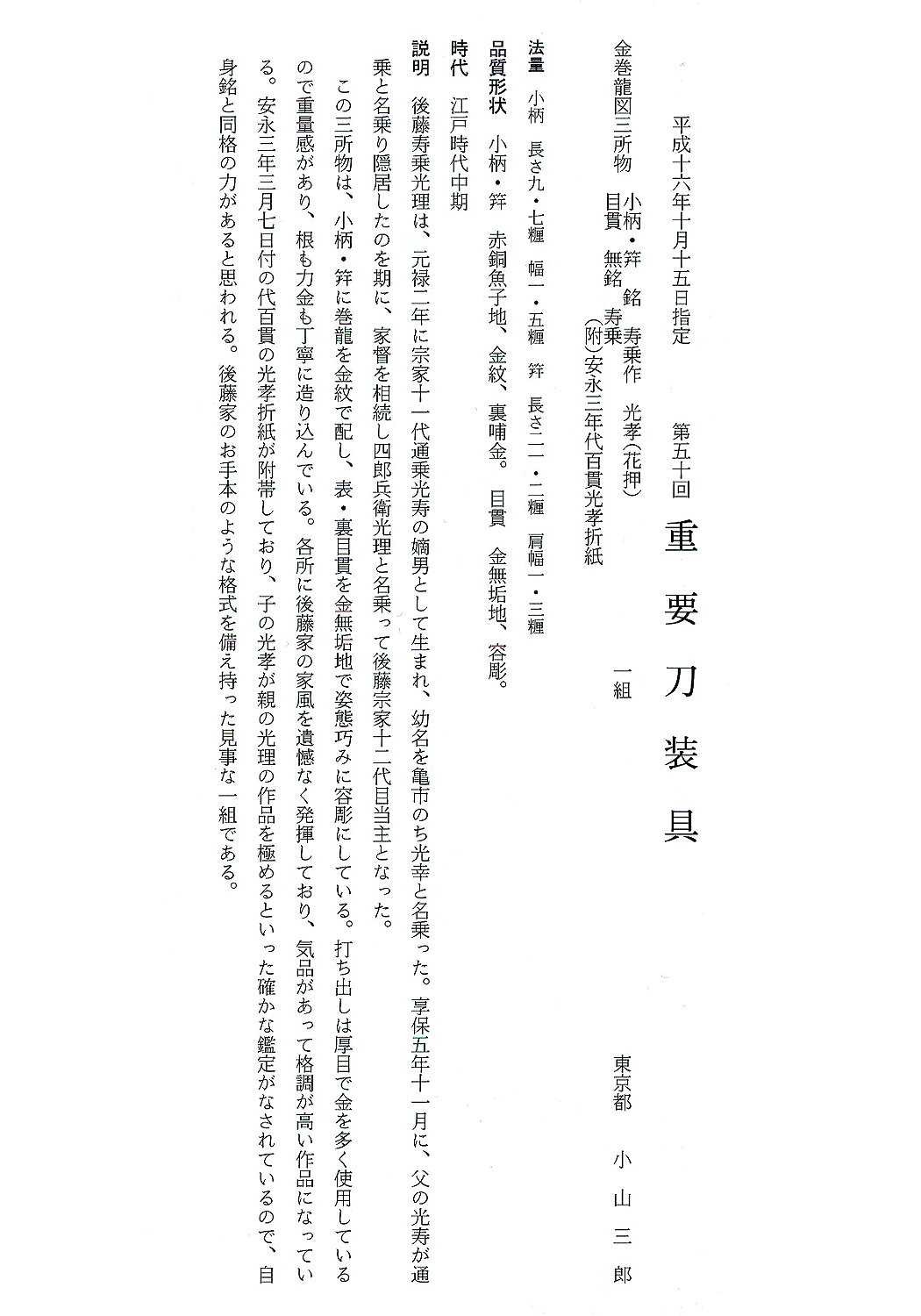
This outstanding mitokoromono set being offered for sale was made Jūyō-Tōsōgu at the 50th Jūyō Shinsa held on October 15, 2004. A full translation of the Jûyô setsumei is as follows:
Jūyō-Tōsōgu at the 50th Jūyō Shinsa held on October 15, 2004
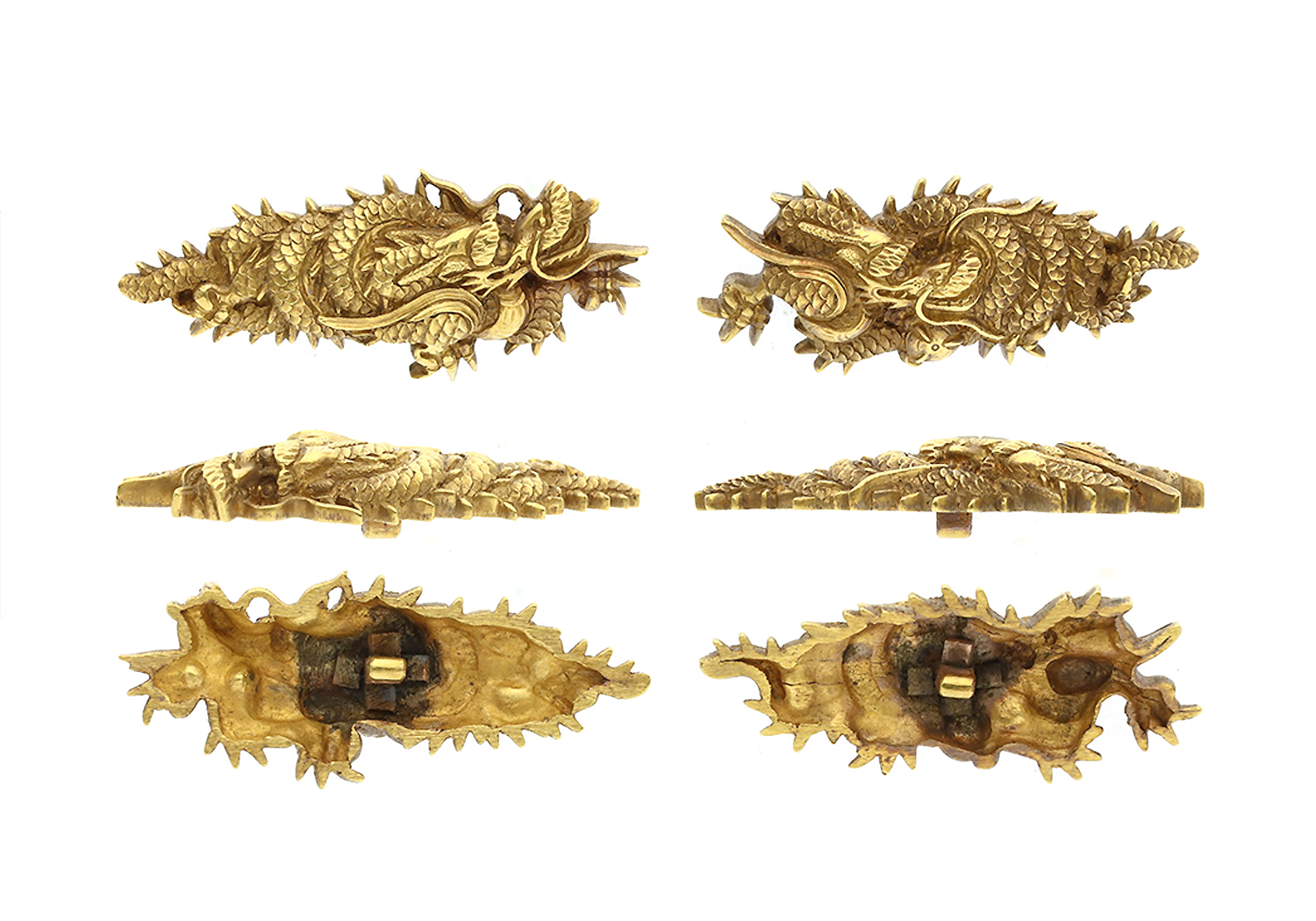
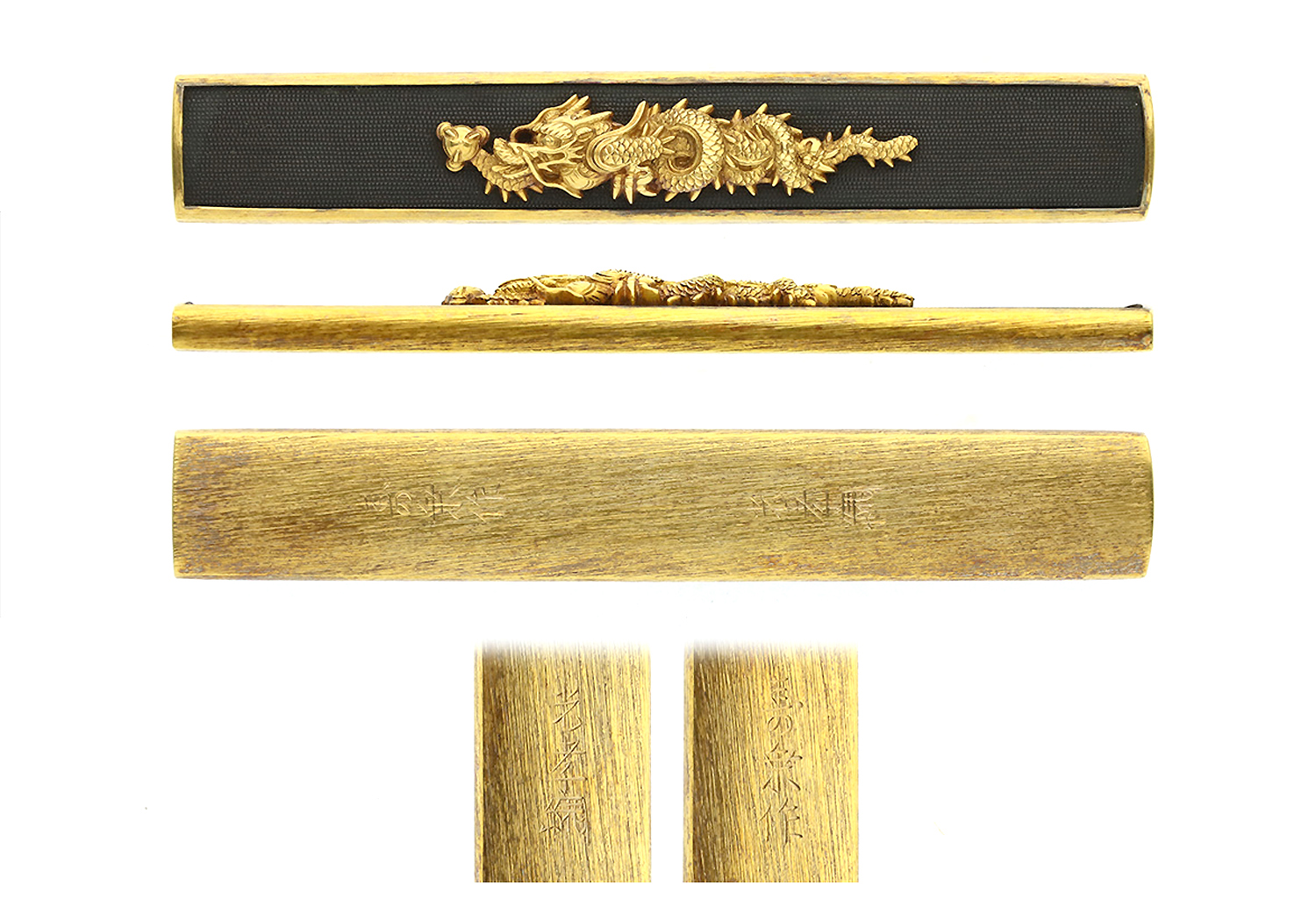
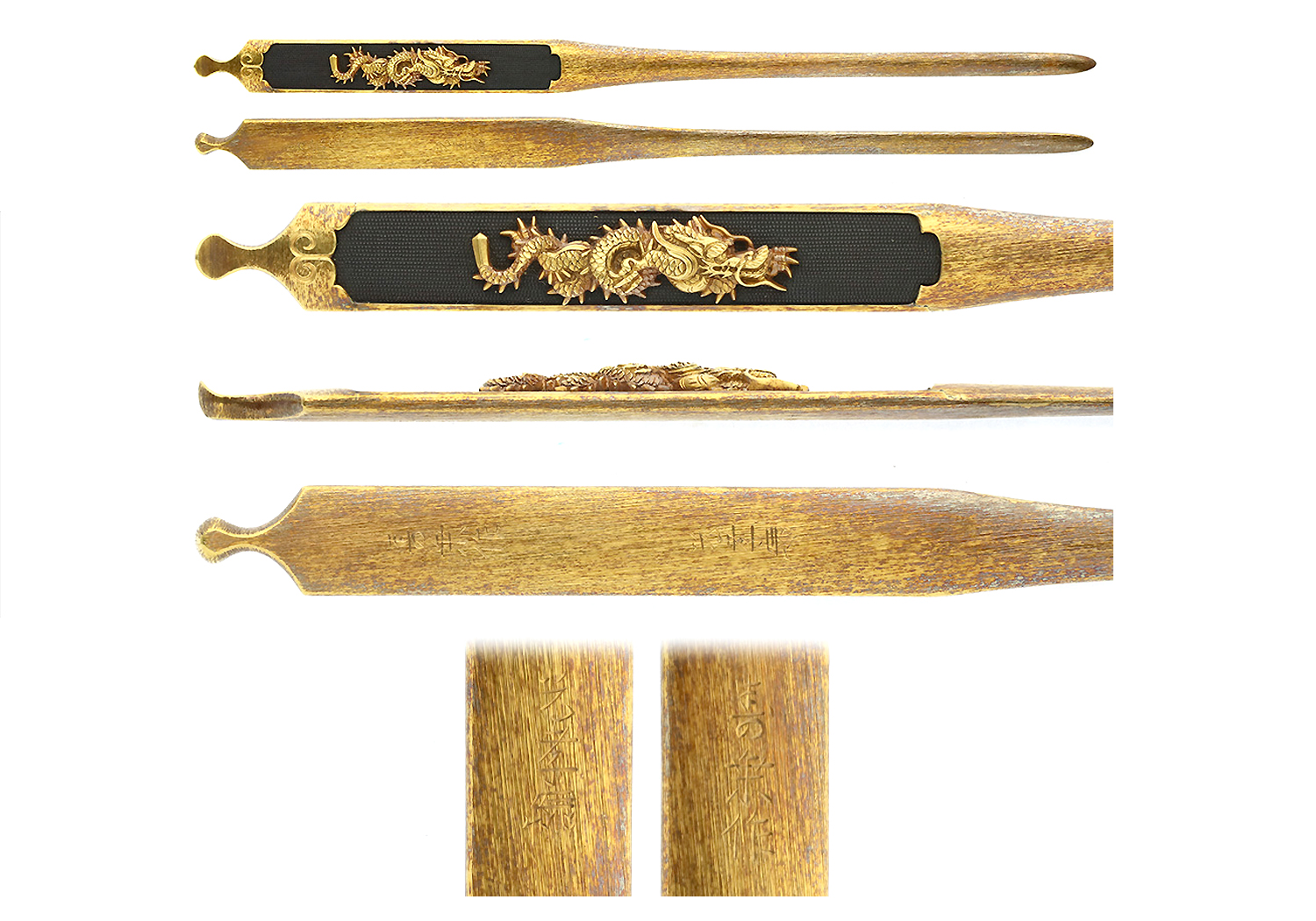
Kin makiryū no zu mitokoromono (金巻龍図三所物) – Mitokoromono depicting coiled dragons in gold
Kozuka and kōgai, mei: Jujō saku Mitsutaka + kaō (寿乗作 光孝「花押」) – “Work of Jujō, [authenticated so by] Mitsutaka + monogram”
Menuki, mumei: Jujō (寿乗) (w/ Mitsutaka origami from An’ei three evaluating it with 100 kan)
Measurements
Kozuka length 9.7 cm, width 1.5 cm; kōgai length 21.2 cm, width at shoulder 1.3 cm
Interpretation
Kozuka and kōgai of shakudō with nanako ground, kinmon motif elements, and gilded reverses; menuki of solid gold and in katachibori
Era
Mid-Edo period
Explanation
Gotō Jujō Mitsumasa (後藤寿乗光理) was born in Genroku two (元禄, 1689) as eldest son and heir of the eleventh Gotō mainline generation Tsūjō Mitsutoshi (通乗光寿). His childhood name was Kameichi (亀市), his legal name was Mitsuyuki (光幸), and when his father retired in the eleventh month of Kyōhō five (享保, 1720), he succeeded as twelfth head of the Gotō main line under the name Shirōbei Mitsumasa (四郎兵衛光理).
This mitokoromono set is comprised of a kozuka and kōgai that are decorated with gold kinmon motif elements of coiled dragons, and solid gold menuki, which follow that subjects in skillfully executed katachibori, meaning that the motif itself forms the outline of the objects. The embossed menuki are thick and thus feel massive, and the pins with chikaraganereinforcements at their bases on the reverses are meticulously executed. Thus, we have here an elegant and highly dignified set that reflects in all aspects the iconic style of the Gotō School, which is accompanied by an origami issued by Mitsutaka (光孝) on the seventh day of the third month An’ei three (安永, 1774), in which he evaluates it with 100 kan. As Mitsutaka was the son of Mitsumasa, he was certainly able to accurately authenticate works of his father, hence unsigned works appraised as such are regarded the same way as if they were signed by Mitsumasa. A gorgeous set, which serves as a textbook example of the distinguished rank of the Gotō School.
[1] Taken from Fukushi Shigeo’s TOSOGU CLASSROOM VOLUME 3 with some editing by the author.

NBTHK JÛYÔ TÔSOGU AND COPY OF GOTÔ ORIGAMI (original to follow)
If you are an experienced collector of sword fittings (tôsogu) or just starting your collection, these important sets would make a wonderful addition (or start) to your collection. The four sets are being sold as one lot. They are all equally fabulous.
PRICE ON REQUEST