The foundation of what we know about Tobari Tomihisa (later known as Shôseisai Tomihisa) is the entry in the Kinkô Tanki (金工鐔寄) which was published in Tenpô ten (天保, 1839), i.e. only 14 years after Tomihisa’s death.
He was a student of the Gotô family, specifically Gotô Enjô, also named Mitsutaka (光孝). Gotô Enjô was born in 1721 and he died on September 18, 1784. He was the first son of Gotô Jujô. He became the 13th master of the mainline Gotô family. Tomihisa studied with Enjô for a period of time and in 1784 then he left Kyotô and moved back to the family village of Zôshigaya, a small village located about 3.5 miles to the northwest of Edo. Later, however, he returned to the Gotô Kyôbashi in Kyôto where he did the preparatory work on dragons and shishi lions for the Gotô family. He also designed his own pieces.
We know that Tomihisa died in Bunsei eight (文政, 1825), that is a considerable time after his master had passed away. We don’t know when he was born but that we know he left a very limited number of dated works, i.e. from Bunka six (文化, 1809), Bunka eight (1811), and Bunsei four (1821). If we assume that he lived to the age of 70 we arrive somewhere around Hôreki five (宝暦, 1755) for his year of birth. This would mean he was probably about 30 years old when his master Gotô Enjô died.
There is another very interesting side to this very talented, Gotô trained fittings maker. When he was not working for the Gotô or making fittings on his own, Tomihisa ran the Kisôji soba shop, a very successful soba noodle restaurant. Tomihisa did not just work in the noodle restaurant, he was actually the fourth generation of that very successful soba business which was located in Zôshigaya. This would explain why he moved back to this area which was at that time a small village located about 3.5 miles to the northwest of downtown Edo. Today it is part of the suburbs of modern day Tokyô.
Renowned soba restaurants like this were places with an endless coming and going of people from all walks of life, from the common servant to the high-ranking bakufu official. We know that Tomihisa later became a relatively well-known figure in the cultural circles of Edo. He made acquaintance with several daimyô, and wrote poetry himself under the pen names Shôseisai (松盛斎), Kôsôken (貢僧軒), and Senri (仙里). He also became a friend of the famous Rinpa School painter, Sakai Hôitsu (酒井抱一, 1761-1829).
His family must have been well off to be able to support their son’s passion for sword fittings and for their ability to arrange an apprenticeship with the renowned Gotô family. When Tomihisa was around 30 years old in 1784, his master Gotô Enjô died and he decided to return to Zôshigaya to take over his family soba business. Therefore, there was no real “break” with the Gotô family. Tomihisa just went back to his initial family business from where he was also able to cultivate and intensify his contacts with persons from culture, business, and government.
Somewhat later in his life he decided to once more focus on his passion of making fine sword fittings and so he returned to Kyôbashi in Kyotô. Apparently the Gotô gave him permission to work from their workshop as evidenced by the fact that Tomihisa’s son, Yoshihisa (喜久), studied with the Gotô family also. However, we know that Yoshihisa later opened his own kinkô workshop in the Suidô-chô (水道町) neighborhood which is about halfway between Zôshigaya and downtown Edo. Also we know that the Kisôji soba shop went out of business at the end of the Bunsei era (文政, 1828-1830), shortly after Tomihisa died.
Thus we might assume that facing the end of his career, Tomihisa shifted more towards the kinkô profession and had his son continued in that same field rather than run the family soba business. We have dated works by Yoshihisa from 1828 and 1841, so he surely did not give up the kodogu craft after his father passed away. [1]
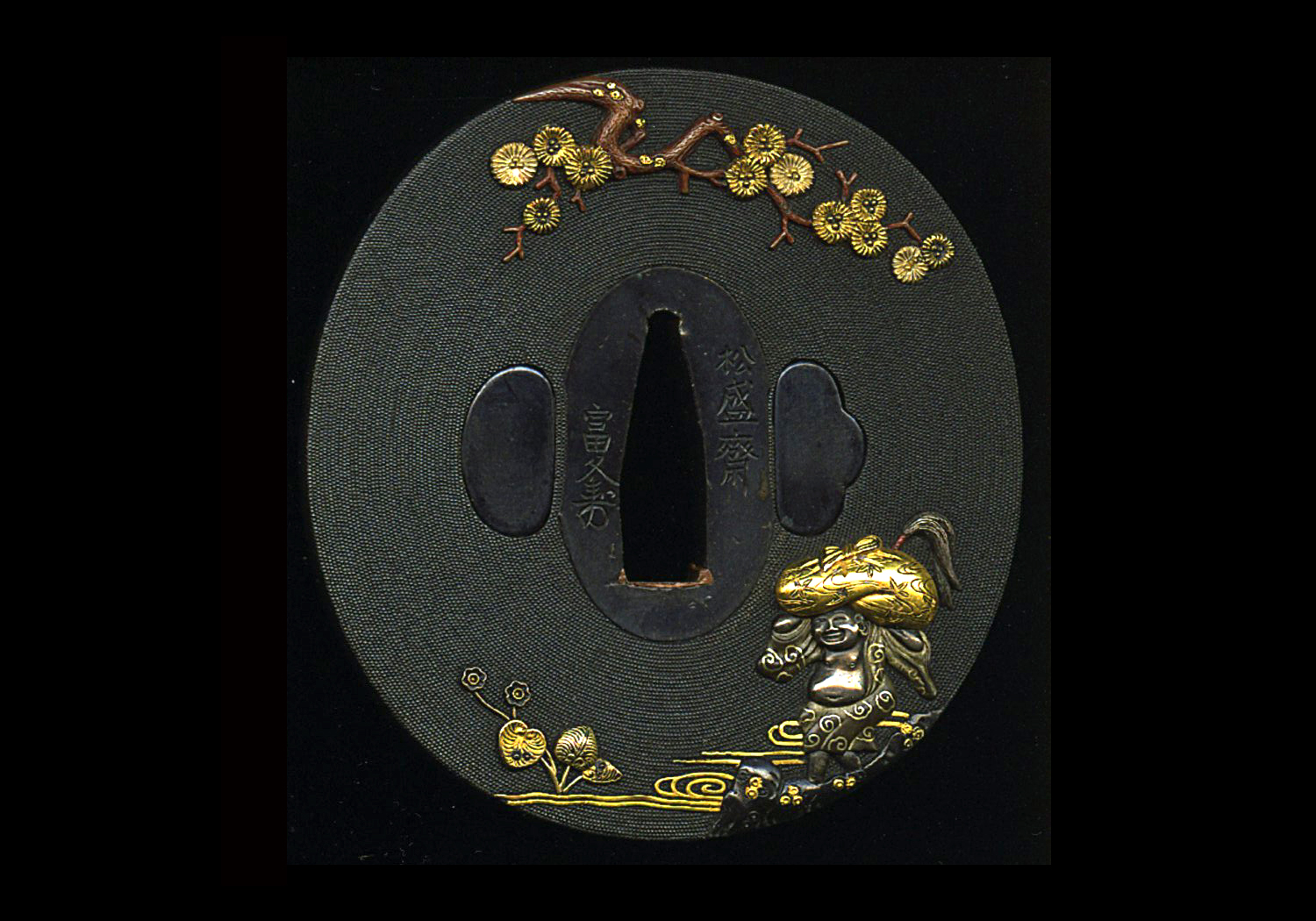
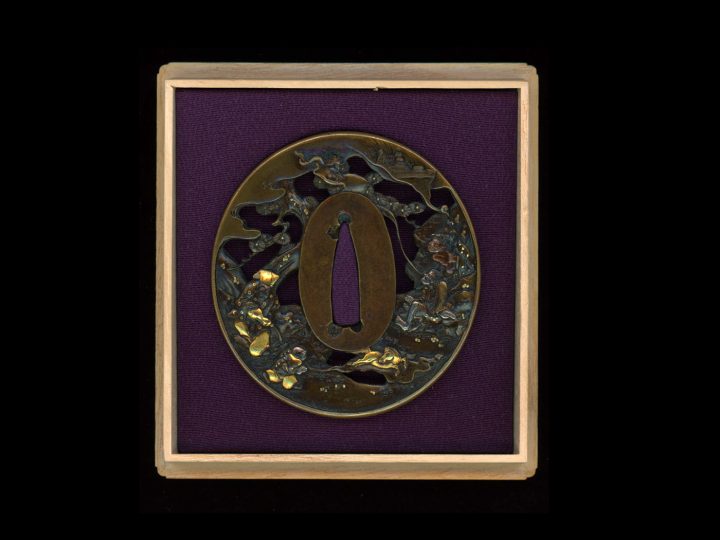
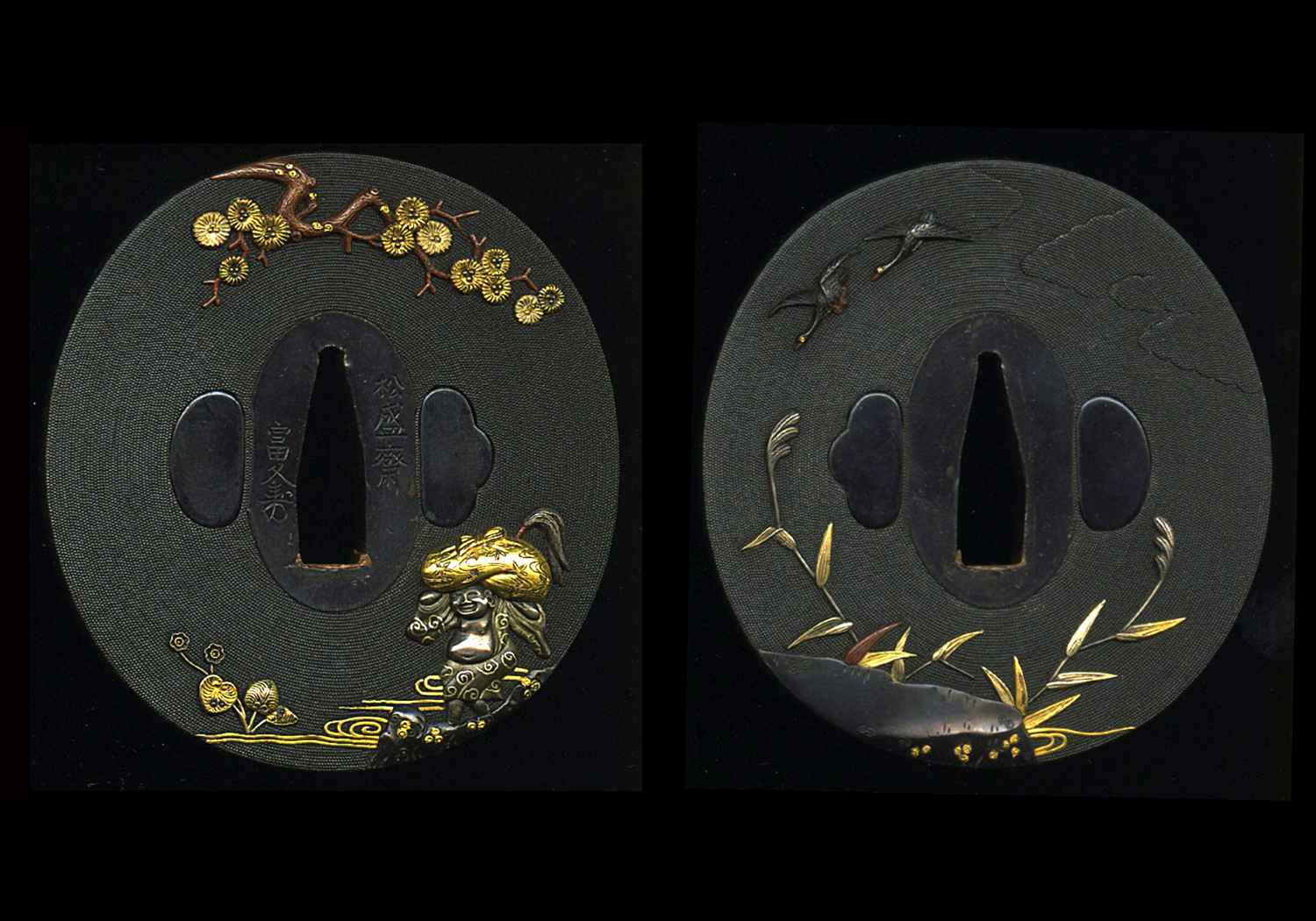
The tsuba offered for sale here is a superb shakudô example of the finest work of this artist. It is signed Shōseisai Tomihisa + kaō (松盛斎 富久「花押」).It is slightly oval in shape and measures 3.04 inches (7.72 cm) by 2.86 inches (7.28 cm). The color of the shakudô is dark and lustrous showing a high gold content in the metal. The entire body of the tsuba, including the mimi (rim) is covered with the finest nanako giving it an almost moist appearance. Exquisitely carved and applied to the lower right portion of the obverse is an absolutely outstanding shibuichi carving of Hotei, the God of fortune, gleefully crossing a river. His image is delicately carved with his usual smiling face and his ample stomach hanging out from his kimono. Perched upon his head to keep it from the river waters is his golden magical bag of treasures. The translation of the name, Hotei, is literally “cloth bag”. Jutting out from the top of his bag is his baton with strands of material to swat away the flies without hurting them. His kimono is decorated with gold spirals creating a delicate pattern in the cloth.
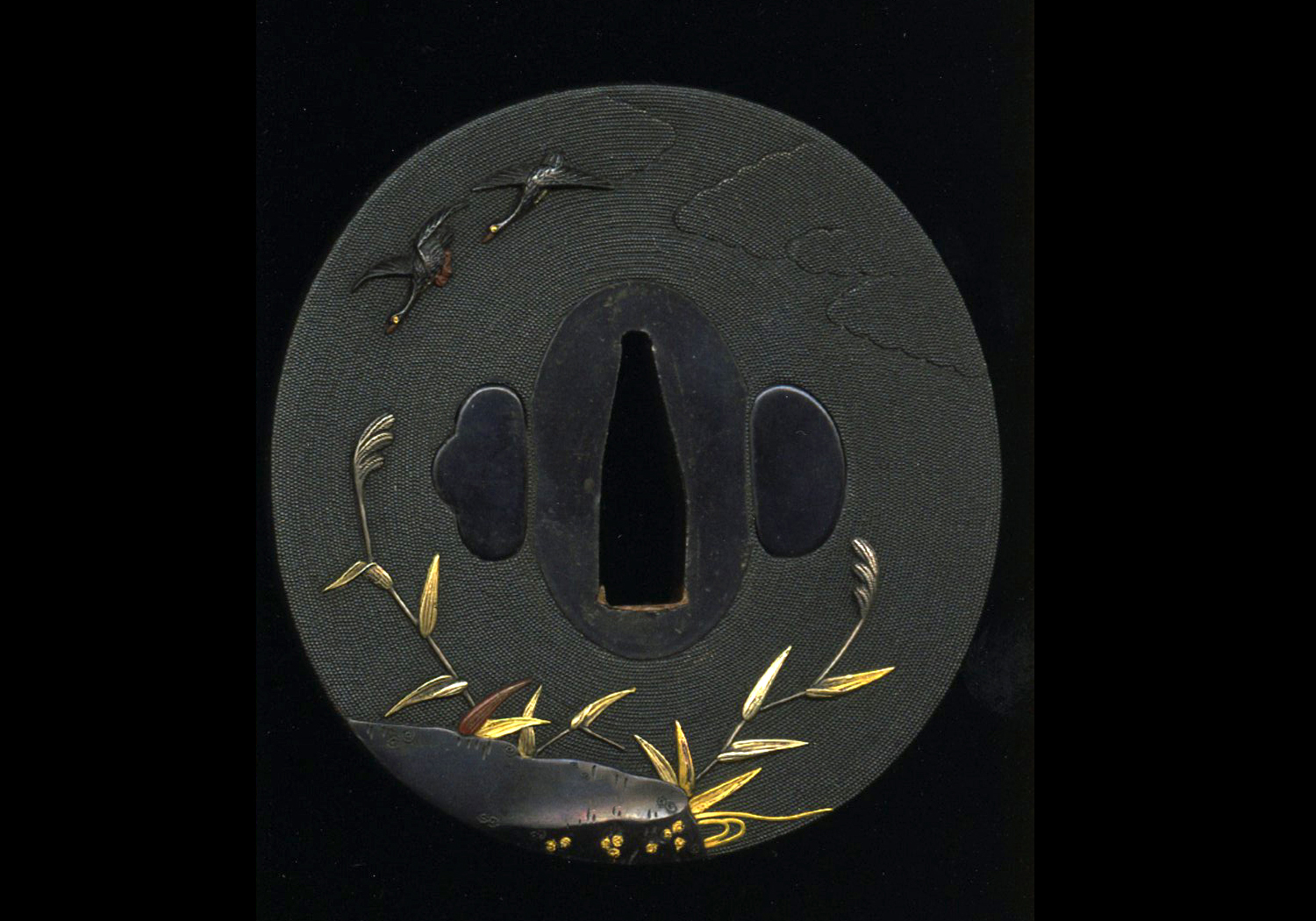
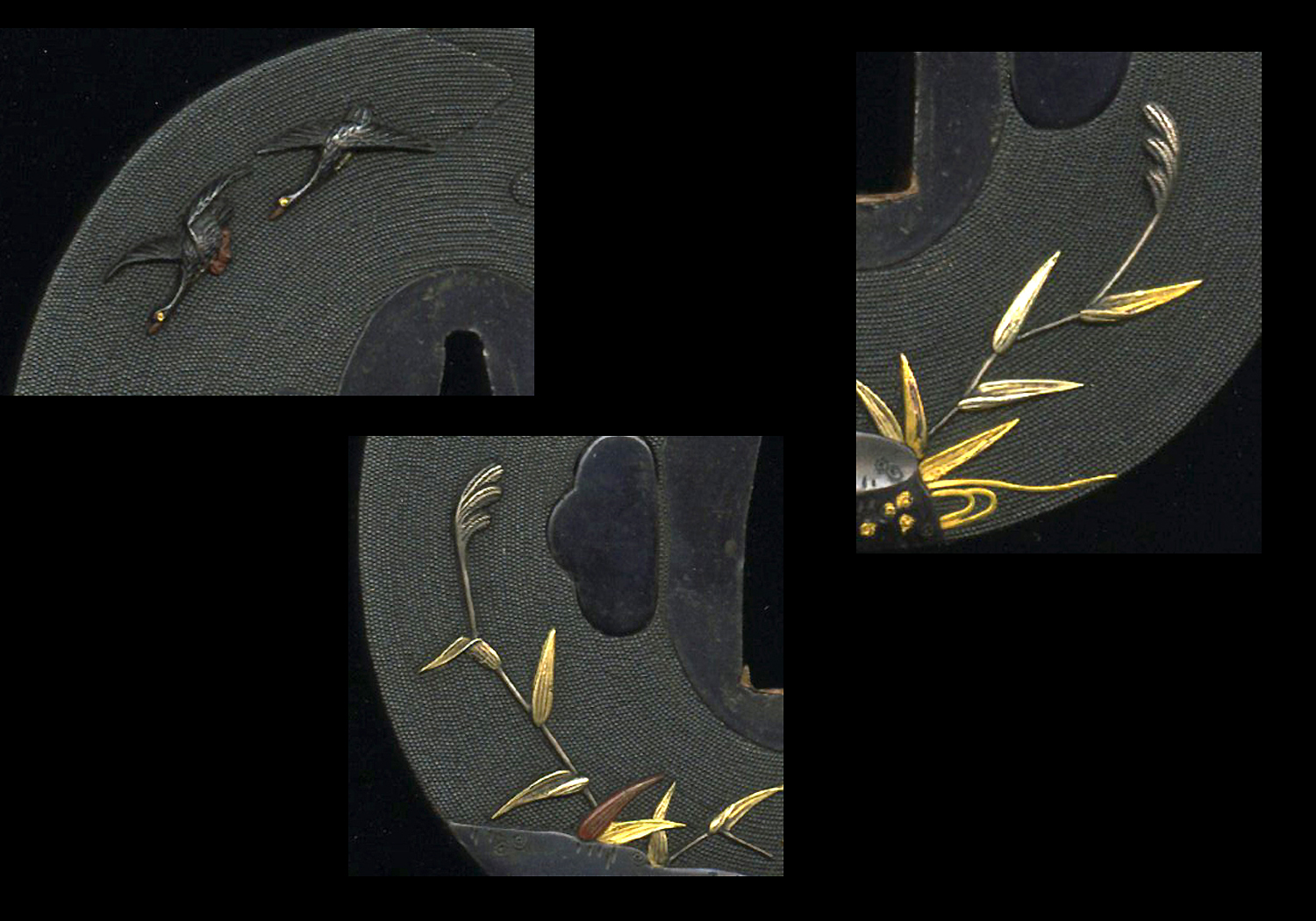
Hotei is walking among shakudô and gold rocks in the river and next to him are some water plants done in gold and silver. The river itself is depicted by delicate strands of gold. The top of the obverse of the tsuba is an exquisite tree made of copper covered with golden blossoms that look like chrysanthemums. The lower reverse has shakudô rocks with golden highlights and beautiful water plants done in copper, silver, and gold. The upper part of the reverse side has delicate clouds done in nanako together with two flying geese done in shakudô with copper feet and golden eyes. This is a real work of art. The tsuba’s condition is perfect.
This tsuba comes in a custom made box with a cloth outer cover. It also comes with NBTHK Tokubetsu Hozon papers attesting to its quality, condition, and authenticity. The translation of the NBTHK papers is as follows:
KANTEI-SHO (鑑定書) ‒ APPRAISAL
Hotei toka no zu tsuba (布袋渡河図鐔) ‒ Tsuba depicting Hotei crossing a river
Mei: Shōseisai Tomihisa + kaō (松盛斎 富久「花押」)
Tatemaru-gata, shakudō, Nanako ground, sukidashi-takabori relief, suemon-zōgan inlay,
iroe accents, kaku-mimi ko-niku
According to the result of the Shinsa committee of our society, we judge this work as authentic
and rank it as Tokubetsu-Hozon Tōsōgu.
December 7, 2017
[Foundation] Nihon Bijutsu Tōken Hozon Kyōkai, NBTHK (⽇本美術⼑劍保存協會)
PRICE: $12,000.00
[1] Much of the above history was blatantly stolen (with the author’s permission) from a wonderful article in Markus Sesko’s blog. I confess to making some severe editing changes.