

The Bizen Province, since ancient times, produced many fine swordsmiths who worked throughout all the periods of sword history from Heian down through the Shinshintô periods and, indeed, even today. Various reasons are given for this and the answer probably rests with the fact that Bizen has been a source of good sand iron, a source of making good charcoal (Bizen even today produces some of the best charcoal in Japan), and a ready supply of good water. All the basic ingredients of sword making. It was in this area where the conditions were almost perfect that during the Heian Era the Ko-Bizen school started.
The origins of the Ko-Bizen school, which is the oldest among the Bizen schools, start in the middle Heian period and continued into approximately the middle of the Kamakura period. One theory has Sanenari (實成), who was reported to have been active around the Tenryaku Era (947-957) as the founder of the Ko-Bizen school. However, since there are no surviving examples of his work most people to think of his son, Tomonari (友成), and Sukenari (介成) as the founders of the school. Both of these smiths worked in the Eien Era (987-989).
There is another theory that says that the Ko-Bizen school was founded by the Ôshû Môkusa kaji (奥州網草梶). These were the sword makers working and arming the Emperor’s army during two famous uprisings in the middle eleventh century. In the Ôshû region of Northern Honshû, these were two famous wars. The first was the Zenkunen no Eki (1056-1064) and the second was the Gosannen no Eki (1086-1089) These wars and disturbances continued from the latter part of the Fujiwara (藤原) Era for a number of years. There are records that the reigning Emperors sent swordsmiths to the Tohoku region (Ôshû) to make swords, and these swords were battle tested during the wars, it would be better to say that the methods for manufacturing weaponry vigorously advanced and developed because of this.[1]
While it was undoubtedly true that these wars advanced sword technology to say that they were the founders of the Ko-Bizen school does not make much sense since the acknowledged founders, Tomonari and Sukenari were living and working about one hundred years before these incidents. Further, the swordsmiths that were sent to this area to work and arm the troops were probably already practicing Ko-Bizen smiths.
Working contemporarily with Tomonari and Sukenari was one of the most famous of all Ko-Bizen smiths, Masatsune. Masatsune worked around the Chotoku Era (995-999) and left us many extant examples of his works. Other close contemporaries of Masatsune were the three famous smith Ko-Bizen smiths, Kanehira (包平), Sukehira (助平), and Takahira (高平). Kanehira (包平) is well known for his famous National Treasure sword the O-Kanehira, perhaps one of the most famous swords in Japan. These three Heian period smiths are collectively known as the “Three Hira from Bizen” (Bizen-Sanpira, 備前三平).
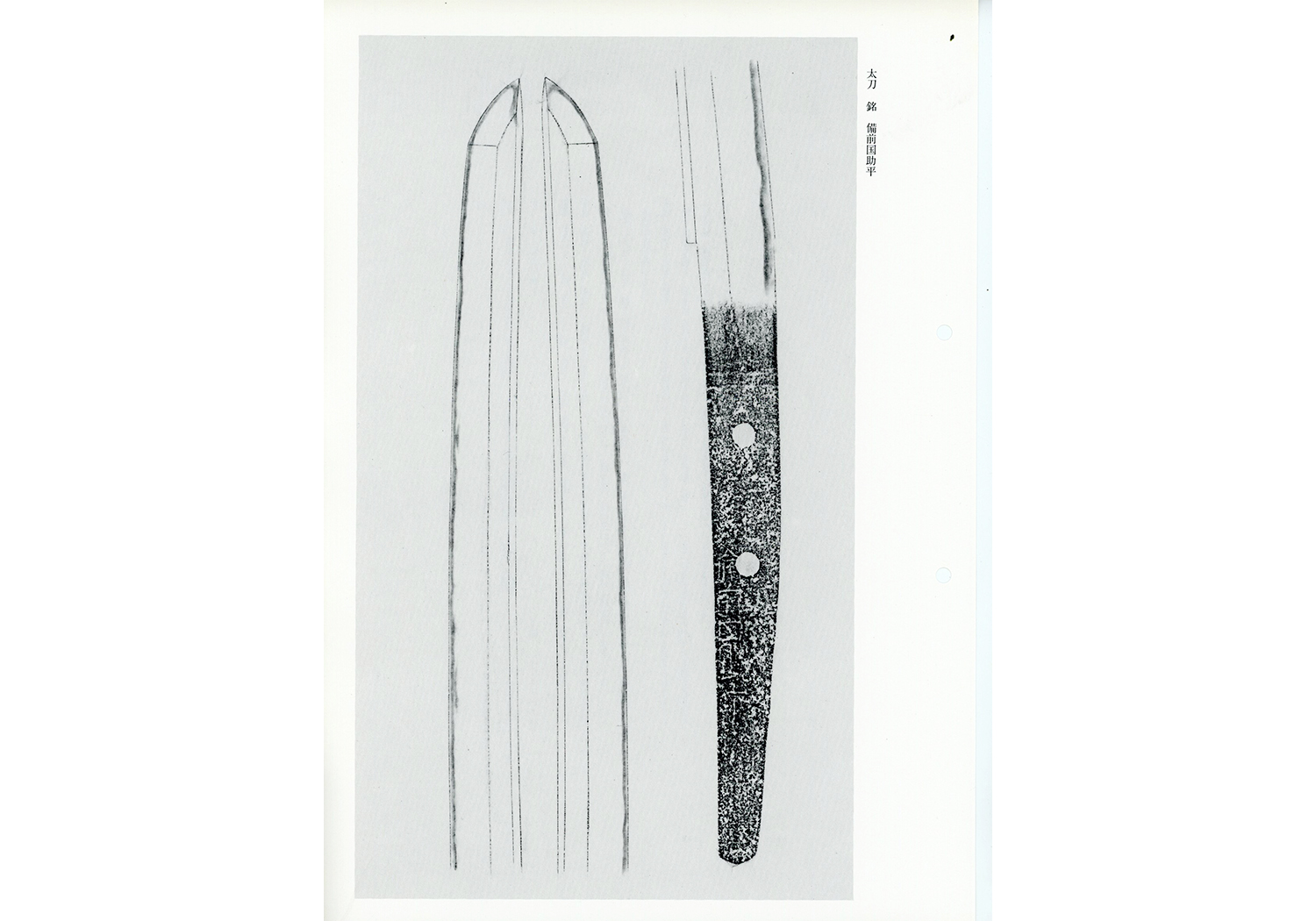
As noted above, Sukehira is a smith belonging to the Ko-Bizen school of the Heian period. He worked around the year 1000 AD. He is well-known as one of the “Bizen Sanpira” together with Kanehira and Takahira. No extant work of Takahira with signature has been confirmed as yet and there are a good number of extant signed works of Kanehira remaining. As for Sukehira, it is very rare to see a signed example of a work by Sukehira. Kanehira normally signs his signature with two characters (包平), but there are two extant works of Kanehira signed with six characters, i.e., Bizen (no) Kuni Kanehira Saku (備前国包平作). Meanwhile, Sukehira always signs his signature in five characters, Bizen (no) Kuni Sukehira (備前国助平). Only five extant signed works of Sukehira have been confirmed. One belongs to the Imperial Collections and another one is owned by the Tôkyô National Museum. The three other signed examples are in private collections. There is also a tachi that belongs to the Nikko Toshogu Shrine, but the blade was burned and no longer has a hamon. There is also an oshigata with an orikaeshi-mei, but only the oshigata exists, the blade has not been found. The signatures of these swords are done in the same manner and the chiseling style looks elegant and tasteful.

The Sukehira presented in the NBTHK Tôken Bijutsu No. 573
The above blade is in shinogi-zukuri with iori-mune and has narrow mihaba, deep koshi-zori but little sori from the monouchi, funbari and elegant tachi-sugata with ko-kissaki. The jihada is itame-hada combined with mokume and nagare-hada in company with thick ji-nie and a lot of fine chikei that slightly stands out and midare utsuri appears. The hamon is narrow ko-midare mixed with ko-chôji, ko-gunome, and ko-notare on the basis of sugu-ha in thick ko-nie deki accompanied with thick nioi-guchi then ko-ashi, fine sunagashi, kinsuji, hotsure, uchinoke, and double and triple-layered yubashiri. The boshi is sugu with niju-ba becoming yaki-tsume. The nakago is ubu (kijimomo-gata) and has kuri-jiri, katte-sagari yasuri at a gentle angle and one mekugi-ana.[2]
The basic characteristics of the swords of Sukehira (助平) and Kanehira (包平) are as follows:
SUGATA: Ko-Bizen swords of the Heian Era will have a pronounced koshi-zori. A few that have not been overly shortened will have strong funbari. The sori will bend down toward the tip giving the appearance of the upper third of the blade straightening out a bit. There will be a rather compact kissaki. Blades by Masatsune and Kanehira will tend to have a wider mihaba in many instances with not much tapering between the hamachi and kissaki. Blades by Sukehira will tend to be somewhat narrower and have a graceful sugata.
JITETSU: One can expect to find a well-forged and very fine ko-mokume often mixed with ko-itame. There will be chikei as well as jifu-utsuri. The jihada of Sukehira is itame-hada combined with mokume and nagare-hada in company with thick ji-nie and a lot of fine chikei that slightly stands out and slight midare utsuri sometimes appears in varying degrees.
HAMON Kanehira made two distinct types of hamon. The first was made narrow and formed in nie-deki with a pattern of ko-chôji midare with ko-midare mixed together with much nie not unlike the hamon of Tomonari. Deep ashi, inazuma, and kinsuji are present. He also worked in nioi with nie clustered around the nioi.
Works by Sukehira will find a hamon with some of the following traits. Narrow ko-midare mixed with ko-chôji, ko-gunome, and ko-notare on the basis of sugu-ha in thick ko-nie deki accompanied with thick nioi-guchi. Ko-ashi, fine sunagashi, kinsuji, hotsure, uchinoke, and double and triple-layered yubashiri can be found.
BÔSHI: The bôshi will generally be midare-komi with a shallow kaeri and lots of nie. Occasionally they will be yakizume also with an abundance of nie present.
NAKAGO: A good many of the extant Ko-Bizen blades have been shortened resulting in the original nakago either partially or completely lost. Ubu nakago will have sori and be made long with a tapering toward the tip. They are Kijimomo in some cases. When file marks (yasurimei) remain, they will be kiri or katte-sagari.
MEI: Most commonly we find a niji mei (two-character signature) cut high around the mekugi ana. When compared to the signatures on Shintô and Shinshintô blades the signatures on Ko-Bizen blades have a sloppy appearance. This points to the low literacy of the sword smiths of that period. On occasion the word “saku” will be added. As noted above both Kanehira and Sukehira have surviving blades with their signatures intact. In the case of Kanehira there are a couple of signed examples with nagamei or six characters. As for Sukehira all of his five existing signed blades are signed with naga-mei of five characters. Unfortunately, most Ko-Bizen blades are suriage and ubu signed blades are rare.
Subject Blade
The subject blade is an ubu signed Heian period tachi by Sukehira. It is Jûyô Tôken and one of the only five known signed blades by this smith. Of the five, one is in the Imperial Collections, one is in the Tôkyô National Museum, and the remaining three, including this one, are in private collections. This blade was awarded Jûyô Tôken status in 1987 in the 33rd Jûyô shinsa. The translation of the Jûyô papers are as follows:
Jūyō-Tōken at the 33rd Jūyō Shinsa held on March 25, 1987
Tachi, mei: Bizen no Kuni Sukehira (備前国助平)
Measurements:
Nagasa 66.7 cm, sori 2.2 cm, motohaba 2.5 cm, sakihaba 1.5 cm, kissaki-nagasa 2.2 cm, nakago-nagasa 20.1 cm, nakago-sori 0.2 cm
Description:
Keijō: shinogi-zukuri, iori-mune, slender mihaba, koshizori, ko-kissaki
Kitae: densely forged ko-itame that is mixed with ko-mokume and that features chikei and plenty of fine ji-nie
Hamon: hoso-suguha-chō in nie-deki that is mixed with gunome, ko-notare, ko-midare, uchinoke, and fine sunagashi and kinsuji
Bōshi: on the omote side a maru-kaeri with hakikake and on the ura side a ko-maru-kaeri
Nakago: slightly suriage, kurijiri, sujikai-yasurime, two mekugi-ana, the haki-omote side bears towards the nakago-mune a finely chiseled five-character signature
Explanation:
Sukehira (助平) is famous since early times as he, Takahira (高平), and Kanehira (包平), are known as the “Three Hira from Bizen” (Bizen-Sanpira, 備前三平). Unlike Kanehira, by whom fairly many works exist, only extremely few blades of Sukehira are extant, and it appears that no authentic works of Takahira have survived. Thus, we have here one of the few signed tachi by Sukehira in existence. It is interpreted in a narrow suguha-chō with ko-midare that is of an unobtrusive elegance, and with the nie-laden jiba, the blade reflects the typical characteristics of Ko-Bizen works.
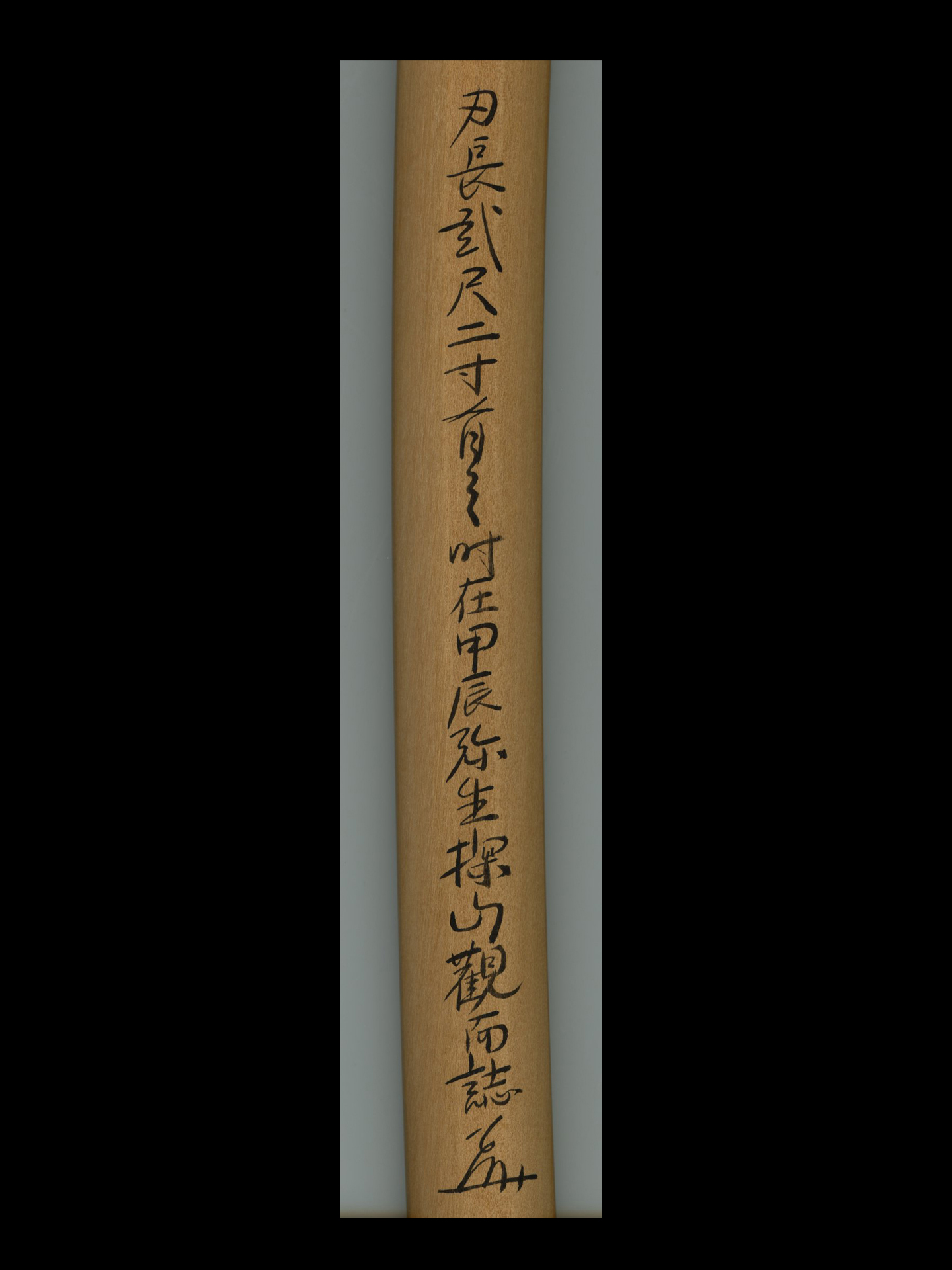
This blade comes in a new shirasaya with a sayagaki by Tanobe Sensei, formally in charge of the research department at the NBTHK in Tôkyô. Tanobe sensei is, without a doubt, the foremost authority on Japanese swords alive today. He writes:
第三十三回重要刀剣指定
備前國助平
生茎僅カニ区ヲ送リ棟目立ッテ丸ク五字銘有之細身・小鋒デ腰反高ク踏張ツキ華奢ナ形態ヲ呈シ地銕ハ小板目良ク錬レル精美ナ肌合ヲ見セ濡色デ地沸ツキ地景入リ温潤ナリテ刃文ハ細直刃小乱ニ小互乃目交ジリ小沸付キ小模様ノ砂流・金筋・打ノケカゝリ帽子ハ丸ク掃掛ケルナド古雅ノ趣ヲ湛ヘ滋味豊カナ優品也同工ハ古備前三平ト称サレ包平・高平ト並ビ現存作稀有之
刃長弐尺二寸有之時在甲辰弥生探山観而誌「花押」
Jūyō-Tōken at 33rd Jūyō Shinsa
Sukehira from Bizen Province
This blade has an ubu-nakago, is slightly machi-okuri, has a prominently round mune, and is signed with five characters. With its slender mihaba, ko-kissaki, deep koshizori, and funbari, it is of a graceful shape. The jigane is an excellent and beautifully forged ko-itame that features ji-nie and chikei and that is overall of a “moist” appearance. The hamon is a hoso-suguha in ko-nie-deki that is mixed with ko-midare, ko-gunome, and with smallish sunagashi, kinsuji, and uchinoke, and the bōshi displays a maru-kaeri and hakikake. Thus, we have here a masterwork that is full of delicate nuances and of a classical elegance. Together with Kanehira and Takahira, Sukehira is counted as one of the “Three Hira from Bizen” (Bizen-Sanpira), but only few (signed) works of his exist.
Blade length ~ 66.7 cm (26 1/4 in.); examined and written by Tanzan [Tanobe Michihiro] in March in the year of the dragon (2024) + monogram.
I feel that it should be pointed out that there are a couple of very minor chips in the hamon from old sword cuts that the polisher decided to wisely leave in rather than try to take them out and hurting the overall shape of the blade. This is just part of the blades long history of battle. They do not detract from the beauty and importance of this sword.
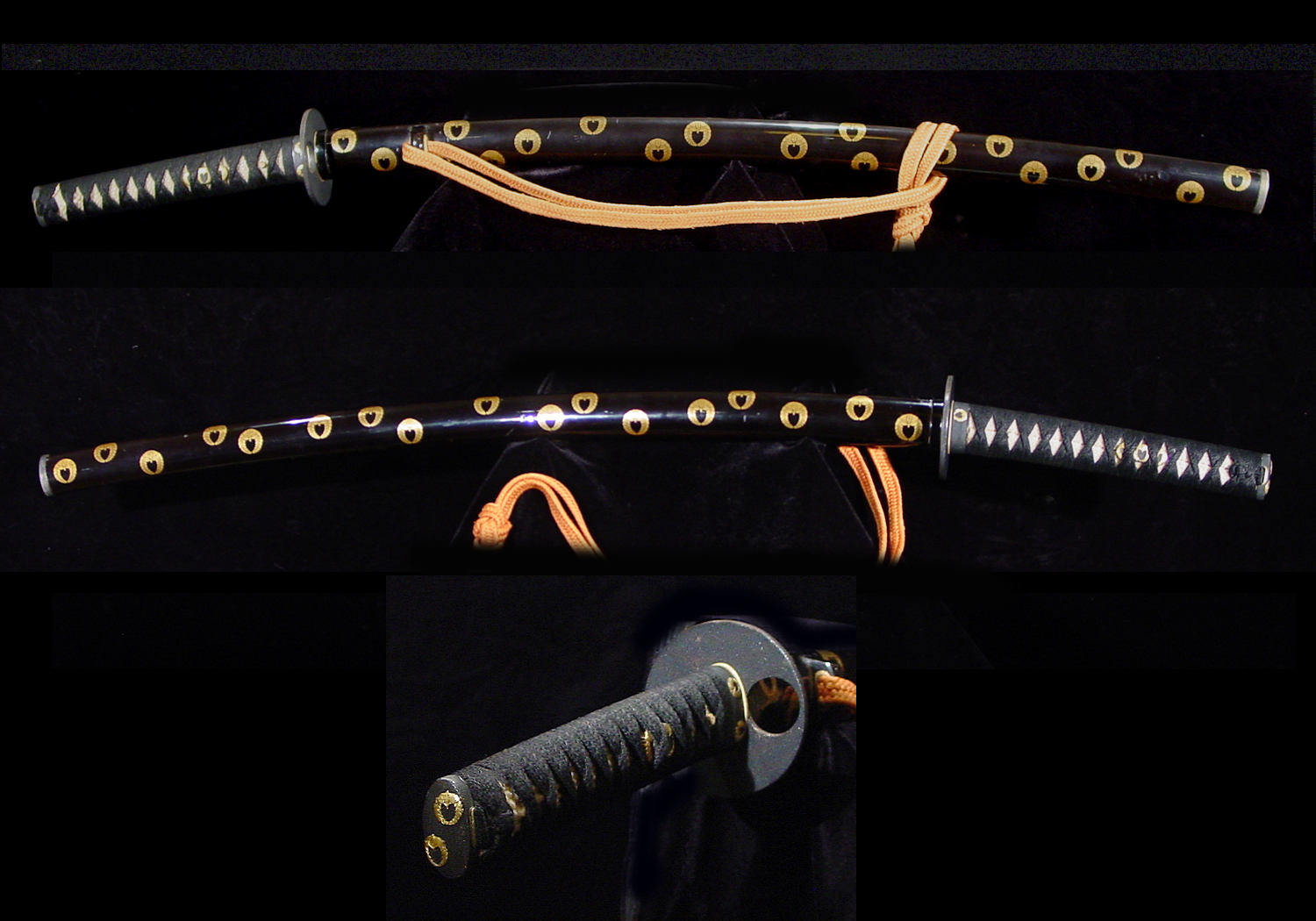
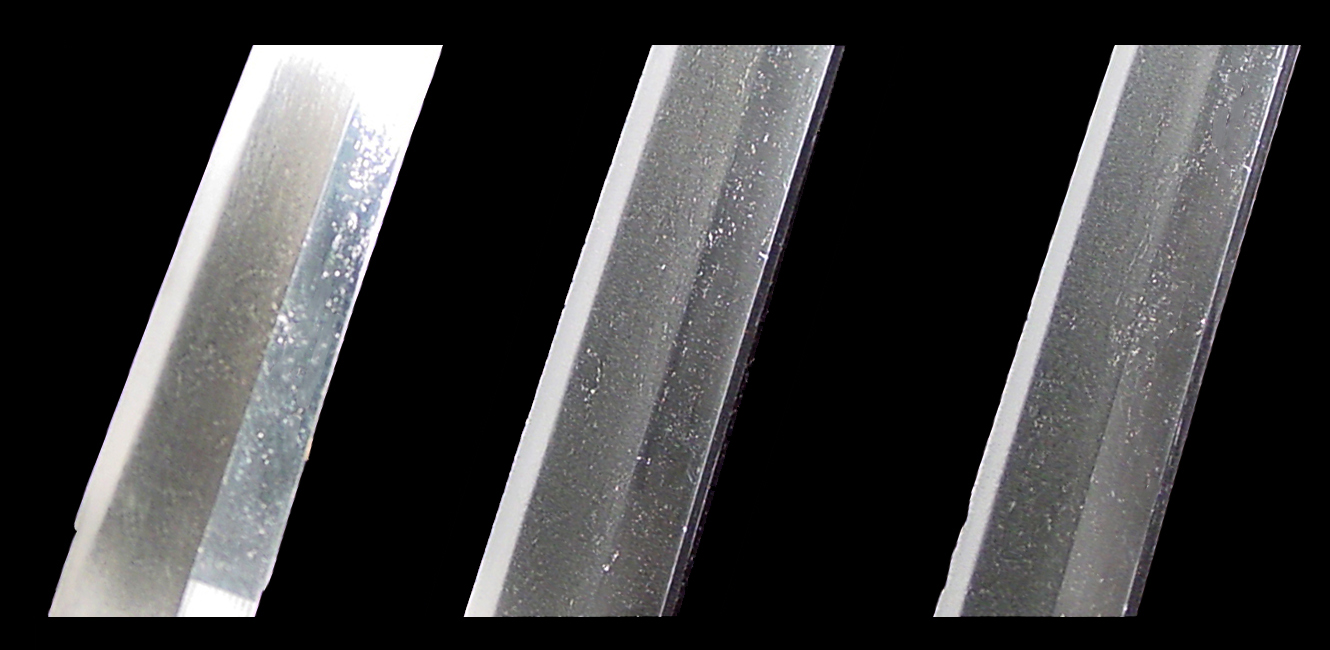
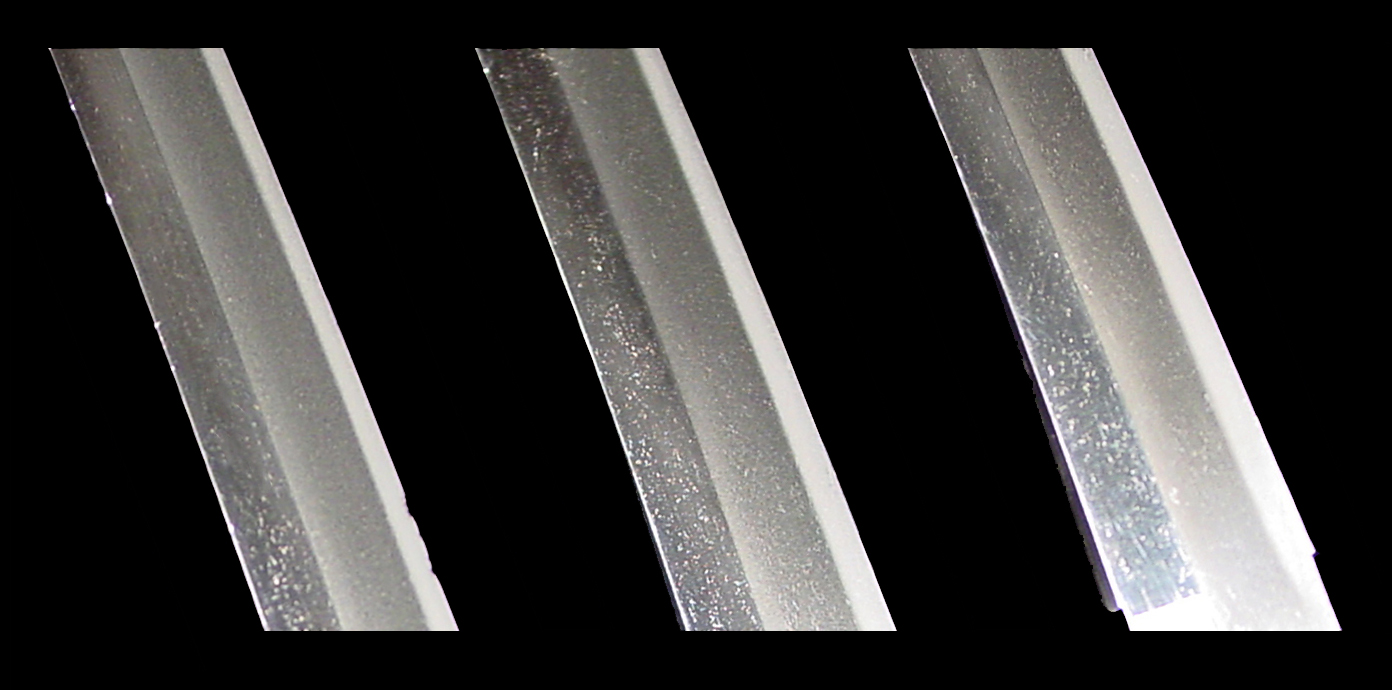
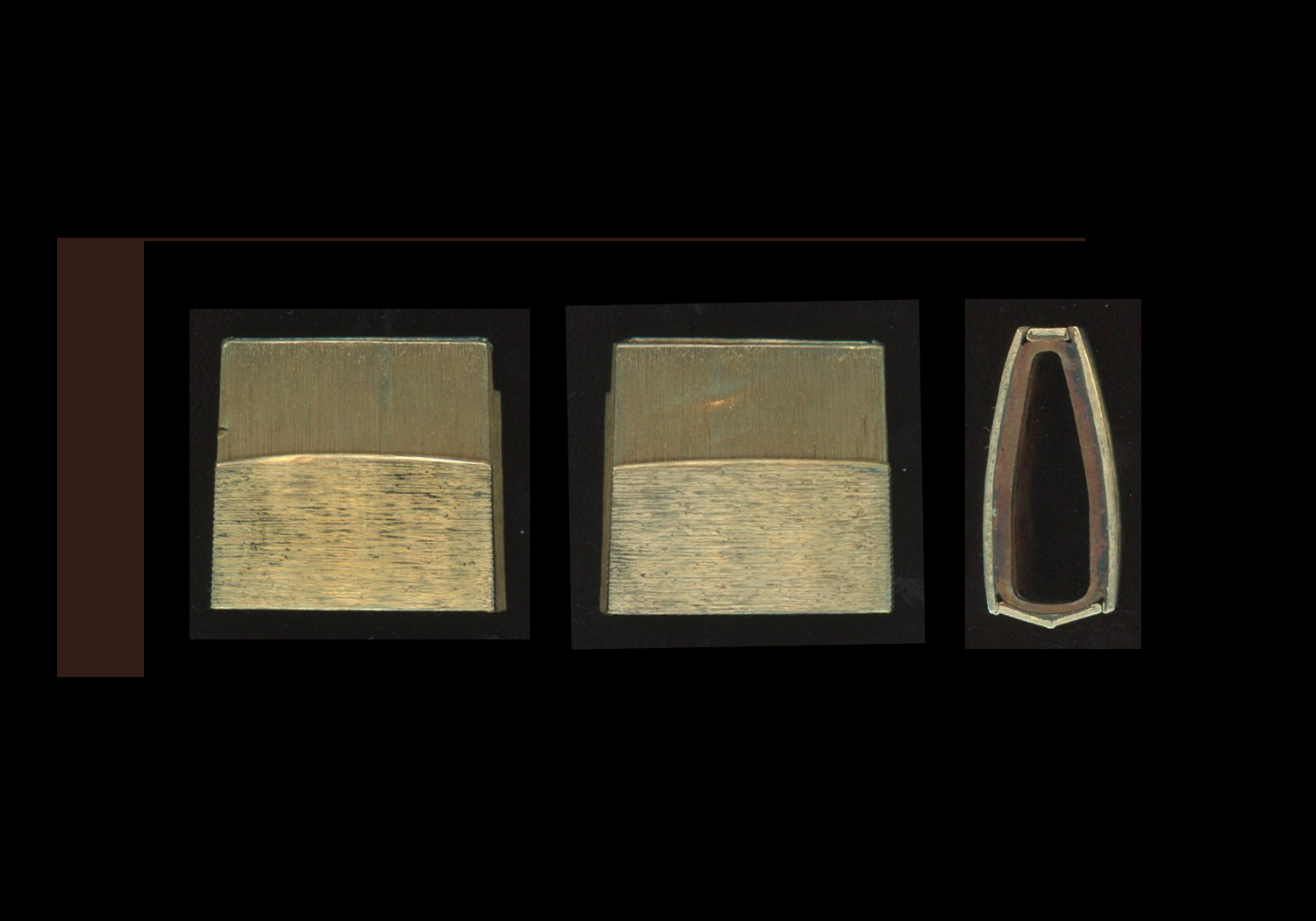
This blade comes with a lovely koshirae with extensive family crests (mon) of the family of its last Samurai owner in the 19th century. The saya is lacquered black and covered with the family mon done in gold lacquer. All of the kodogu comprising this koshirae are made of shakudo nanako. The tsuba is round with two large round openings. Both sides of the tsuba and the mimi (rim) are also shakudo nanako and the balance of the metal fittings are shakudo with heavy gold matching family mon. This blade obviously belonged to a high ranking Samurai of this clan.
[1] Nihon Tô Koza page 134 (slightly paraphrased-FW).
[2] NBTHK Tôken Bijutsu No. 573
SOLD







KOSHIRAE