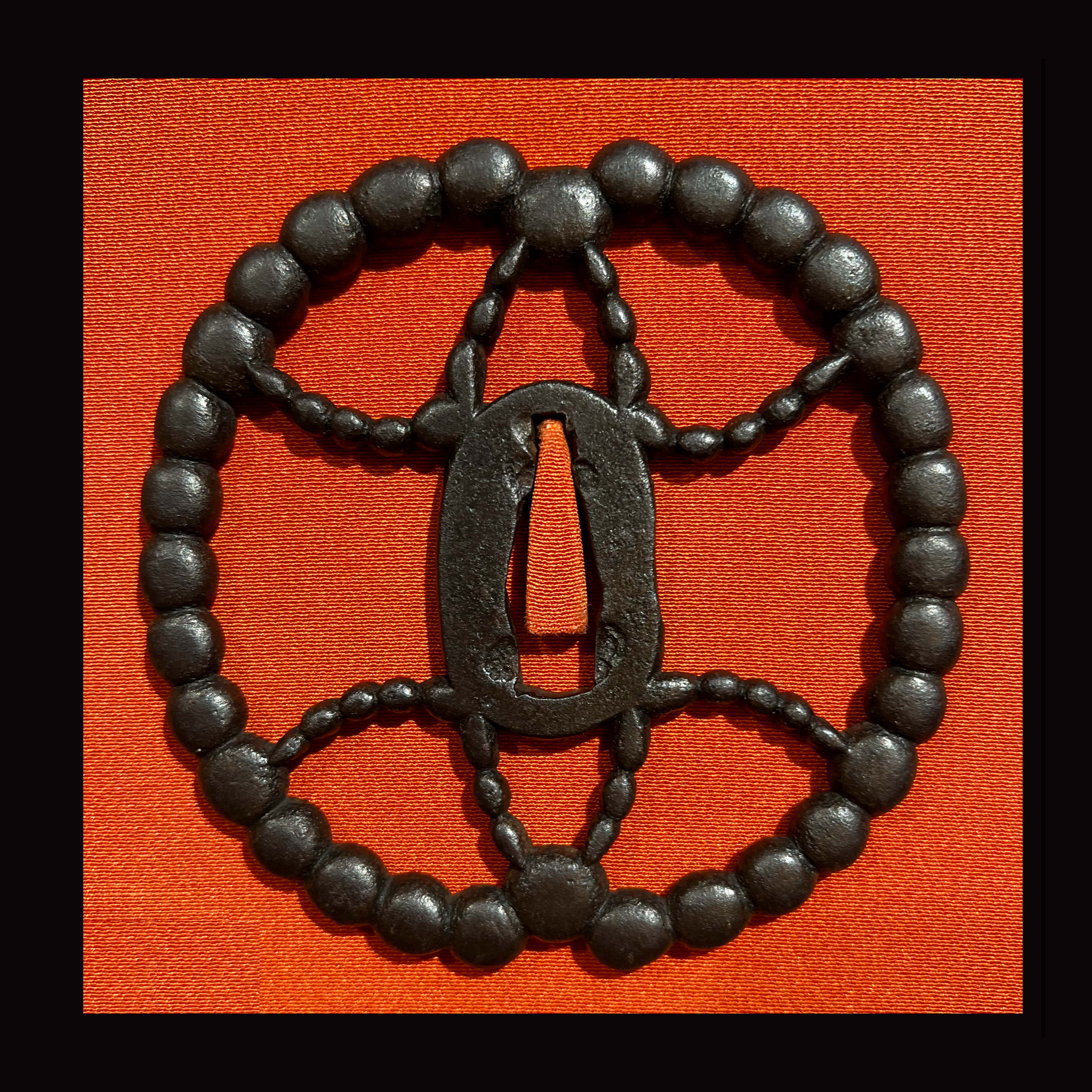
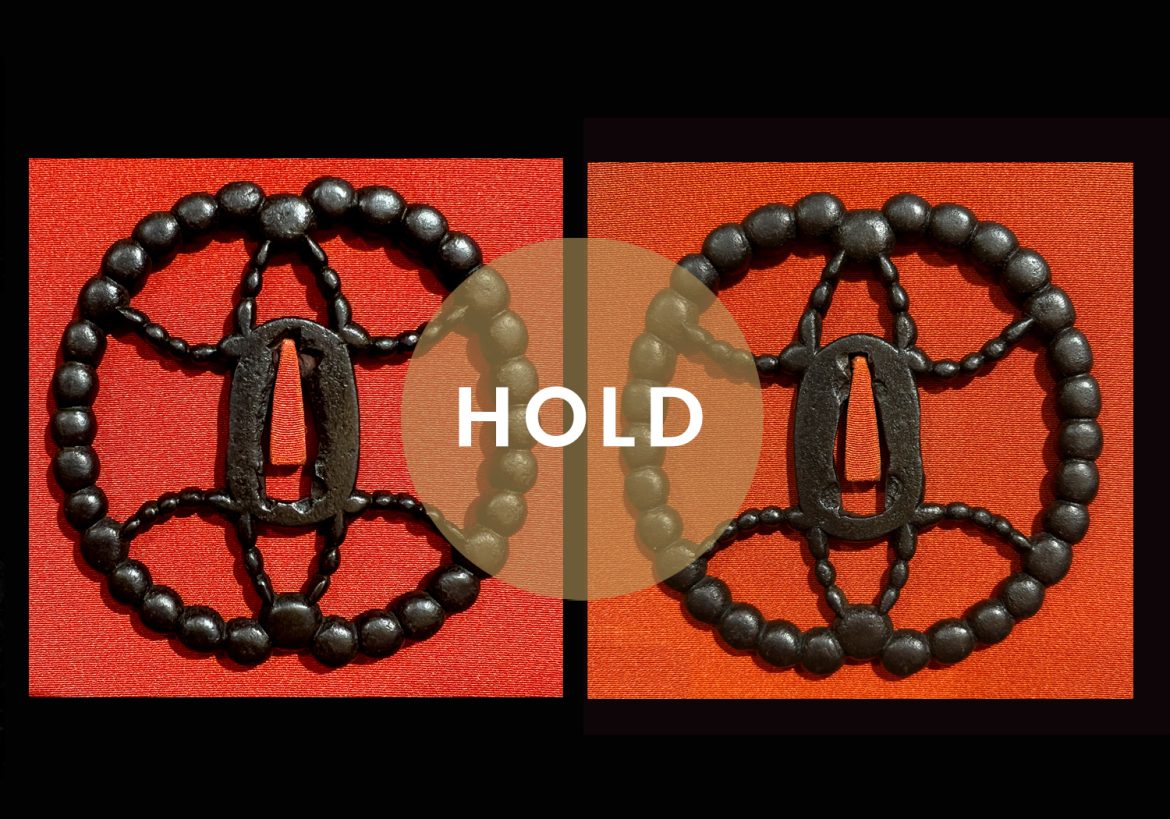
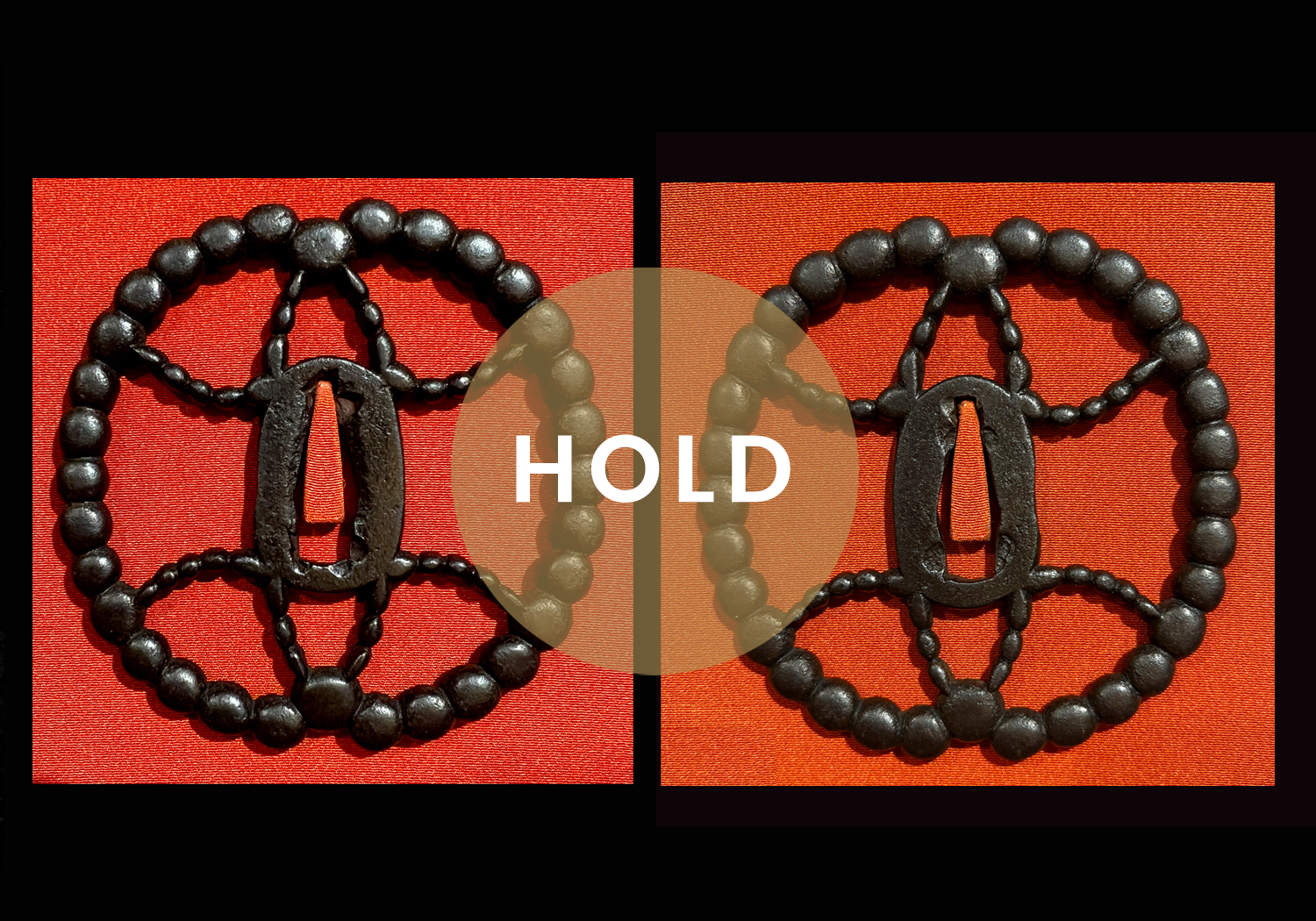
This is a large tsuba of excellently forged iron, which mimics, through three-dimensional openwork (nikubori ji-sukashi), a Buddhist rosary (juzu, 数珠). The rosary consists of individually carved beads (omodama, 主珠), whose different sizes create subtle variety. At the top and bottom, we see one large bead (oyadama, 親珠) each, which are connected to the seppa-dai through extensions that feature smaller beads (deshidama, 弟子珠). The iron of this Haguro-tsuba is powerful, but differs in appearance from the also powerful iron of Nobuie or Owari-tsuba.
Usually, iron tsuba were and are named after their (assumed) places of production, for example Owari. The term Haguro-tsuba in use today, however, is rooted in the assumption that such tsuba were made by mountain priests (Yamabushi) from Haguro, who followed the syncretic Shūgendō religion, although details about those makers are unclear.
The massif formed by the three mountains Gassan (月山), Yudono (湯殿), and Haguro (羽黒), which is located in the center of Yamagata Prefecture (former Dewa province), is referred to as Dewa-Sanzan (出羽三山), lit. the “Three Dewa Mountains.” Like Mt. Ōmine (大峯山) in Yamato, the Three Kumano Mountains (Kumano-Sanzan, 熊野三山) in Kii, and Mt. Hiko (英彦山) in Buzen, the Three Dewa Mountains are regarded as sacred and were a center of the Shūgendō belief. During medieval times, it attracted a large number of Shūgendō practitioners and Sōhei warrior monks, and the center was then supported by the family of the Tokugawa Shōgun throughout the Edo period. Accordingly, the local belief, which was initiated by the Haguro Shūgendō practitioners, also gained many followers in the more or less adjacent regions of Ōshū, Kantō, Shin’etsu, Kai, and Mikawa.
Shūgendō practitioners underwent a rigorous physical training in the mountains, and so people believed that they had supernatural powers. In the Uji Shūi Monogatari (宇治拾遺物語), for example, a collection of stories that is dated to the early Kamakura period, we read of an episode in which a Shūgendō practitioner was able to retrieve a boat from the other side of the lake by mere prayers. Thus, people asked Shūgendō practitioners to perform incantations and prayers, for which they used mantras referred to as kuji (九字), and recited a long Dhāranī prayer. Often, the Shūgendō practitioners rubbed together the beads of their Irataka-nenju (いらたか念珠) rosaries, which generated a unique sound. It is said that this sound alone has the power to ward off calamities and evil. For many people at that time, such rituals were science and also therapy. It is possible, that Haguro juzu-tsuba, like the work introduced here, were once associated with the incantations and prayers of Shūgendō practitioners.[1]
[1] This description is taken from the NBTHK Journal from March of 2022 wherein this tsuba was presented in a special article.
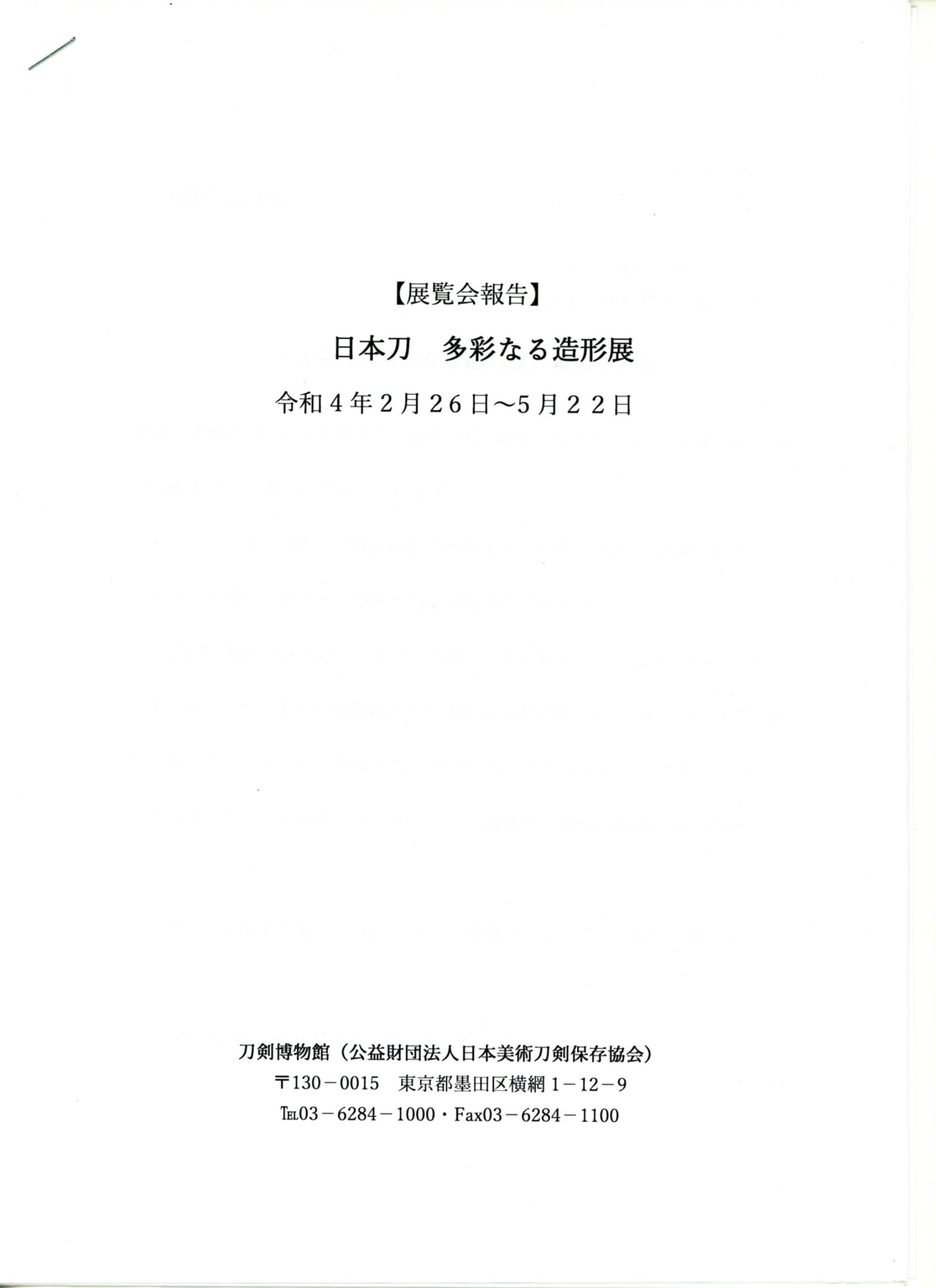
This tsuba was also on view during April and May of 2022 in the exhibition: Nihontō – Tazai Naru Zōkei.
While this motif of a Buddhist rosary (juzu, 数珠) tsuba is not, in itself, exceedingly rare, what makes this tsuba special is the quality of the work and the fact that it is only one of five or six tsuba from this school that have ever been awarded the coveted status of Jûyô Kodôgu. It is also safe to say that this is one of the top one or two tsuba ever reaching this status and certainly one of, if not the, largest ones. Also, it should be noted that I have been informed that there will be no further tsuba from this school awarded Jûyô status in the future.
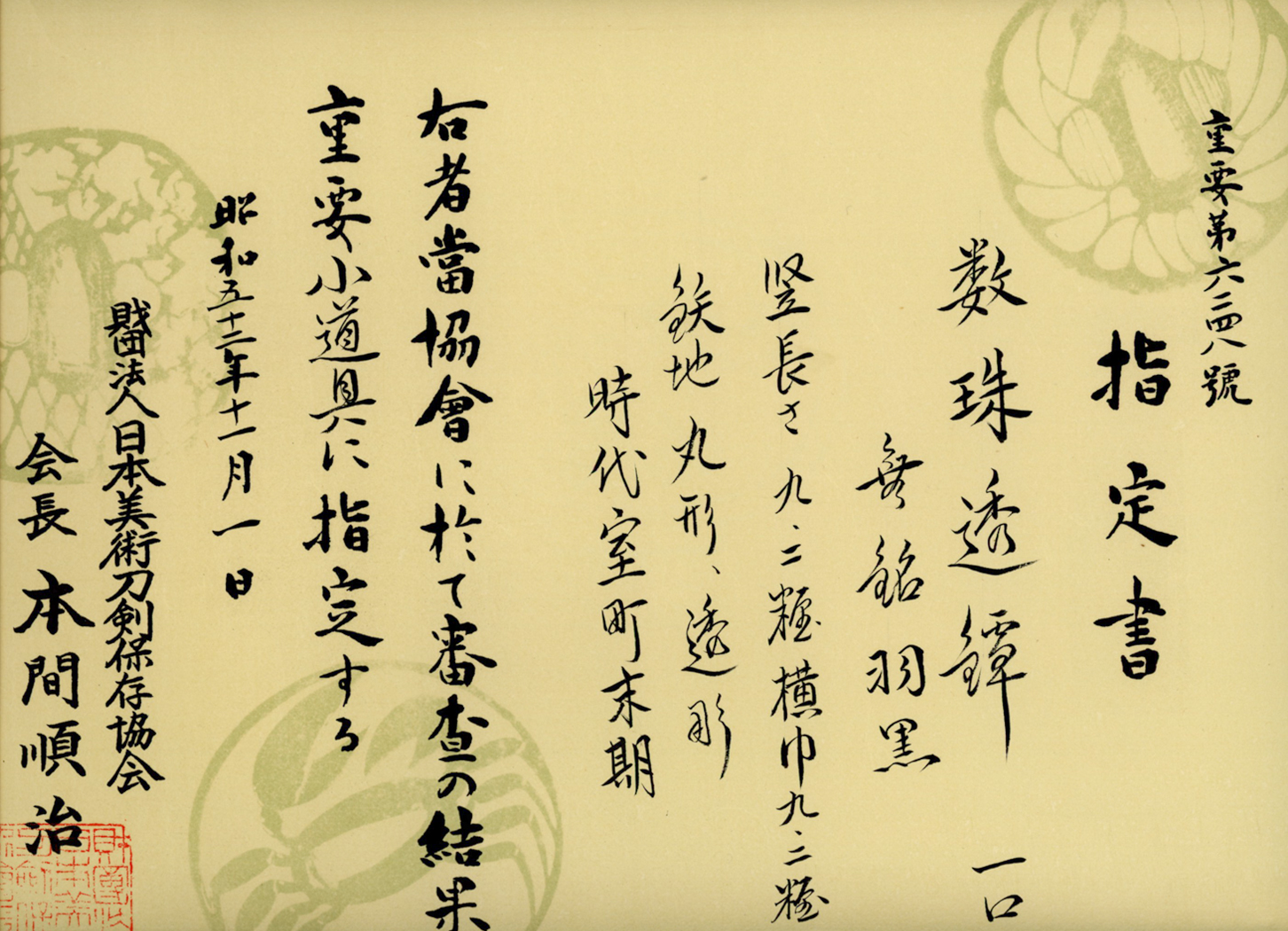
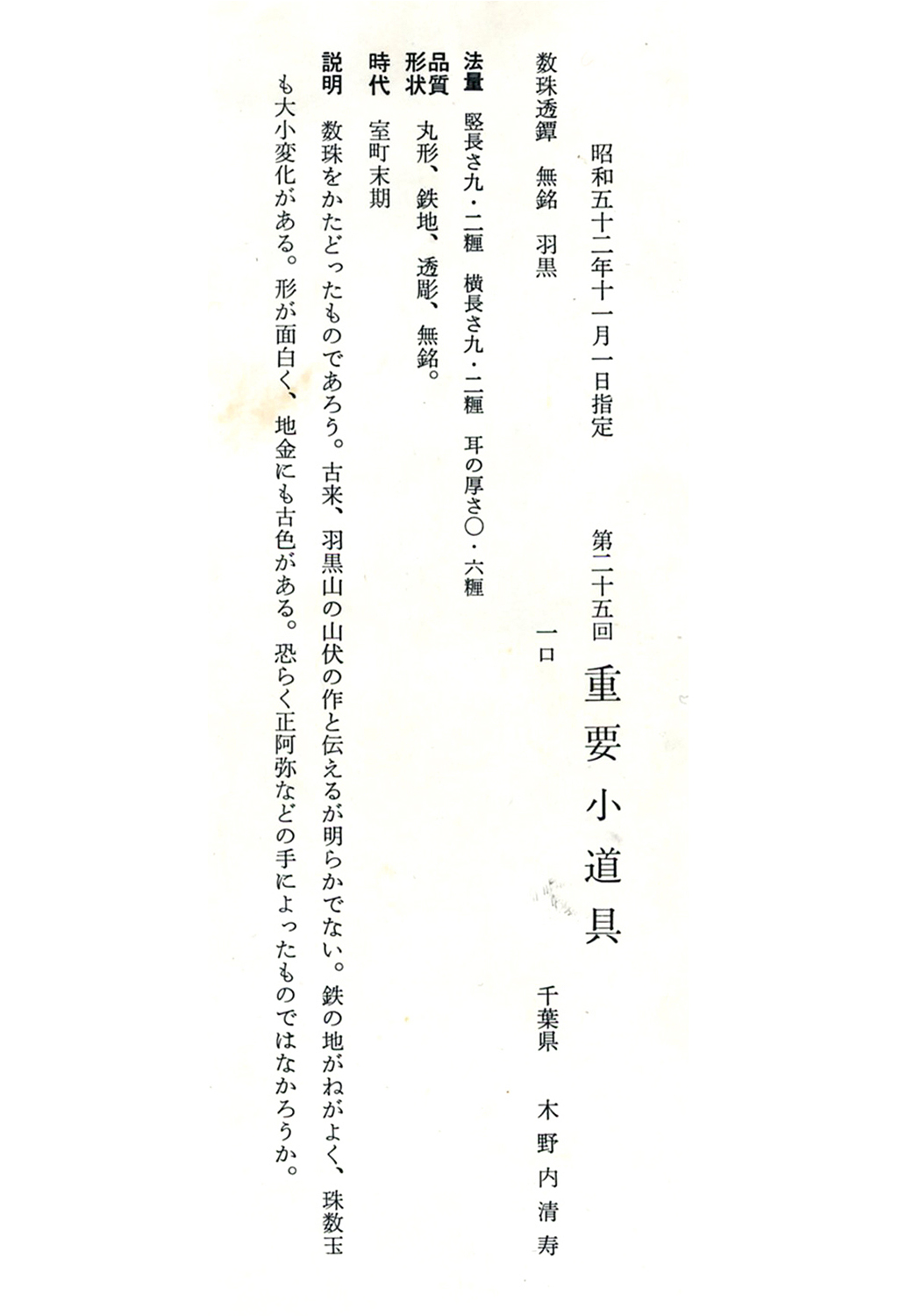
As noted, this tsuba was awarded Jûyô Kodôgu status at the 25th Jûyô Shinsa held in November of 1977. The translation of the setsumei for this tsuba is as follows:
Jūyō-Kodōgu at the 25th Jūyō Shinsa held on November 1, 1977
Juzu-sukashi tsuba (数珠透鐔) – Tsuba with openwork design of Buddhist rosary
Mumei: Haguro (羽黒)
Measurements:
Height 9.2 cm, width 9.2 cm, thickness at rim 0.6 cm
Description:
Hinshitsu-keijō: marugata, iron, sukashibori openwork, mumei
Jidai: End of Muromachi period
Explanation:
This tsuba appears to be modelled after a Buddhist rosary. Tradition has it that such tsuba were made by mountain priests (Yamabushi), but details about that are unclear. This tsuba is made of an excellentjigane and the beads of the rosary vary in size. The shape of the tsuba is appealing, and the jigane has an early patina. Possibly, tsuba like this were actually made by Shōami (正阿弥) or other artists of that time period.
This is an outstanding tsuba and one like it will probably not likely be for sale in the foreseeable future.
HOLD