

Nihonto.com is pleased to present this fantastic daisho set of swords made by two of the most important Shintô smiths, Shodai Yasutsugu (first generation) and Shodai Kunisada (first generation). Both of these smiths are rated as JoJo saku by Fujishiro. This means top, top class smiths. There is only one rank above this designation.
SHODAI YASUTSUGU
The story of the Yasutsugu (康継) lineage starts with the first generation, Ichizaemon (市左衛門), who is believed to have been born around the middle of the sixteenth century. His place of birth was in Shimosaka (下坂) of Shiga-gun in the province of Omi. Omi is next to Mino and contains Lake Biwa. Yasutsugu (康継) was born into a sword making family headed by his father, Hironaga (廣長), reputed to be the last descendent of Yamato no Kuni Senjuin (大和国千手院). Though his father was from Omi, he was trained in the Mino (美濃) tradition.
Yasutsugu’s (康継) early training was in the Senjuin style of Yamato (大和) as well as the Mino (美濃) tradition. His first signature was Echizen Ju Shimosaka (越前住下坂). Later he started experimenting with the Sôshû (相州) tradition and he became adept in all three traditions. During the Bunroku era (1592-1596) he received the title of Higo Daijô (肥後大掾) About this time or around the beginning of the Keicho era (1596) he moved to Echizen Province and settled in Fukui.
Throughout Japanese history, many swordsmiths flourished when they came under the patronage and protection of the local feudal lords. Yasutsugu (康継) was one such swordsmith. Whether by chance or intent, he became noticed and supported by Matsudaira Hideyasu (松平秀廉), who was the third son of Tokugawa Ieyasu (徳川家康). Hideyasu (秀廉) was the Daimyo of Echizen province and as such was in a position to be of great help to Yasutsugu (康継). As has often been the case throughout history who one knows is often as important, or more important, that what one knows. There were several contemporary swordsmiths of greater skill than Yasutsugu (康継) (i.e. Umetada (埋忠), Hankei (繁慶),Kunihiro (国広)), but because of the patronage of Matsudaira Hideyasu (松平秀廉), Yasutsugu (康継) became known to Tokugawa Ieyasu (徳川家康) and Tokugawa Hidetada (徳川秀忠), the first two Tokugawa Shoguns.
By the fifth year of Keicho (1600) Yasutsugu (康継) was well established in Echizen (越前). His patronage by Hideyasu (秀廉) secured his livelihood and allowed him the freedom to produce swords in a variety of styles. About this time, using the Echizen (no) Kuni Shimosaka (越前下坂) signature and the Higo Daijo Fujiwara Shimosaka Echizen (no) Ju (肥後大掾藤原越前住) signature, he began to produce utsushi-mono (reproductions) of famous Soshu-den (相州伝) works of Masamune (正宗) and Sadamune (貞宗) as well as Awataguchi Yoshimitsu (粟田口吉光) and others.
One may ask why would Yasutsugu (康継) make reproductions (a nice word for forgeries) of these famous smiths. The answer is that he was probably asked (ordered?) to by his sponsors, Hideyasu, Ieyasu, and Hidetada. We must remember that throughout Japanese history and up until today, gift giving is an integral part of the Japanese culture. In those days, especially, a very appropriate gift or reward for service was a sword. The more famous the sword the better. For the Tokugawa family, swords made by Yoshimitsu (吉光) and his descendants were thought to be especially auspicious. Of course, there was a finite number of “real” ones around to be used as gifts. Therefore, it was necessary to “create” a few extra from time to time. The recipient was probably fully aware that the sword was not the “real thing”. It truly was the thought that counted especially since it was not uncommon for the same sword to be re-gifted back to the donor at some suitable future date.
Around the 11th or 12th year of this same period of Keicho (1606-1607), Yasutsugu’s (康継) fame reached the point that he was called to Edo (Tokyo) to share his forging skills with Tokugawa Ieyasu (徳川家康). About this time Yasutsugu (康継) was given the privilege of using the character “Yasu” (康) from Tokugawa Ieyasu’s (徳川家康) name. Thus, from that point on, he changed his name to Yasutsugu (康継). About the same time (some feel it was a few years later) he was given the additional privilege of carving the Hollyhock crest (Aoi mon) on his blades. These privileges were given in perpetuity to Yasutsugu and his descendants. Thus the Yasutsugu (康継) swordsmiths became the kaji of the Tokugawa Family.
The first generation Yasutsugu (康継) was also adept at the art of saiha, the re-tempering of blades that had lost their tempered edge in a fire. Since this was the end of the Sengoku Jidai (the age of the country at war) there were still battles being fought and many important blades were being damaged. This was especially true after the summer and winter campaigns at Osaka Castle in 1615. Many of the famed Meibutsu-cho owned by the Toyotomi family were damaged in the burning of the Osaka castle and were re-tempered by Yasutsugu (康継).
One also cannot but help to notice that many of the blades by the first generation Yasutsugu (康継) contain wonderful, skillfully done carvings (horimono) on the blades. While it is believed that Yasutsugu (康継) carved his own early blades, the most famous and beautiful of the carvings on his blades were done by the famous Kinai family of carvers. They were skilled in carving a variety of subjects on swords.
Yasutsugu (康継) worked in Echizen and Edo as was the custom with the Tokugawa family in those days. It was much like the practice of Sankin Kodai (alternate year attendance) that was required of the Daimyo of the country. He died in seventh year of Genna (1621) probably in his 70’s.
The typical forging characteristics of the first generation Yasutsugu are as follows:
SUGATA: Shodai Yasutsugu made katana, wakizashi, and tantô in many styles. His original works were most often made in typical Keicho-Shinto style with wide mihaba (width), extended nagasa (length), marked sori(curvature), and often with an extended bôshi (point). He was also famous for making blades in the style of the koto Sôshû school. Of his katana, shinoji-zukuri are the most common. Occasionally we find a blade in katakiriba-zukuri. The mune is usually iori-mune, but there is an occasional mitsu-mune blade. Wakizashi can be found in shinogi-zukuri, ukubi-zukuri, o-hira-zukuri, shobu-zukuri, and kata-kiriba zukuri. His tantô are most often hira-zukuri, but he did use other styles as in the wakizashi. Generally, his blades give the feeling of great strength as in the Nanbokucho period.
JIHADA: He is most famous for tight itame hada mixed with some mokume hada. There is always masame hada present in the shinogi-ji. The Yasutsugu school is famous for what has been called Echizen gane or hadadachi-gokoro. This hada consists of the tight itame/mokume mentioned above with the presence of shirake or whitish patches in the steel structure that are mixed with the real color of a darker hue.
HAMON: Yasutsugu made temper lines in various styles. His nioi-guchi tends to be somewhat rough and unclear with an abundance of nie in the habuchi. His blades show sunagashi, kinsuji, uchinoke, hakikake, and nijuba. There are frequent cases when the nie is very coarse which adds to the overall feeling of “disorderliness” for which he was famous. Of course, he also made tantô with hoso-suguba where the nie is extremely fine and the nioi line is as wide as possible.
HORIMONO: His swords contain the usual types such as ken, and bonji. Swords are also encountered with the engravings of plum branches and bamboo. It is generally thought that while he did some carvings by his own hand, most of the carvings on his blades were done by the famous Kinai family who were specialists in carving horimono.
BÔSHI: Generally, Yasutsugu’s bôshi has an undulating pattern (notare) with a somewhat pointed tip. The kaeri (turnback) is always long, extending below the yokote. This is an important kantei point. The pattern of the temper in the bôshi can vary from quiet to hakikake.
NAKAGO: The nakago is kaku-mune and the tip is slender. The jiri (butt) can be kengyo, iri yama gata, or kuri in shape. The yasurime (filings) are katte-sagari (slanting) and sujikai (oblique). The nakago is kaku-mune and the tip is slender.
MEI: The following are most common signatures used by Yasutsugu:
ECHIZEN (no) KUNI SHIMOSAKA 越前国下坂
HIGO DAIJO FUJIWARA SHIMOSAKA ECHIZEN JU 肥後大掾藤原越前住
HIGO DAIJO ECHIZEN YASUTSUGU 肥後大掾 越前康継
HIGO DAIJO FUJIWARA ECHIZEN YASUTSUGU 肥後大掾藤原越前康継
HIGO DAIJO ECHIZEN YASUTSUGU 肥後大掾越前康継
ECHIZEN (no) KUNI JU YASUTSUGU 越前国住康継
MOTTE NANBANTETSU OITE BUSHU EDO ECHIZEN YASUTSUGU 持南蛮鐡於武州江戸越前康継*
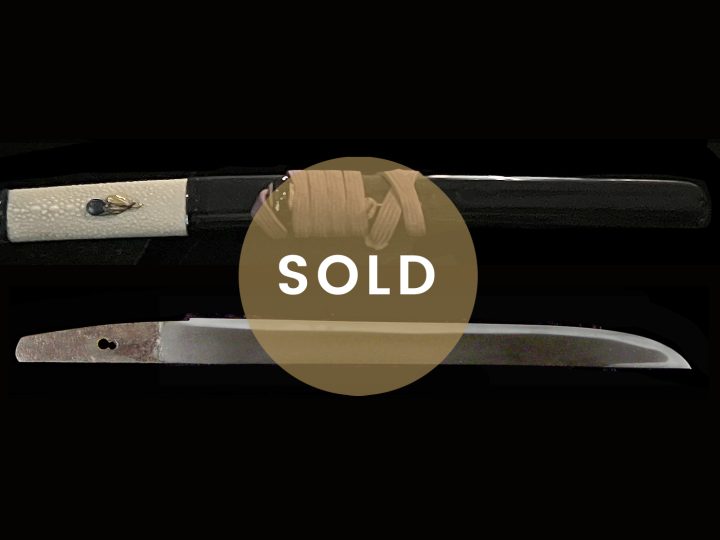
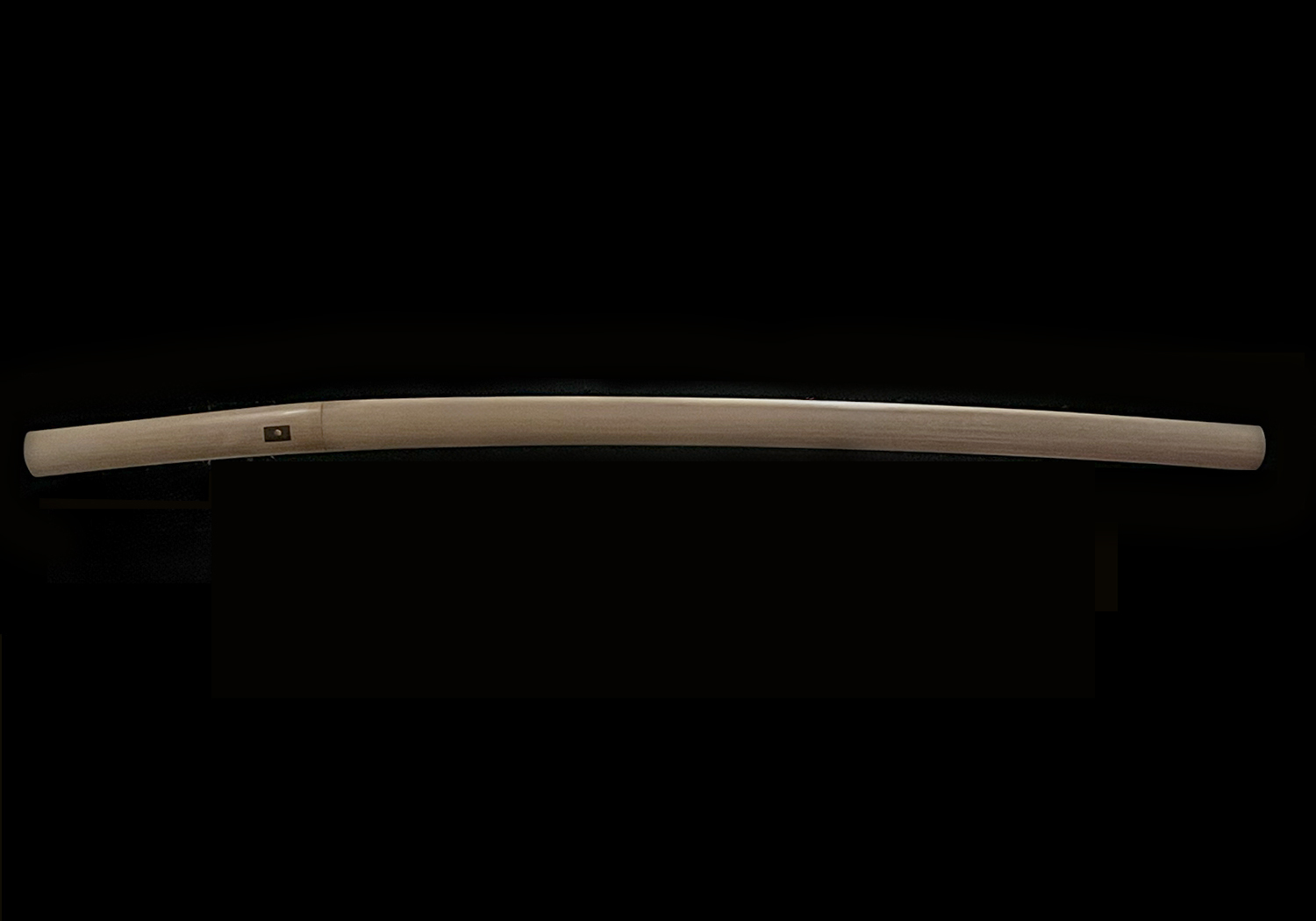
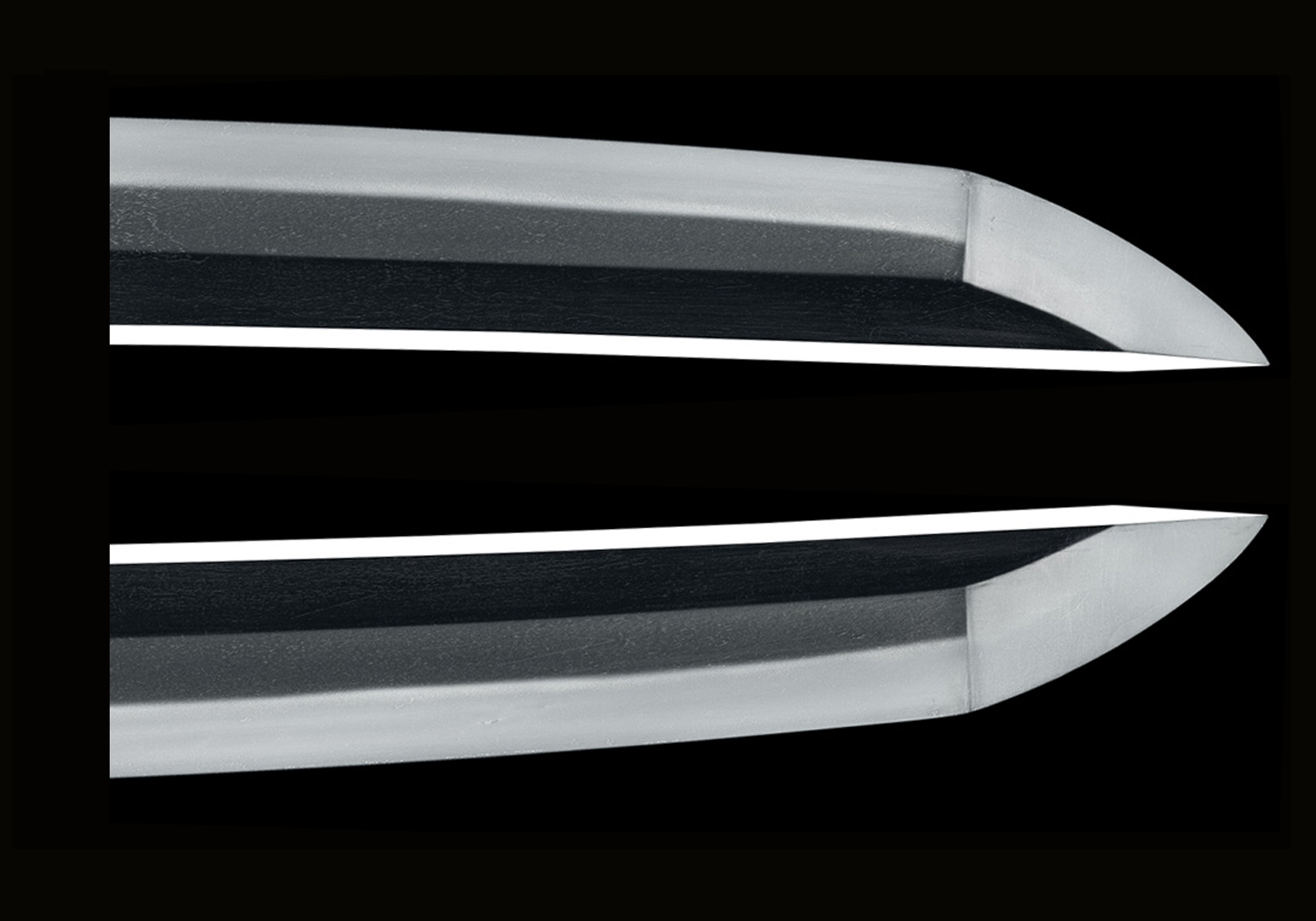
The katana of this beautiful daisho is a long katana by the first generation Yasutsugu. It is signed 以南蛮鉄駿州越前康継. This is read “Motte Nanbantestu Sunshû Echizen Yasutsugu”. This means made in Suruga (Sunshû) out of foreign steel by Yasutsugu of Echizen Province. This is where it gets very interesting. I wondered why it does not have the Hollyhock above Yasutsugu’s signature then I did some research and found out that “Sunshû” is short for the Province of Suruga which is where the first Tokugawa Shôgun, Tokugawa Ieyasu lived after he retired as Shôgun. This would indicate that this sword was made by Shodai Yasutsugu for Ieyasu or someone within Ieyasu’s close inner circle. It would have been rude to put the hollyhock leaf on a sword you were giving to Ieyasu or someone in his inner circle because that was part of Ieyasu’s personal mon and he was the person who allowed Yasutsugu and his descendants to use in on blades they made.
Ieyasu retired to Sunpu in Suruga in 1605 and he died in 1616. That means this Yasutsugu dates somewhere between 1605 and 1615. It was possibly made for Ieyasu for the Osaka castle campaign which took place from November 8, 1614 to May–June 1615.
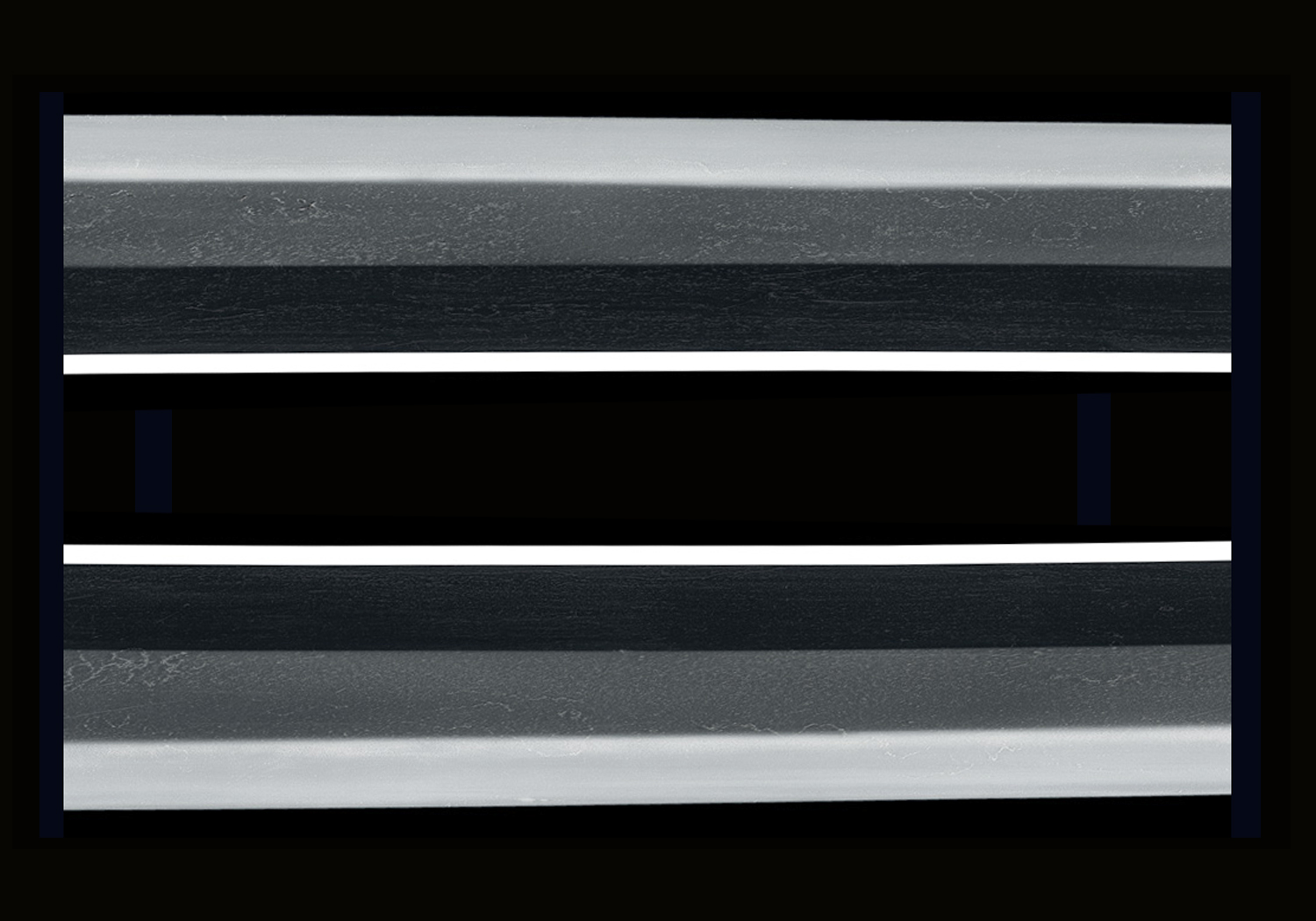
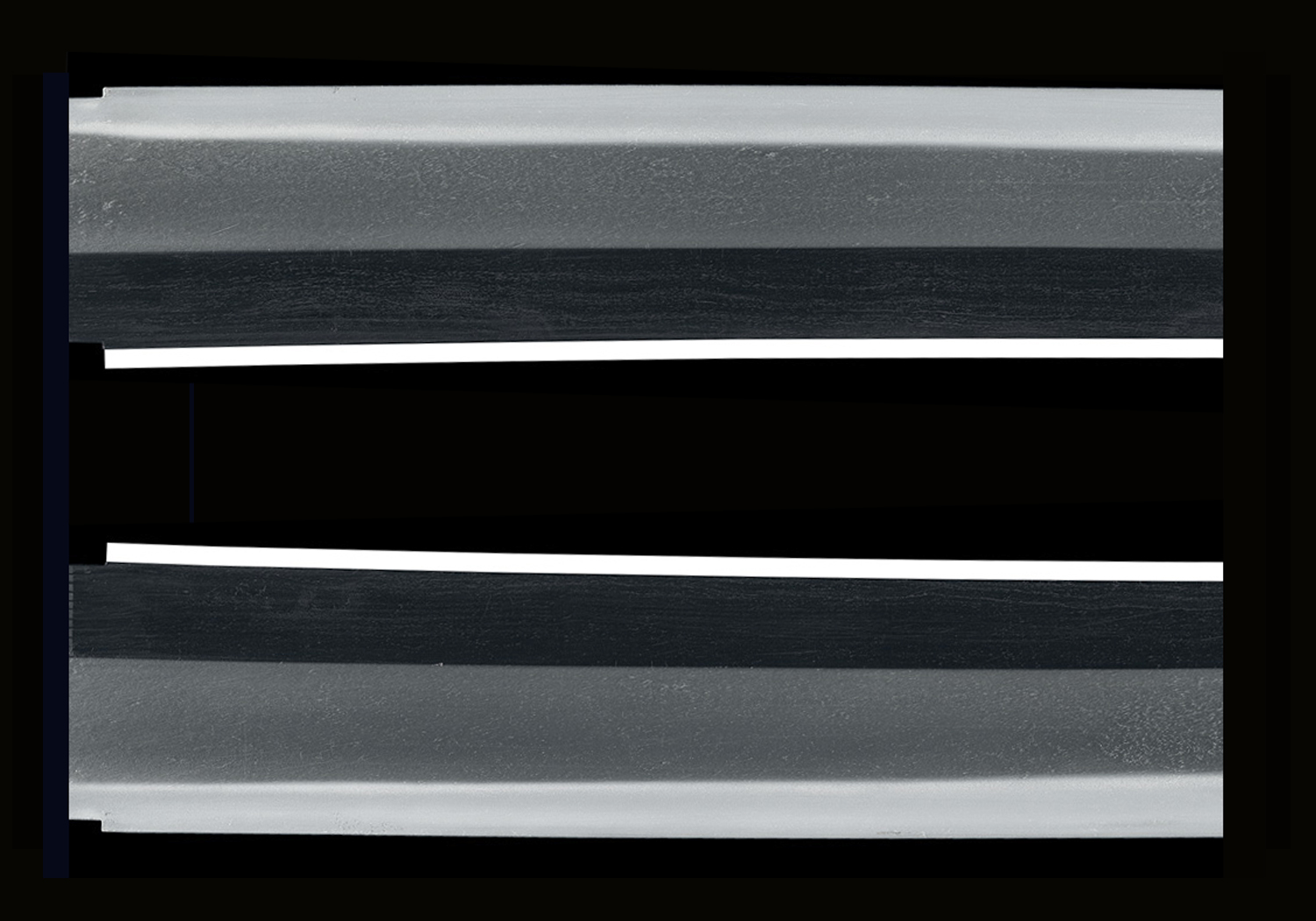
Even though this blade has been shortened by 3-4 inches, it’s cutting edge still measures 76.2 cm or 30 inches and it still bears the full signature at the bottom of the tang. The moto-haba (width at the base of the blade) is 3.07 cm or 1.21 inches and the saki-haba (width at the beginning kissaki) is 2.0 cm or 0.8 inches. The kasane (thickness of the blade) is 0.8 cm or 0.3 inches. The sori of this blade (curvature) is in the middle of the blade (torii sori) and it measures 1.05 cm or 0.4 inches.
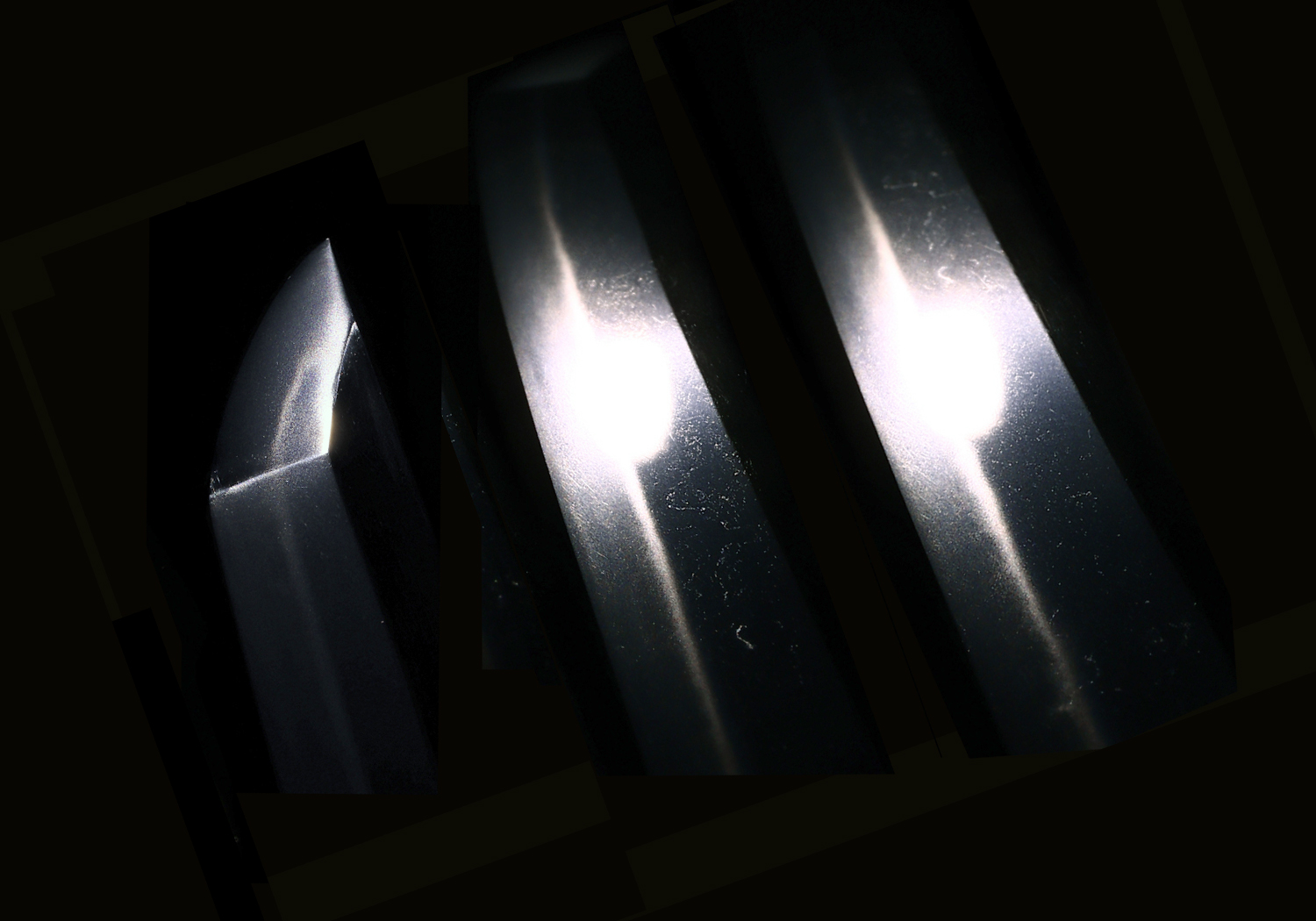
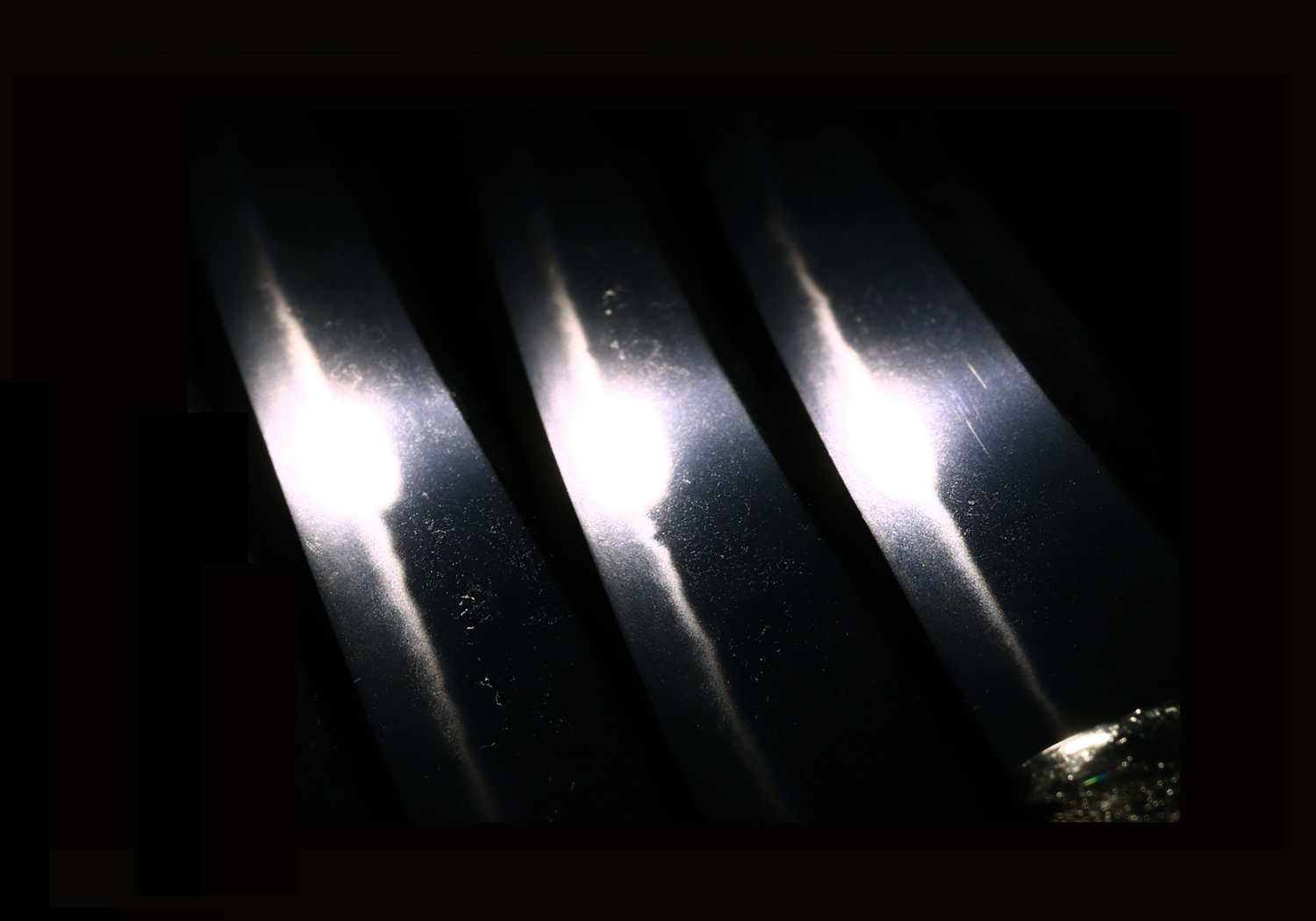
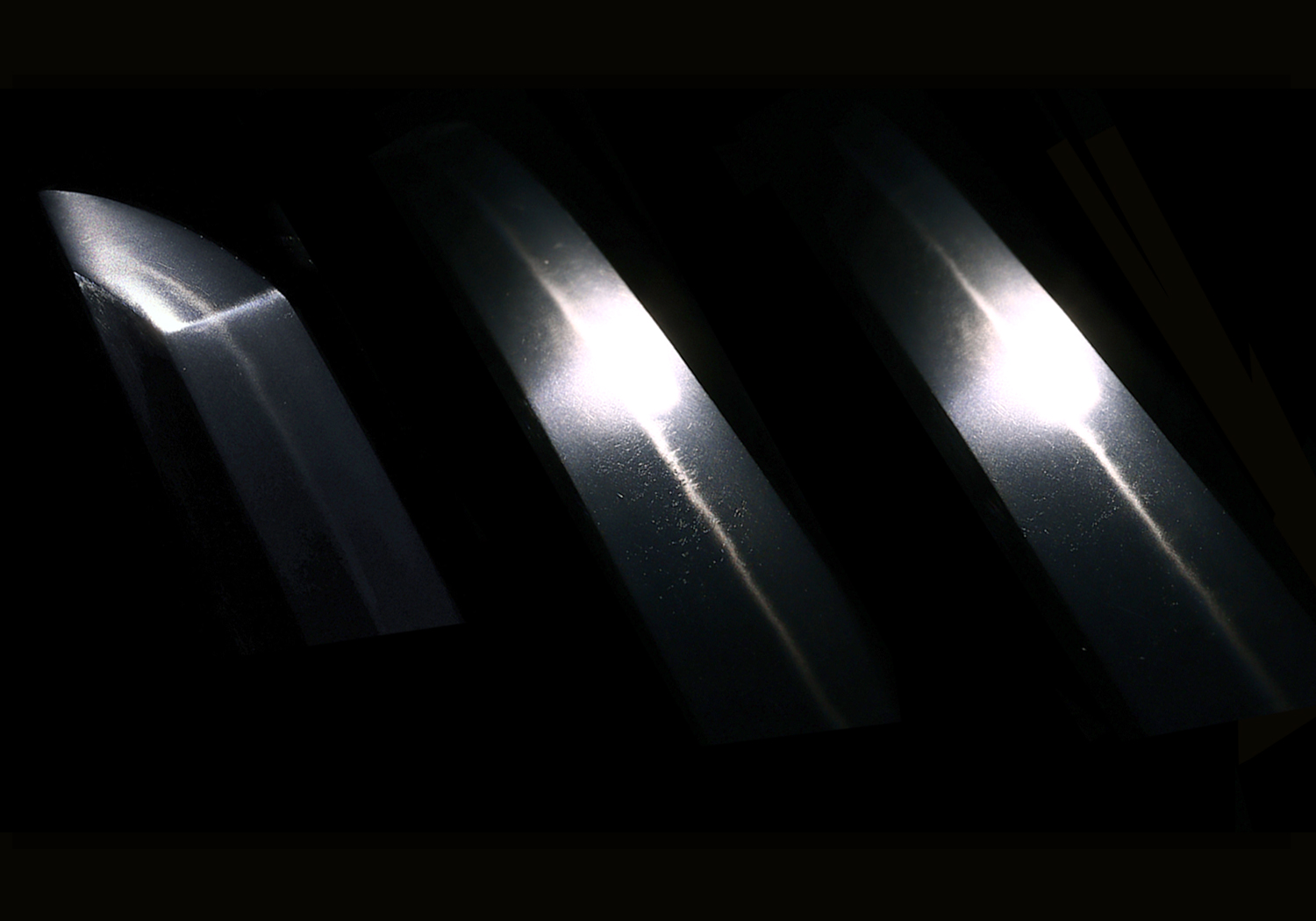
The hada (grain of the steel caused by the folding process) for which Yasutsugu is most famous is known as Echizen-gane, i.e. a tight a itame hada mixed with some mokume hada. There is always masame hada present in the shinogi-ji. To my eye this sword looks like Yasutsugu went back to his roots of the Yamato school when he made this sword. The suguha hamon and the really strong masame in the shinogi-ji coupled with the Yamashiro style suguha with a wide nie deki evokes kotô Yamato work.
The hamon (temper) is a beautiful wide suguha running the length of the blade and continuing into the bôshi (tip) of the blade. The hamon in the bôshi almost covers the entire bôshi but it makes a o-maru kaeri (wide turn-back) and continues down the mune (back edge) of the blade for what looks like a relatively short distance. When you examine the blade more closely, however, you will see spots of the hamon showing up here and there on the mune until you get the bottom third of the blade. In that area about 8 inches above the habaki you will see some outstanding areas of temper that continue in a cloud-like pattern on and off until you reach the habaki. This appears on the omote (front) side of the blade almost exclusively. Whether this was done intentionally or by accident, we may never know, but it is outstanding to behold.
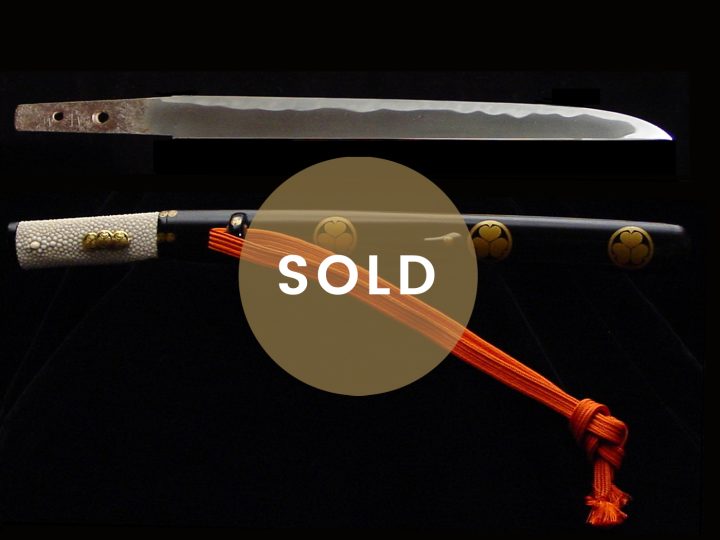
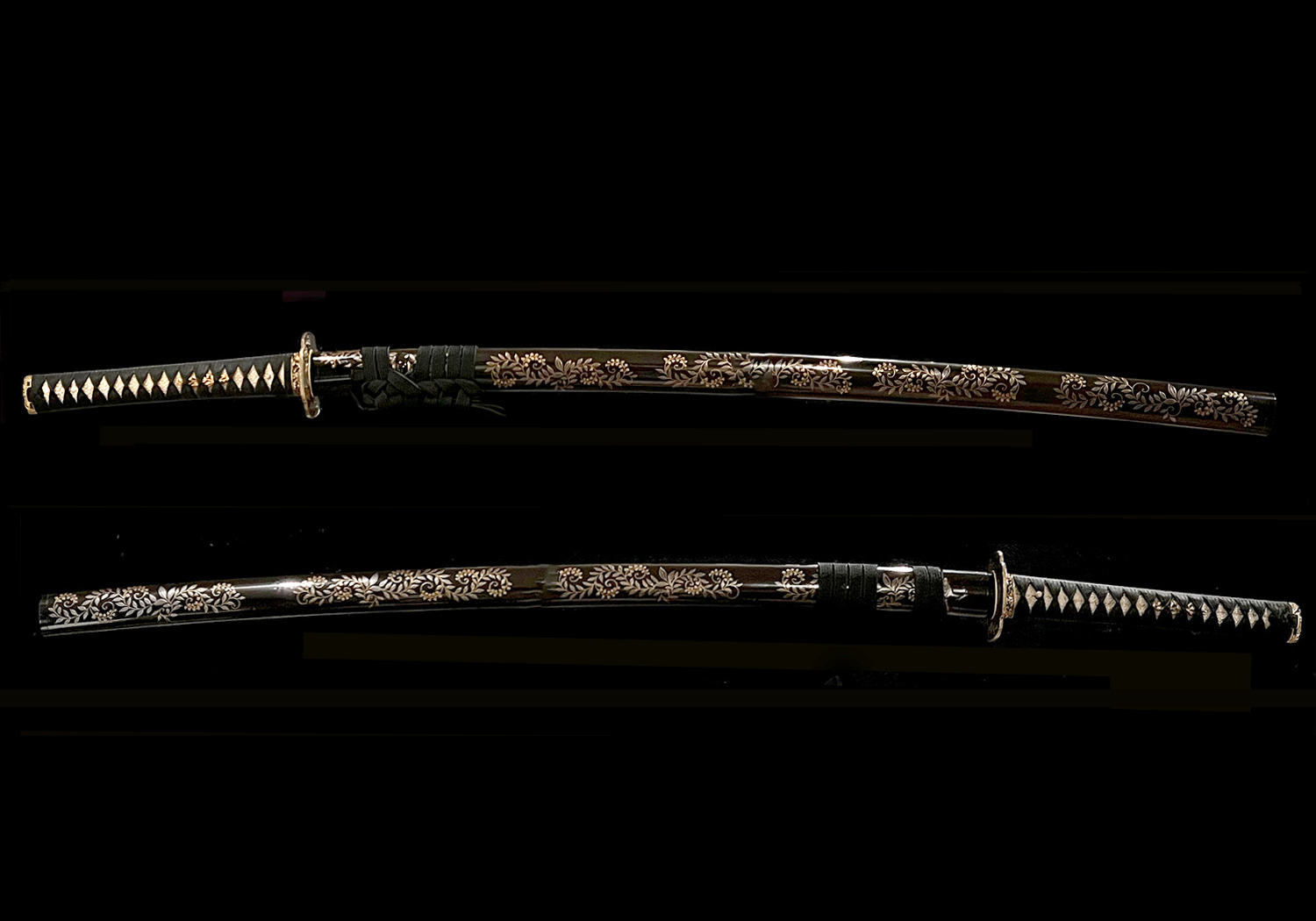
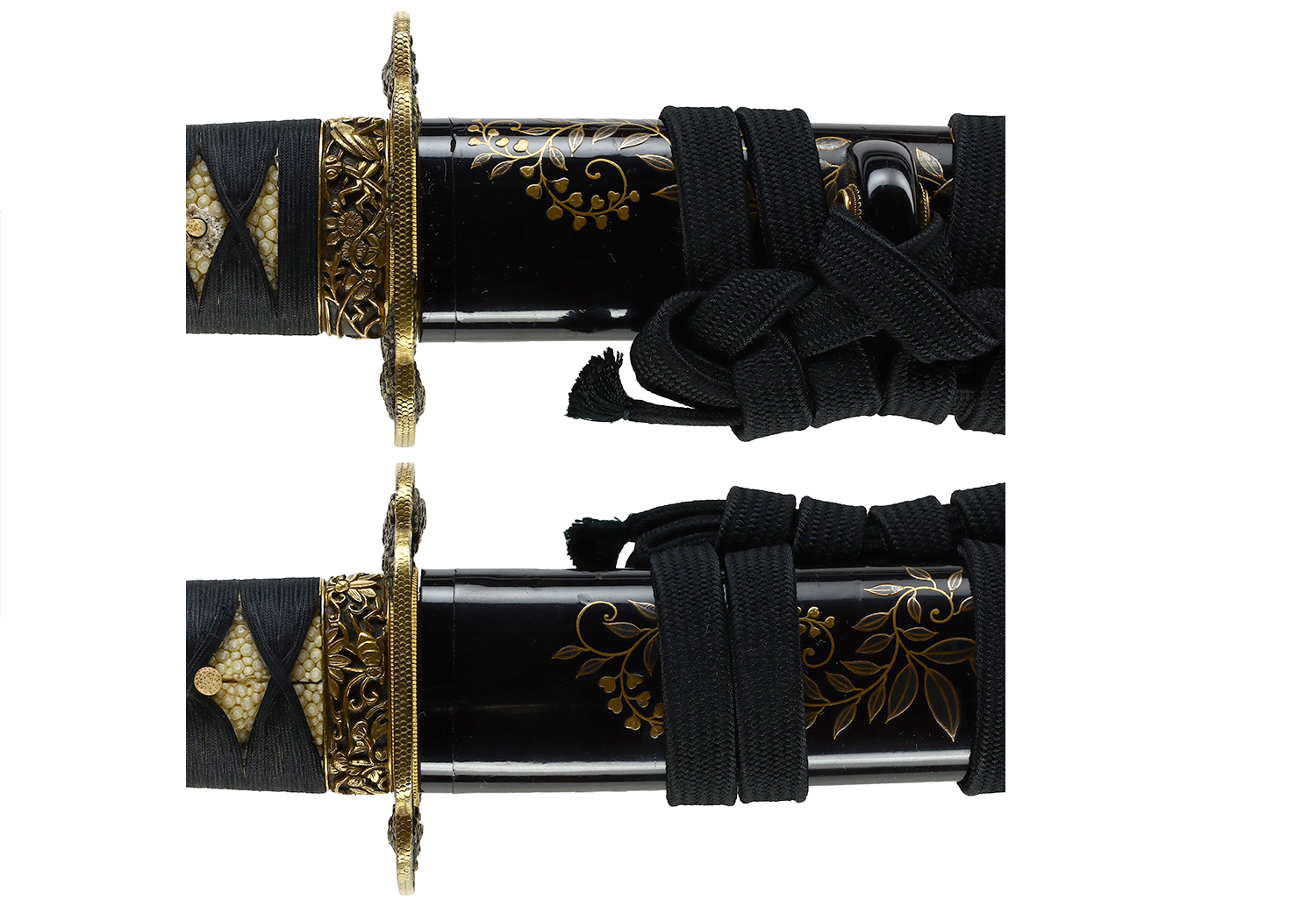
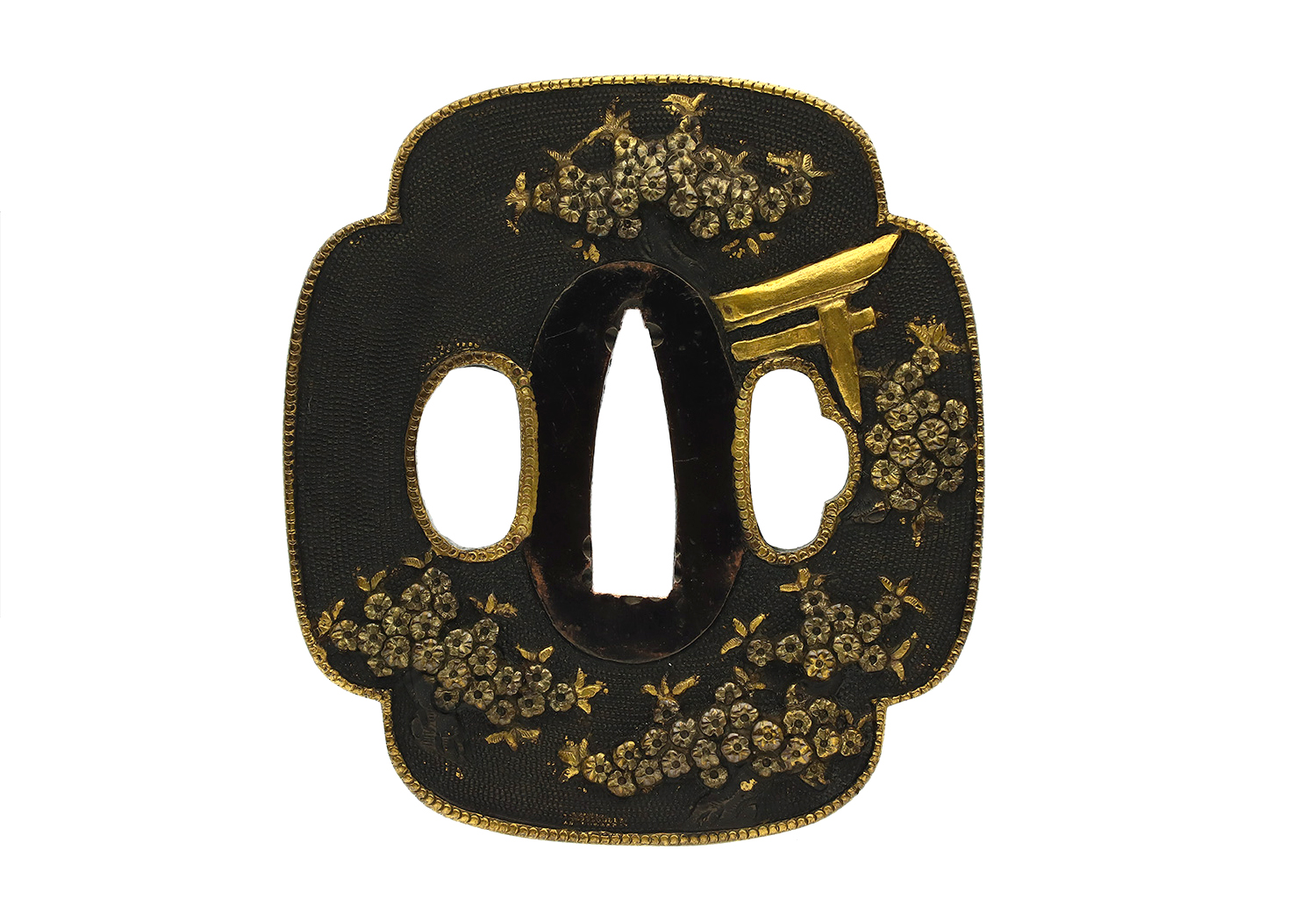
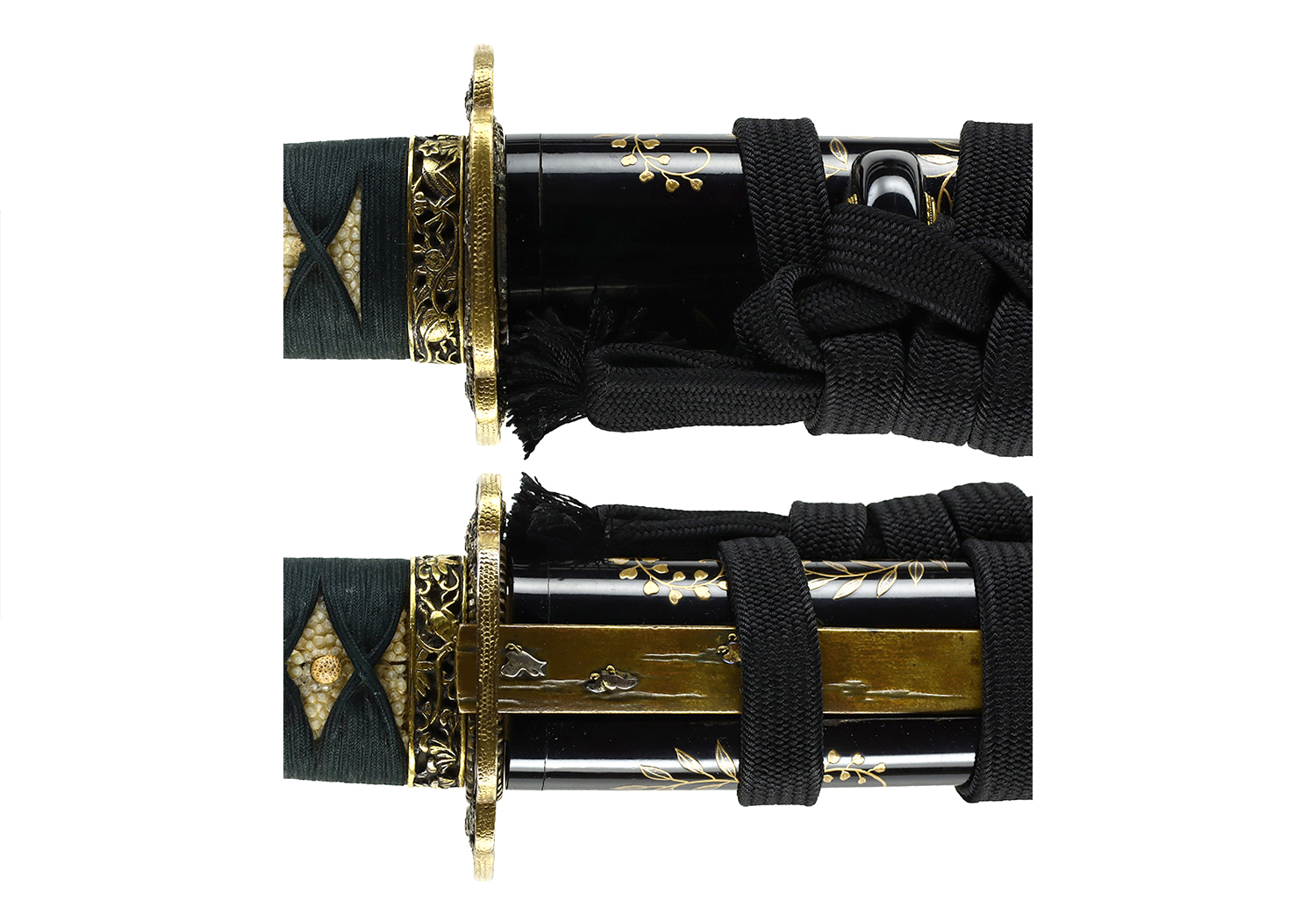
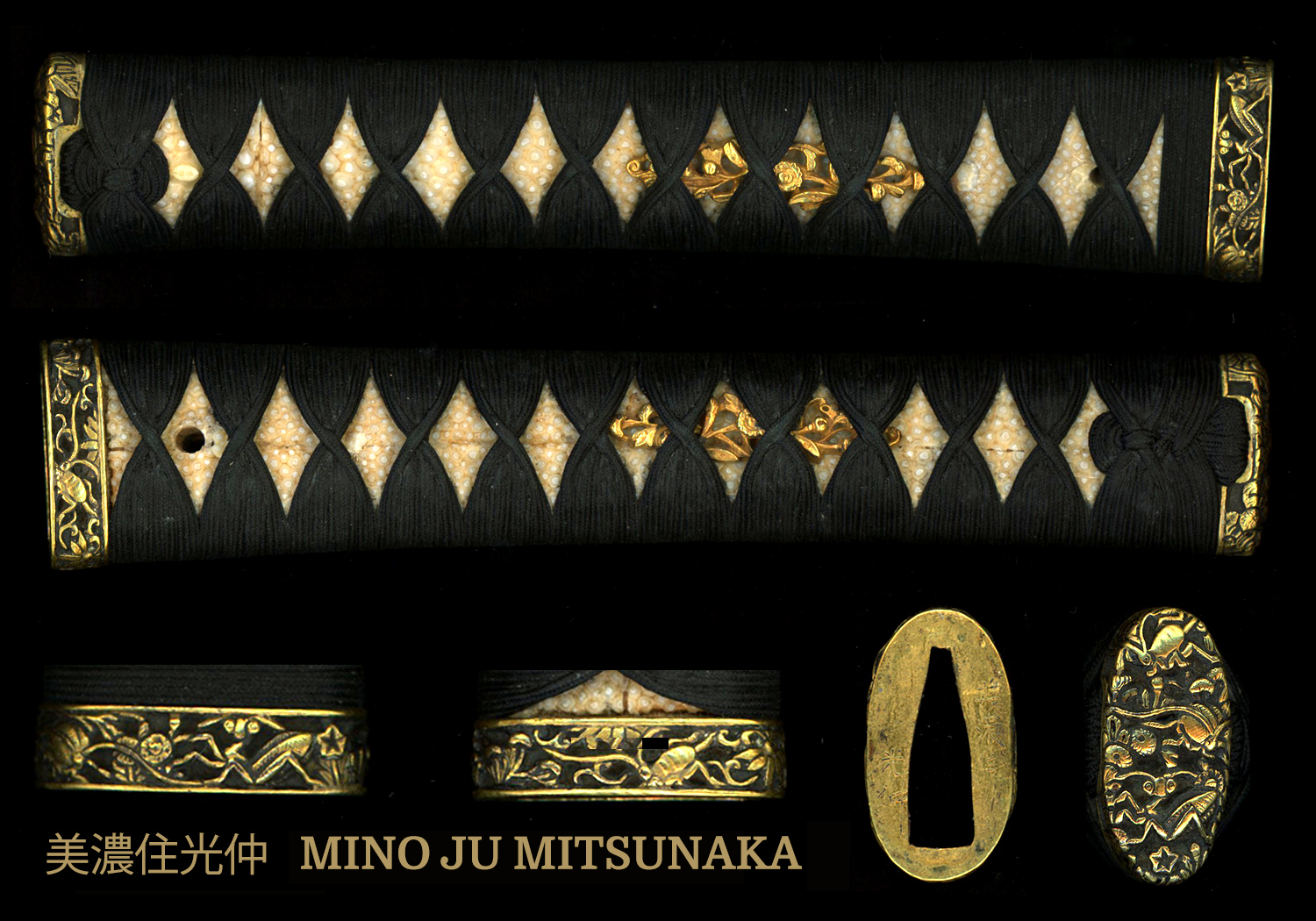
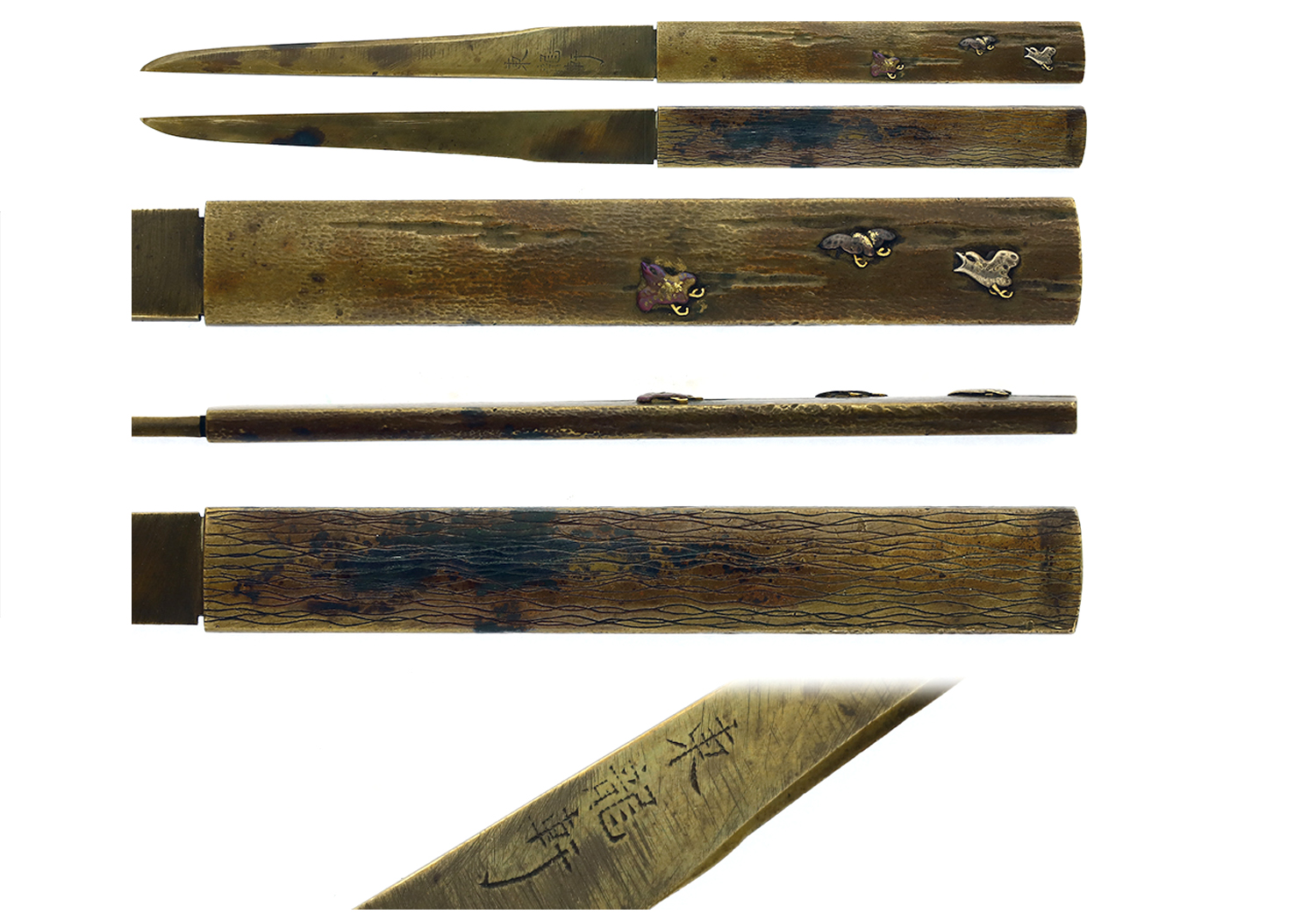
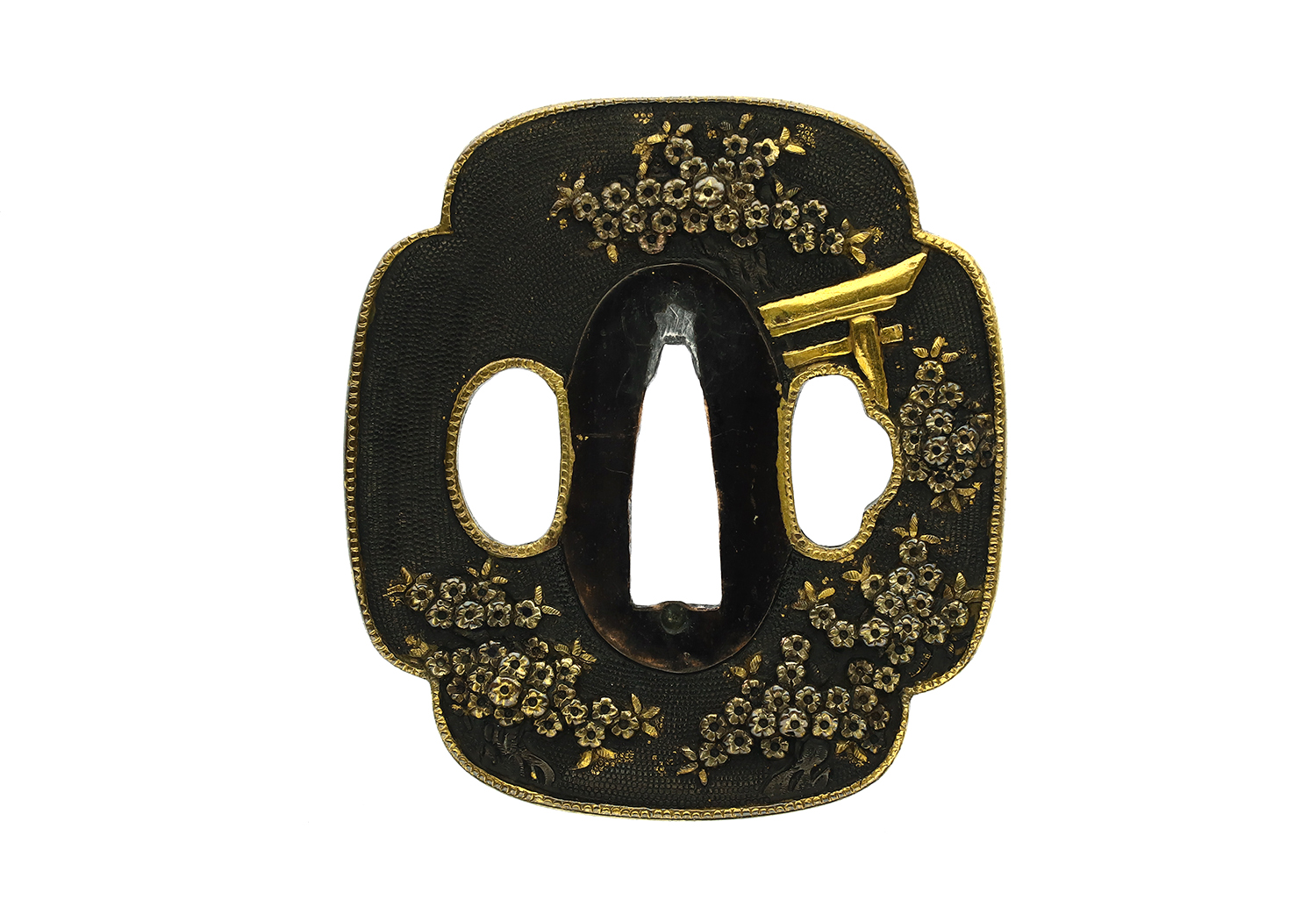
All in all, this is a great blade with what is potentially a wonderful history. It is in excellent condition and comes as part of a daisho of swords. The wakizashi is an outstanding blade by another famous swordsmith of the Shintô era, Izumi no Kami Kunisada (also known as Oya Kunisada) the father of Inoue Shinkai. Both blades are in a very attractive set of daisho koshirae with fittings done in traditional Mino style.
OYA KUNISADA
Oya Kunisada (国貞) was born in Tensho 18 (1590) in Hyuga province, present day Miyazaki prefecture. He became a student of the famous smith, Horikawa Kunihiro (堀川国広). It is commonly believed that since he was only twenty-five years old when Kunihiro died, both he and Kawachi no Kami Kunisuke (河内守国助) came under the tutelage of Echigo no Kami Kunitomo (越後守国儔). His early signature and work style resembles that of Kunitomo (国儔) who was a senior student to him in the Horikawa Kunihiro (堀川国広) school.
It is thought that he moved to Osaka in Genna 7 (1621) and once there he founded the Osaka Shinto School. His early swords show features in common with the Kunihiro school. After he moved to Osaka, Kunisada established his own style, which became known as the Osaka Shinto school. He received the title of Izumi no Kami (和泉守) in Genna 9 (1623) and he passed away in Keian 5 (1652). He is known to have become a monk in his last days and he used the name of Dowa.
Kunisada (国貞) is also famous for being the father of Inoue Shinkai (井上真改). Inoue Shinkai (井上真改) is one of the most famous smiths of the Shinto period and was known as the Masamune of Osaka. When Shinkai (真改) first began signing swords, he signed them Inoue Izumi no Kami Kunisada (井上 和泉守国貞) that was very similar to his father’s signature. For that reason, we call the first generation Kunisada, “Oya Kunisada” meaning the “parent Kunisada”.
SUGATA: His works are mostly katana and wakizashi in shinogi-zukuri. There are also kanmuri–otoshi-zukuriand hira-zukuri wakizashi. Rarely, there are also tanto of standard proportions.
JITETSU: His kitae generally has the appearance of nashiji as his ko-itame hada shows its very tight grain formations. There are some in which the hada is a well-refined ko-mokume like the stripes of chirimen (crepe paper). Occasionally there is one that gives the appearance of very well executed o-itame hada. Often the shinogi ji has a tinge of masame and the ji-nie is often thick and profuse. The burnished surface of the shinogi-ji is dark and looks like the surface of a mirror. This feature is called Osaka tetsu or Osaka gane.
HAMON: His hamon overall consists of deep nioi admirably sprinkled with fine nie grains. There are various types such as suguba, notare, gunome midare, o-midare, and so on When it is midare, there are frequently works in which a hamon of gunome with maru kashira (round heads) are arranged in 3’s, 4’s, 5’s, and 6’s. The tone of his hamon resembles those of Kunitomo. In all of them the nie and nioiare lively. The hamon always starts in suguha yakidashi that becomes notare and almost always shows some tobiyaki in the monouchi area up to where the boshi turns back.
BÔSHI: His bôshi, which in most cases is in ko-maru, is characterized by its slight widening in the middle. It usually ends in a short kaeri, but on occasion it will return in an extremely long kaeri becoming almost mune-yaki.
HORIMONO: There are frequently horimono. In fact, Kunisada is known for the greatest number of examples of works with horimono in the Horikawa School. It is especially frequent in wakizashi and tanto. There is horimono of the Sadamune style engraved on tanto.
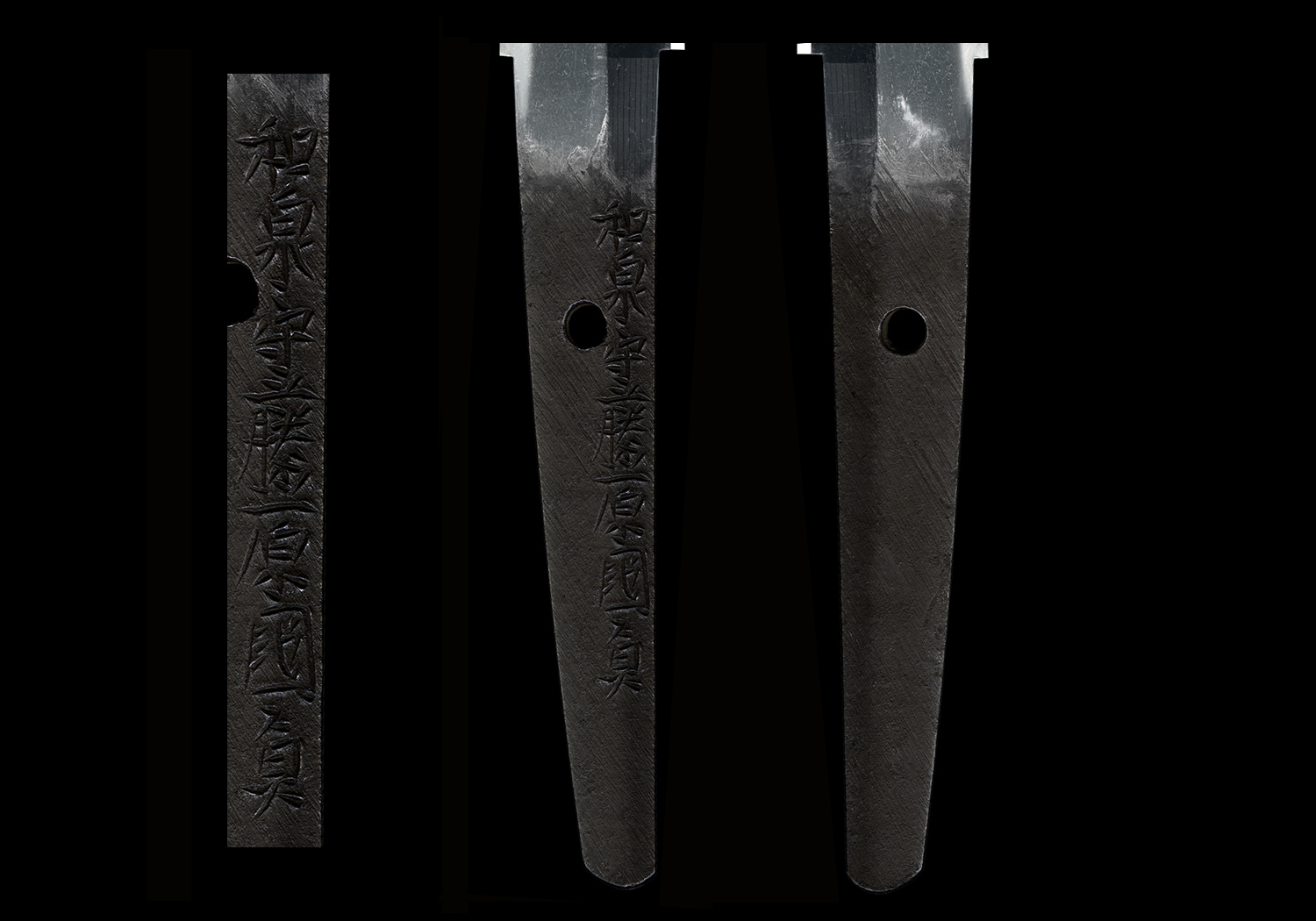
NAKAGO: The mune is ko-maru, and as for the saki, the works of his younger years are a shallow kurijiri, but as he aged, they gradually became slender and in a ha-agari kurijiri shape. The yasurime is o-sujikai all the way up to the hamachi.
MEI: After the second year of Shoho (1645), his mei of IZUMI NO KAMI KUNISADA was chiseled in sosho script (grass writing). This is regarded as his Dowa-mei, that is, Kunisada’s mei after he entered the priesthood.
IZUMI NO KAMI FUJIWARA KUNISA
OITE OSAKA IZUMI NO KAMI FUJIWARA KUNISDA
Some of the examples of his mei before he received the “Izumi no Kami” title are as follows:
KUNISADA (very early mei)
FUJIWARA KUNISADA
SESSHU OSAKA JU FUJIWARA KUNISADA
SESSHU JU FUJIWARA KUNISADA
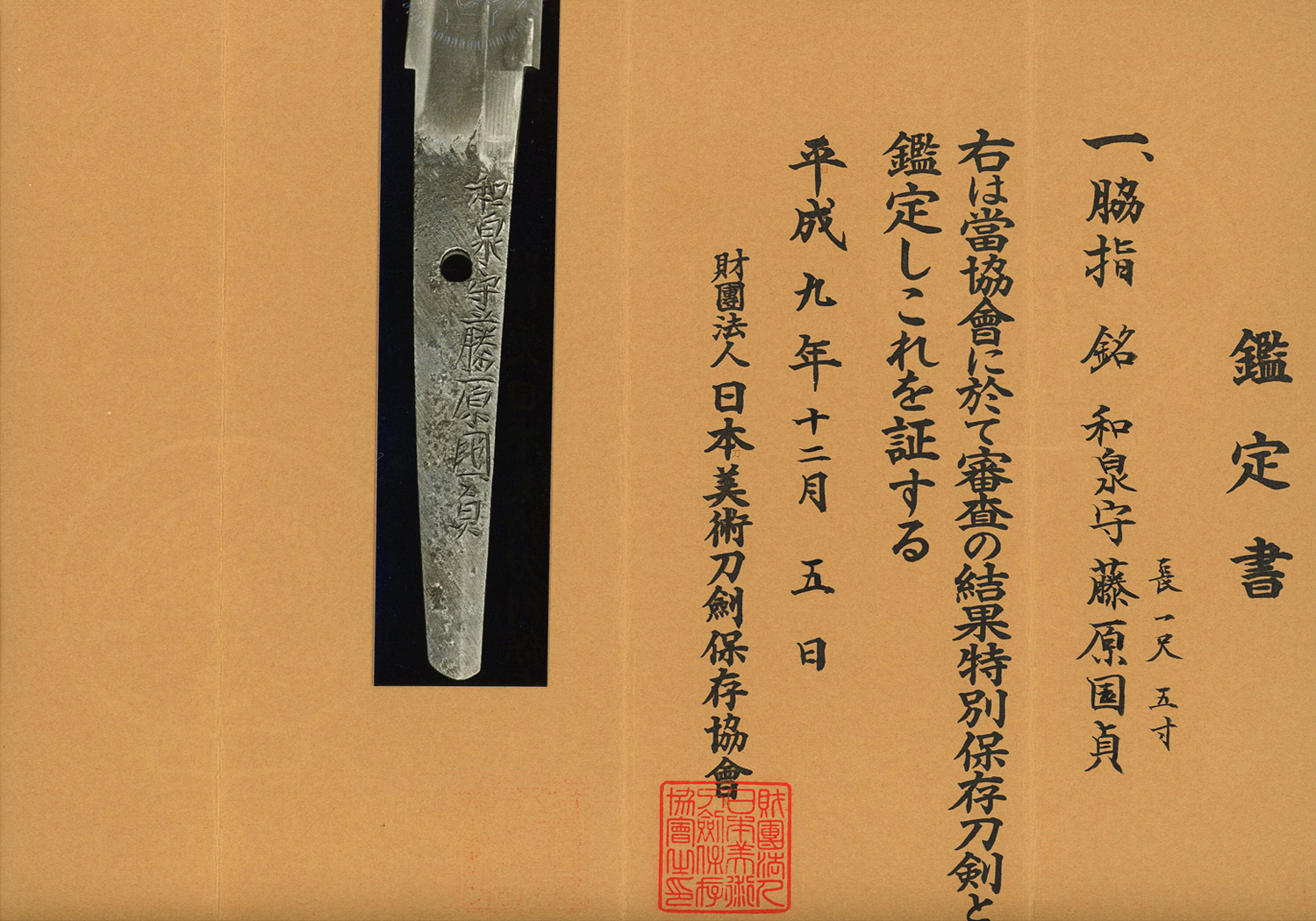
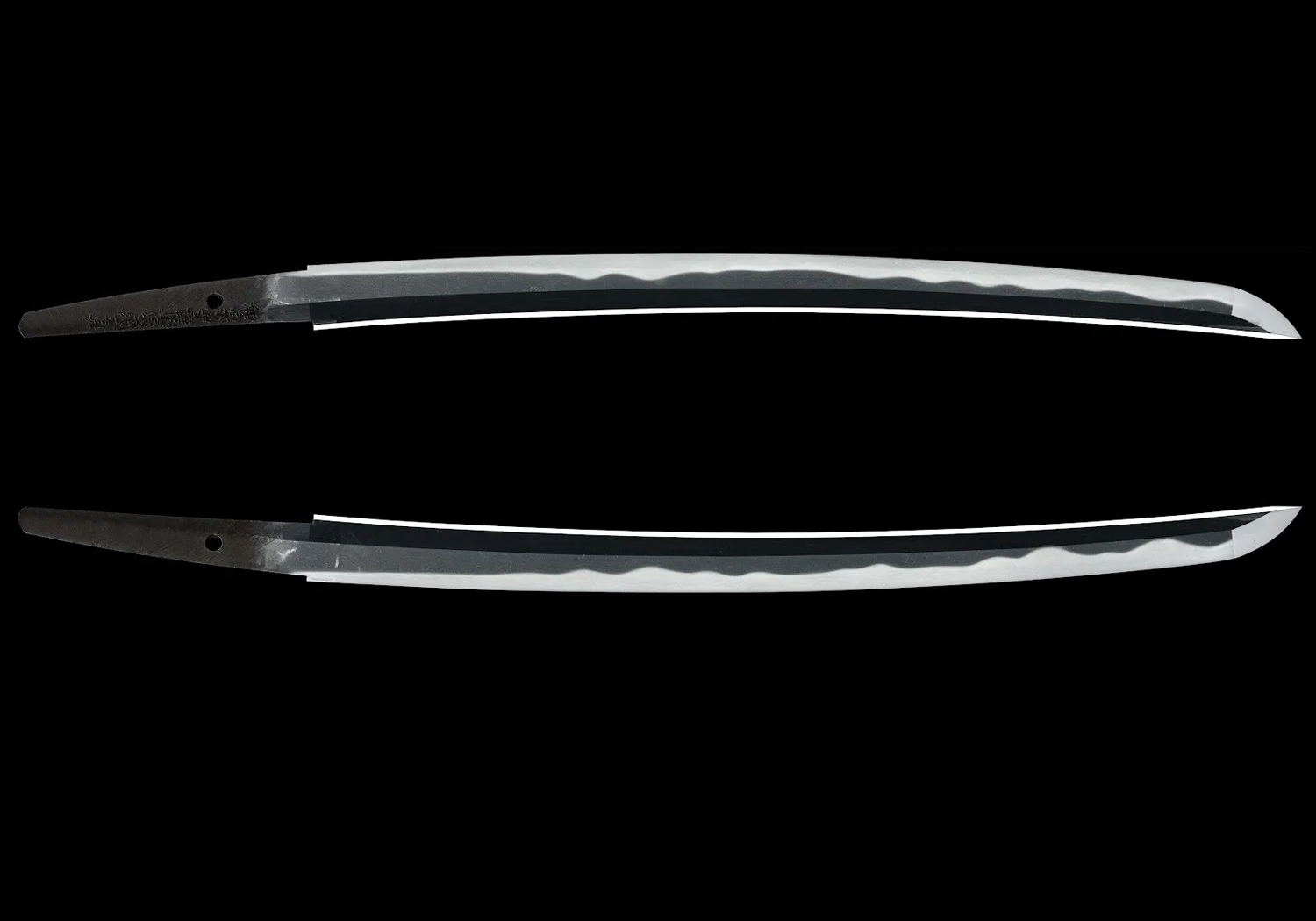
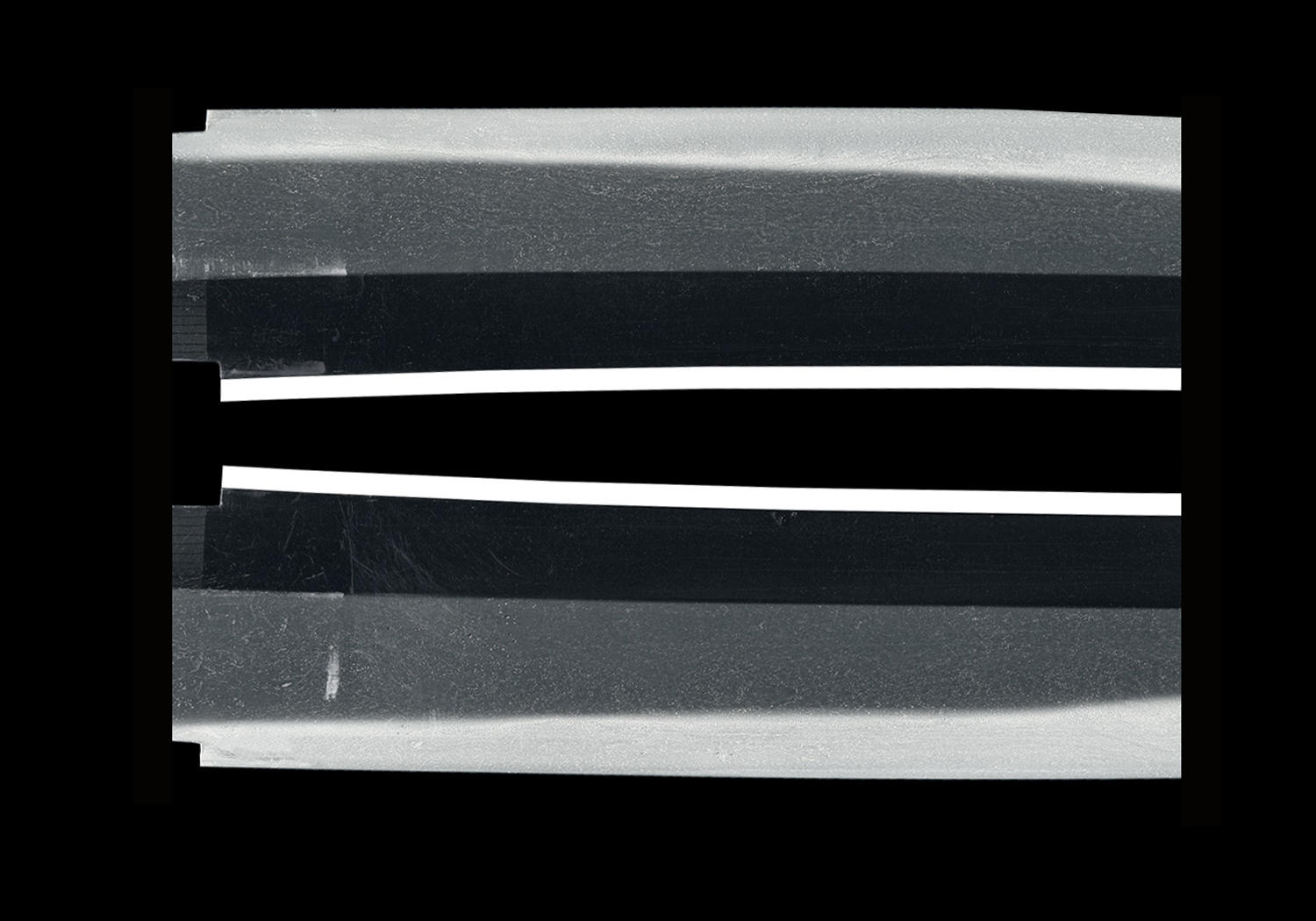
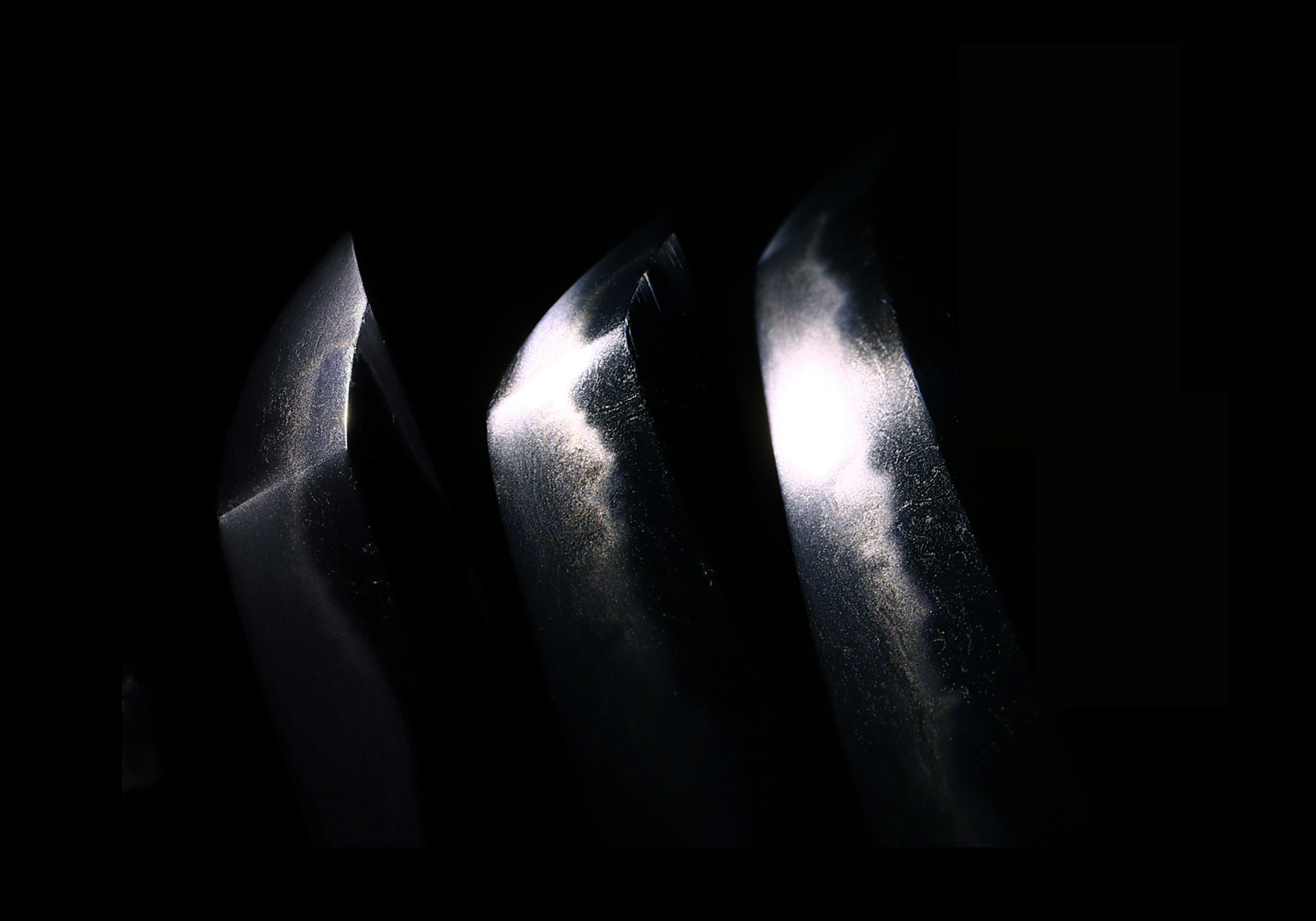
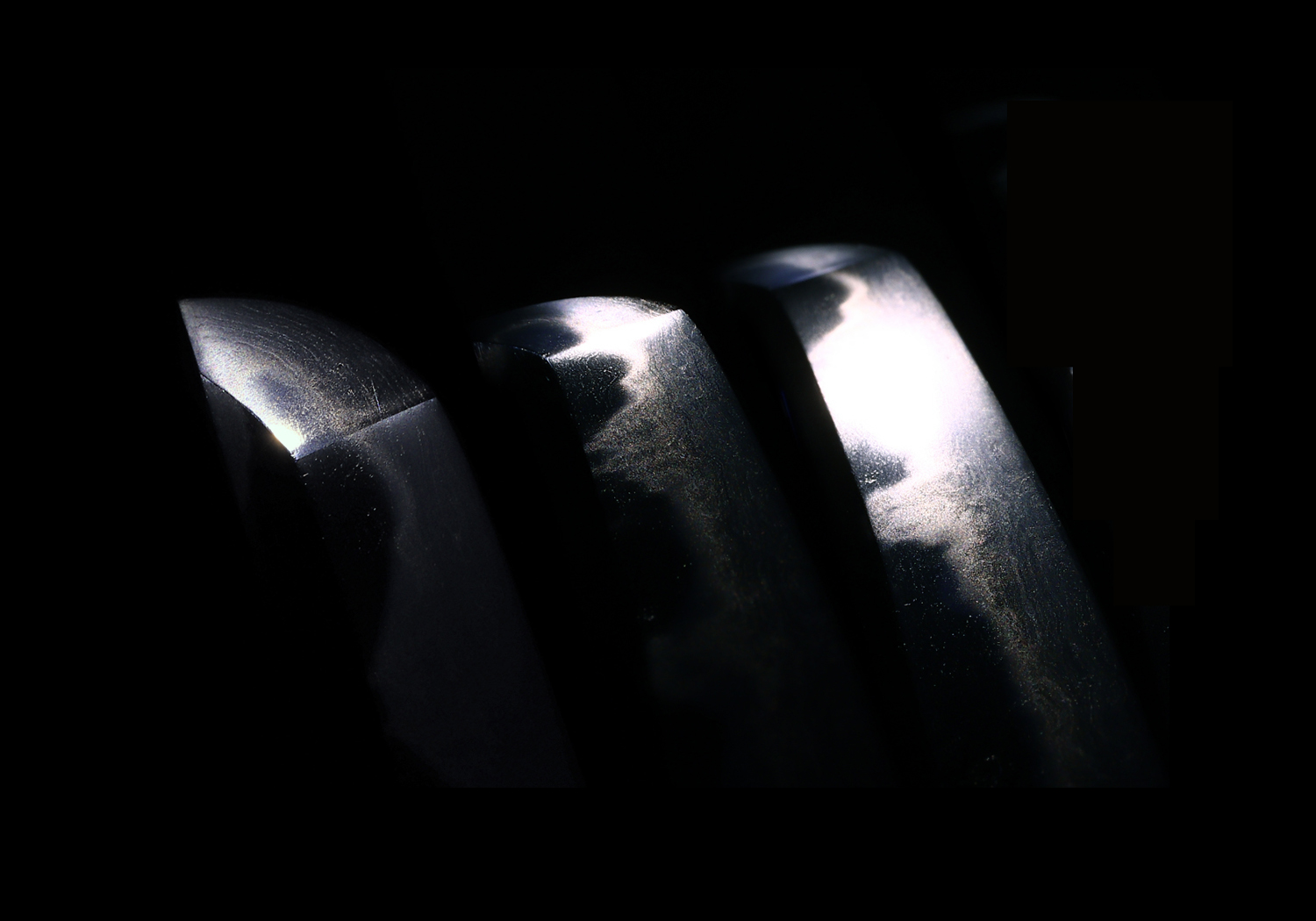
The wakizashi of this great daisho is a beautiful blade signed IZUMI NO KAMI FUJIWARA KUNISADA (和泉守藤原国貞). It has a nagasa (length of the cutting edge) of 45.5 cm or 17.875 inches. The moto-haba (width at the base of the blade) is 2.89 cm or 1.14 inches and the saki-haba (width at the beginning kissaki) is 2.1 cm or 0.83 inches. The kasane(thickness of the blade) is 0.78 cm or 0.3 inches. The shallow sori of this blade (curvature) is in the middle of the blade (torii sori) and it measures 1.0 cm or 0.4 inches. The nakago is ubu (unshortened) and it has only one mekugi ana (hole for the mekugi pin).
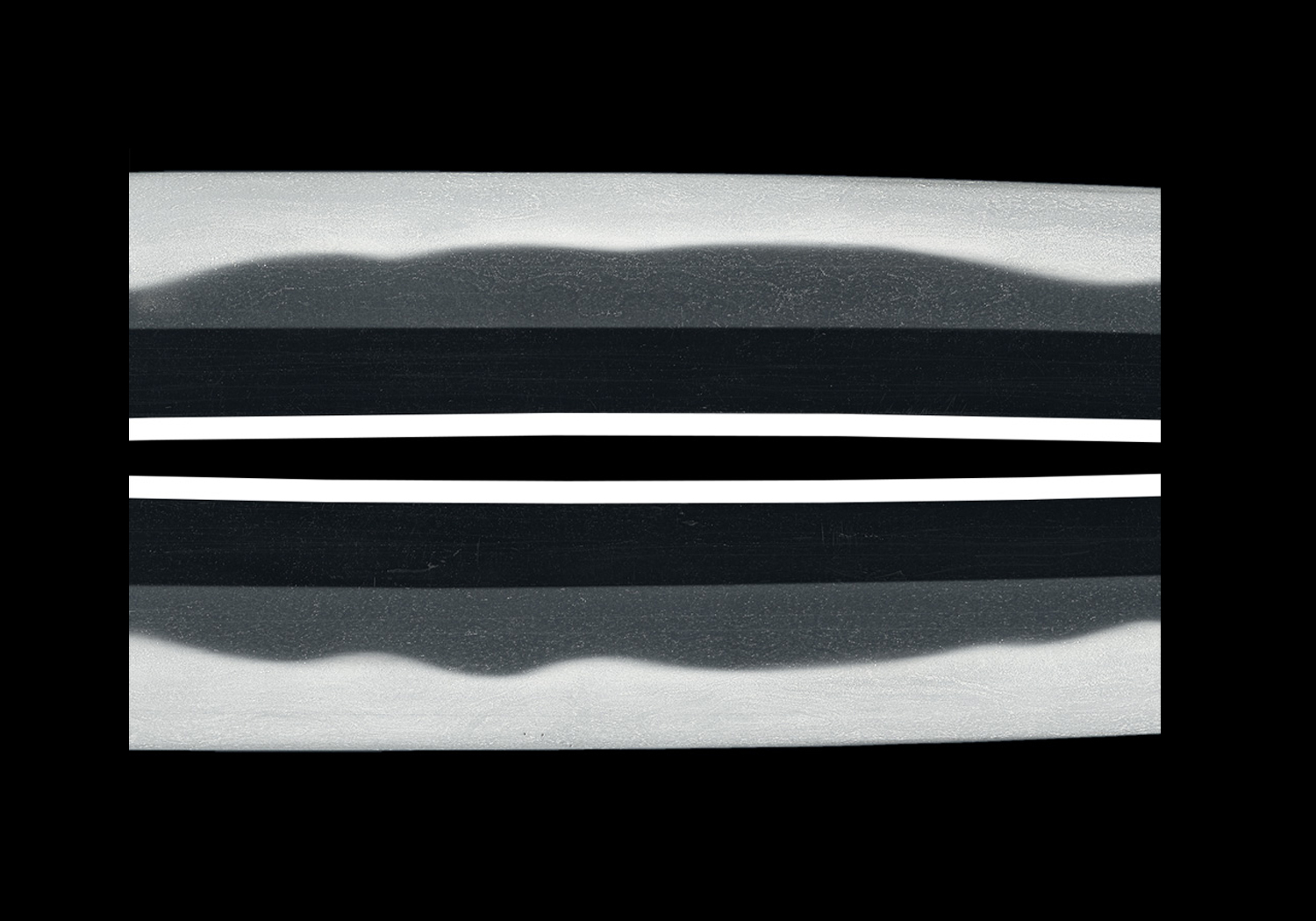
The overall sugata (shape) of the sword is typical of the Kanbun (1661) era style with a shallow torii sori and a slightly robust and stretched kissaki. The jigane (grain of the steel) is a beautiful itame with areas of mokume and there looks to be slight evidence of masame hada in the shinogi ji. The hamon is an irregular notare midare with a very vivid and robust habuchi of intense nie that spill over into the hada in the form of ji-nie and areas of tobiyaki. The hamon begins at the hamachi as a upwardly slanting suguha (straight) that quickly develops into the wide midare. It becomes even more active and wide as it approaches the monouchi area. It even touches and slightly crosses over the shinogi in a couple of areas. This is one of the characteristics of both this smith and his son, Inoue Shinkai.
This wakizashi is in excellent polish and comes with a shakudo habaki bearing a family mon. It is accompanied by NBTHK Tokubetsu Hozon papers which attest to its quality and authenticity.
It is in flawless condition and comes as part of a daisho of swords. The katana is an outstanding blade by another famous swordsmith of the Shintô era, Shodai Yasutsugu with potential connections to Tokugawa Ieyasu. Both blades are in a very attractive set of daisho koshirae done in traditional Mino style.
SOLD
YASUTSUGU KATANA








YASUTSUGU KOSHIRAE



NBTHK TOKUBETSU HOZON CERTIFICATION

OYA KUNISADA








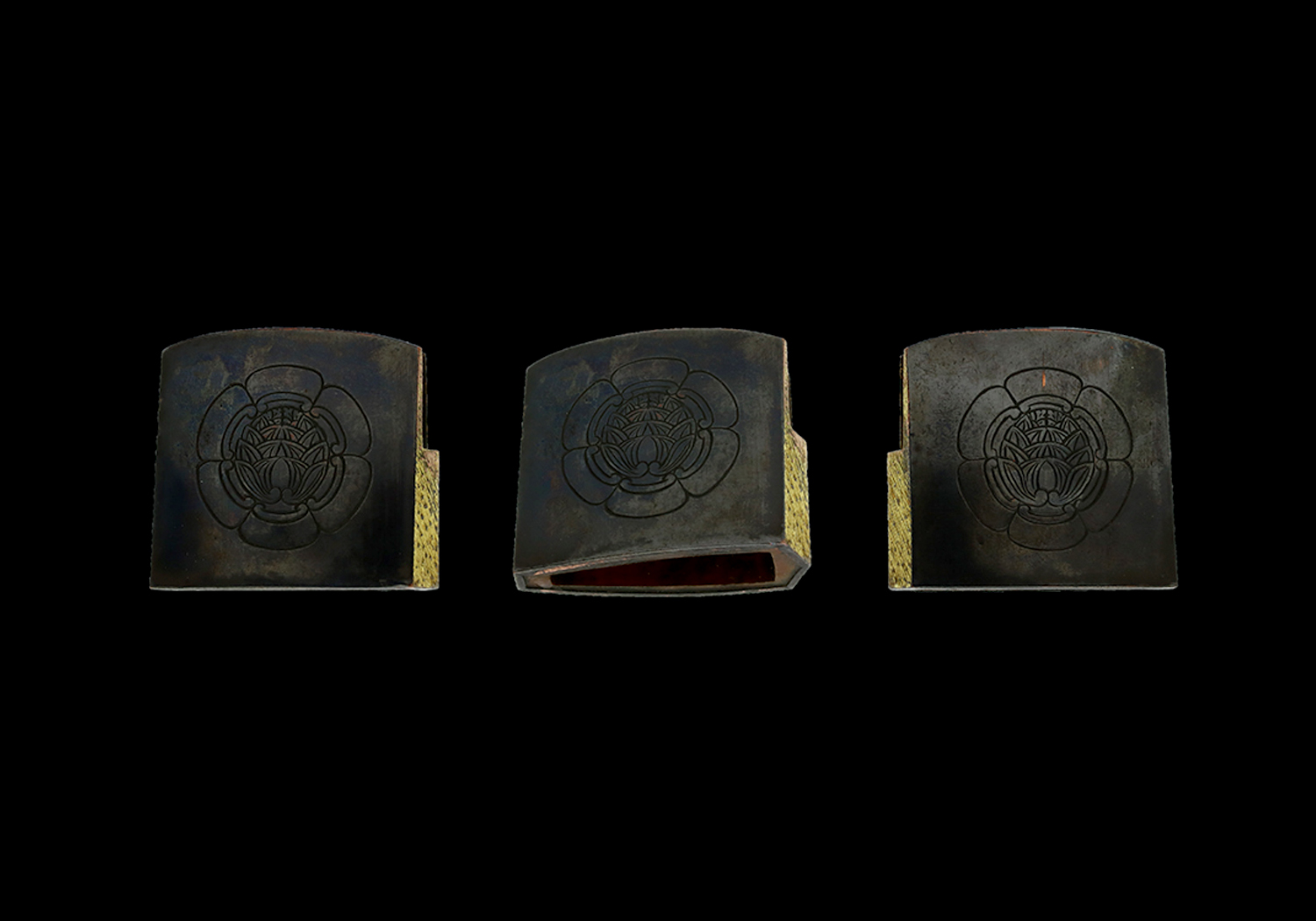
OYA KUNISADA KOSHIRAE




OYA KUNISADA NBTHK TOKUBETSU HOZON CERTIFICATION